
A wave of attacks shook southwestern Colombia this weekend.
The most serious occurred on Saturday afternoon in the municipality of Cajibío, in the department of Cauca, where at least 20 people died.
On Friday a car bomb had exploded in a military base in Cali, the third largest city in the country, while the Army reported at least 26 attacks in the departments of Cauca and Valle del Cauca in the last two days.
In total, almost 50 people were injured, including five minors.
Authorities of the country, such as President Gustavo Petro, described the events as terrorist.
The Colombian president blamed dissidents from the Revolutionary Armed Forces of Colombia (FARC) for the events, which occur just over a month before the presidential elections on May 31.
What was the deadliest attack like?
The most lethal blow occurred in an area called El Túnel, in a sector that connects the cities of Cali and Popayán, capitals of the departments of Valle del Cauca and Cauca, respectively.
The exact time of the attack differs in different local press reports; between 12:30 and 1:30 p.m. on Saturday.
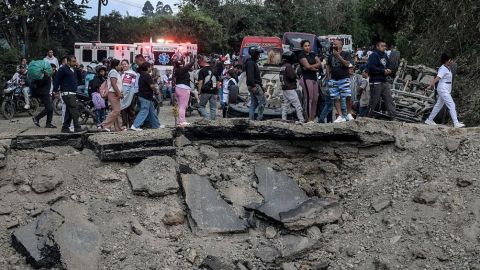
On the Pan-American Highway, the main highway in southwestern Colombia that also connects almost the entire continent, the detonation of a cylinder with explosive devices destroyed a bus, other cars and overturned several vehicles.
The explosion was so strong that a huge crater opened in the highway.
A survivor told the Colombian media El Tiempo that, while he was traveling to pick up some tanks to collect coffee, he felt his car rise up the highway as a result of the explosion.
“The truck flew away. I fell hit against the top of the cabin. I thought it was the end. I asked God for another chance,” said farmer Mario Guerrero.
In images shared on social networks, several bodies could be seen covered by sheets, while rescue teams arrived at the scene to help the injured.

Among the fatalities are several inhabitants of rural areas who were traveling on the road. There would be 15 women and 5 men.
Some of them, according to El Tiempo, lived in the La Palma village, a town of no more than 500 people in the La Pedregosa district.
According to the community itself, several of the deceased were part of peace efforts promoted in the area.
“Today we mourn the loss of 11 colleagues who were fundamental to sowing reconciliation, dialogue and dignified life in this territory,” they said in a statement.
One of the fatalities was the driver of one of the damaged vehicles. It was José Ciro Puliche, 61 years old.
According to the same media, the list also includes Daniela Valencia Holguín, who was 26 years old and lived in La Palma, as well as the farmer Teodomira Salazar Navia, 78 years old.

Local media also highlight that among the deceased is the social leader Patricia Mosquera, a member of the El Puro community council and an official of the Cauca Regional Autonomous Corporation (CRC).
“We deeply regret the departure of our colleague Patricia Mosquera, from the Patía Territorial Directorate, who lost her life in the midst of the recent attacks in Cauca. She always distinguished herself as an excellent colleague and friend, committed to the defense of the environment and its conservation, leaving an indelible mark on the Regional Autonomous Corporation of Cauca and on all of us who had the privilege of knowing her and working at her side,” they declared from the CRC.
Mosquera would have been on the Pan-American Highway with his cousins Nereida and Nidia, who also died in the explosion. According to local media, the three women had attended the funeral of a relative hours before in the municipality of Palmira, in Valle del Cauca, and were aboard a bus.
The governor of Cauca, Octavio Guzmán, described the victims as “poor people, humble people; peasants, indigenous people, merchants, transporters…”.
The authority declared three days of mourning for the tragedy.
Who are aliases Marlon and Iván “Mordisco”?
Iván Jacob Idrobo Arrendondo, alias Marlon, has been named by the authorities as the person responsible for the most lethal attack.
President Petro even announced that he had increased the reward for information leading to his whereabouts to 5 billion Colombian pesos (around US$1.4 million).
Alias Marlon serves as head of a Jaime Martínez military structure, deployed in the southwestern area of Colombia.
This organization is designated as part of the Central General Staff, a FARC dissident that operates under the command of Néstor Gregorio Vera Fernández, alias Iván “Mordisco”, another of the most wanted men in the country.

These groups, disagreeing with the signing of the peace agreements with the government in 2016, refused to lay down their arms and remain active.
In addition to territorial disputes and clashes with the armed forces and police, they are noted for their links to drug trafficking and other forms of organized crime.
“This is a cowardly display of weakness by a prison structure whose main leader is a dangerous criminal,” Defense Minister Pedro Sánchez said on Saturday.
“It is a mentally alienated person who does that, alias Marlon, the structures of Iván Mordisco’s dissidents. Those are the enemies of the people,” stated Governor Gúzman.
What is the situation in southwest Colombia?
The southwest of Colombia is one of the hottest spots of the armed conflict.
In Cauca, for example, violence intensified in 2025 with harassment, ambushes, explosions and combats, according to the Pares Foundation.
Classic violence is mixed with “the use of drones loaded with explosives, car bombs, motorized pumps, dump trucks equipped as launchers and the installation of cylinders in urban and rural areas,” says Pares’ analysis.
This area is one of the most militarized in the country, where the public force fights guerrilla structures such as the Mordisco dissidents.
Pares points out that the expansion of attacks by these groups against civil infrastructure and the increase in explosions in populated areas have expanded the humanitarian and economic impact, “deepening the perception of insecurity in the civilian population.”
This weekend’s episodes, just over a month before the elections, are seen by analysts such as Laura Bonilla, deputy director of Pares, as a “clear interest” of groups like the EMC in creating chaos and destabilizing the country.
Petro’s term ends in August of this year and the presidential campaign is in its final stretch. Security is one of the issues that marks the contest.

In the first round on May 31, Iván Cepeda, Petrista candidate from the Historical Pact party, the right-wing Abelardo de la Espriella, and Paloma Valencia, from the conservative Democratic Center (CD) party of former president Álvaro Uribe, will compete.
Cepeda, who is the favorite according to the polls, has stood out for participating in several negotiation tables with armed groups.
De la Espriella and Valencia promise a tougher approach against insecurity.
Petro presented the weekend attack in Cauca as an operation by guerrilla dissidents to promote a change of direction to the right in the elections.
He accused them of being “terrorists, fascists and drug traffickers” and stated that they want “the extreme right and fascism to govern Colombia because they know that they do their cocaine and illicit gold business with them.”
In a similar vein, Cepeda expressed himself: “It is deeply worrying that these terrorist actions occur in southern regions of the country where there is broad citizen support for our political project.”
“A legitimate concern arises about whether, in addition to causing harm and anxiety in the population, these events seek to generate a climate of fear that favors the interests of extreme right-wing sectors determined to destabilize the country and hinder the democratic development of the electoral process,” he added.
The right-wing candidates pointed to the Petro government and its concept of “total peace,” which included negotiations with various armed factions without achieving the expected results.

click hereto watch more stories from BBC News World.
Subscribe hereto our new publication to receive every Friday a selection of our best content of the week.
You can also follow us on YouTube, instagram, TikTok, x, Facebookand on our channel WhatsApp.
And remember that you can receive notifications in our app. Download the latest version and activate them.
- At least 20 dead and dozens injured after attacks with explosives in southern Colombia
- Who are the candidates for the presidency of Colombia and which Congress will the next president meet after the results of the legislative elections?


