
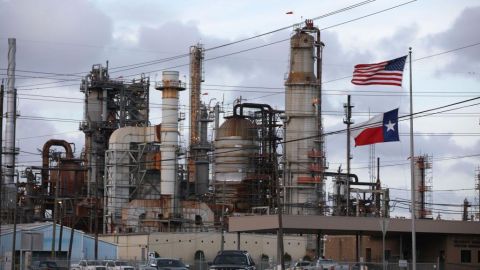
Mexico has been facing an energy problem for several years and the recent oil tensions in the Middle East, as well as Donald Trump’s aggressive international policy, are raising alarms: it is highly dependent on gasoline from the United States.
At least 75% of Mexico’s daily consumption of that fuel comes from its northern neighbor, mostly from the border state of Texas. And almost half of the imported gasoline is used to generate electrical energy.
If for some reason, political, economic or even pure (as already happened with a severe storm in 2021) there were a closure of the cross-border valve for this fuel, Mexico would be in a serious situation.
What to do to avoid such a risk is the question that the president of Mexico, Claudia Sheinbaum, has opened and that has generated a debate among politicians, analysts and scientists related to the energy sector.
The president has promoted the idea that the country explore a solution that has been opposed by the left-wing movement to which she belongs: the exploitation of so-called unconventional gasoline through frackinga controversial extractive technique due to its harmful effects on the environment.
“For many years I myself said ‘the fracking No’. But when I see the new technologies, the situation of the country in terms of dependency, the worst thing we can do is just say ‘no’; instead of ‘let’s find out if, in fact, there are new technologies, lower environmental impacts,’” he said recently.
His statement was made when presenting a panel of scientists and experts who will rule on whether there is technology that makes fracking a less harmful technique for the environment and the communities where it is carried out.
While this verdict is being given, Sheinbaum has not failed to express that the decision entails not only the energy sovereignty of the country, but also the “viability and development” of the country and the next generations of Mexicans.

The weight of imported gasoline
Mexico currently requires about 9,000 million cubic feet of pure gasoline per day, but only produces 2,300. The remaining 6,800 (75%) are acquired in the United States market, mainly from the state of Texas (80%).
Just over half of that pure gasoline (56%) is destined for the generation of electrical energy that the country requires, while 19% is used by the state company Petróleos Mexicanos (Pemex) for fuel extraction. Industry (13%) and households (11%) consume the rest.
The numbers reflect the vulnerability to an adverse event.
The country has only installed gasoline storage to last for about three days, and other energy sources would not be enough to meet the demand of a country of 130 million inhabitants.
In 2021, a severe winter storm in Texas and northern Mexico led to the closure of gas pipelines, causing blackouts in almost half of the Mexican territory for several days.

“By constantly building more combined cycle plants to produce electricity, Mexico has become increasingly dependent on gasoline. The problem is that we passed the peak of national gasoline production in 2009. Then, when the decline in national production begins, gasoline imports skyrocket,” explains geologist Luca Ferrari, an Italian researcher on the global energy sector at the National Autonomous University of Mexico (UNAM).
The scenario “is dramatic,” he continues, because if what Pemex uses for its oil activities is eliminated from the equation, the dependence on American gasoline for consumption in the rest of the country’s sectors is almost 90%.
And a parallel and no less serious problem, he warns, is the constant drop in oil production due to which Mexico has to import almost 50% of the gasoline and diesel it currently uses and which will continue to worsen in the next decade due to the end of the useful life of the rich oil wells that the country had in its heyday.
“We are in this situation of the end of oil technology,” he says. And not only in Mexico, but in many parts of the world.

The fracking dilemma
In her first year of government, President Sheinbaum presented an energy plan through which she intends to increase electricity generation with renewable energies from 24% to 38% by the end of her government (2030).
But even with that and other national sources added to the energy matrix, the growth in demand could not be covered in the short and medium term.
“If we do nothing, then we are going to import more and more. What is the problem with importing fuel? Now look at what many countries in the world suffered with what happened in Iran,” Sheinbaum said, referring to the global escalation in energy prices as a result of the war in the Middle East.
For Sheinbaum, who in her academic days was an energy research scientist, a medium-term solution is the exploitation of unconventional gasoline that exists in the subsoil of Mexico through hydraulic fracturing or fracking.
This is a technique that allows the so-called shale gas to be extracted, a type of hydrocarbon that is literally trapped in layers of rock at great depth. After drilling until the shale rock is reached, large amounts of water with chemical additives and enviornment are injected at high pressure to fracture the rock and release the methane gasoline.
When the gasoline begins to flow back, it does so with part of the fluid injected at high pressure.

He fracking It has been used in the world since the middle of the last century and since then the technique has been criticized for the excessive consumption of water it requires, the contamination of the liquid with harmful chemicals, leaks into underground aquifers, the seismicity it causes in the environment and the impact on nearby communities, among other problems.
The president has recognized that it has effects, like “all human activity,” and is not the vital solution or a definitive option for the problem. But since he opened the debate on its implementation, his speech has tended to use the fracking as a solution for the country’s energy sovereignty.
“If I have dedicated so many years to climate change, I am not going to say that ‘oil is the solution’. But we need a part, for a long time, in which we develop other alternatives. Yes, we have to continue using it, in which we continue to reduce energy consumption,” he said recently.
The key to using frackinghe considers, is to use new techniques that do not require massive use of water, that do not use such harmful chemicals and that there is a consensus with communities in the areas.
Is it a solution?
Mexico has several basins in which there is a presence of shale gas that could be exploited, especially the one in the northeast of the country (and which is part of the geological region exploited by Texas), and in some points near the Gulf of Mexico.
According to the director of Pemex, Víctor Rodríguez Padilla, the country’s “abundant pure gasoline resources” that “have not been used” would allow the generation of about 8,000 million cubic feet by 2035, a volume little deprived of regular consumption, which would give some viability to self-sufficiency.
Pemex has already carried out dozens of drillings for several years using fracking that President Andrés Manuel López Obrador limited to the maximum when he came to government (2018-2024).
Although he defends the causes of his predecessor, Sheinbaum insists that his government has detected “an enormous innovation on this issue that allows such polluting chemicals to no longer be used, biodegradable chemicals to be used, and also water recycling.”
“So, that makes us see that we have to look at non-conventional gasoline again with eyes of sovereignty and with eyes of maximum reduction of environmental impacts. I don’t say ‘zero environmental impact’, because there is no human activity that has zero environmental impact, but rather reduction and mitigation of environmental impacts.”
He convened a team of researchers from the main public academic institutions to evaluate in two months whether the possible new techniques are viable.

Ferrari, however, points out key problems with the use of the fracking massive as the Mexican government would intend to do.
On the one hand, the researcher assures that there is no developed industry or consistent studies that validate that there is a “greener” technology currently in the use of fracking.
“I immediately started searching the scientific literature, because there is always propaganda from small companies that sell magic. But there are a few scientific articles and they are quite experimental things, tested on a pilot scale here and there, which really do not change much the issue of environmental impact,” he says.
“Above all, they are not the industry standard. Because they are more expensive and there is not even industrial production of these compounds that they call biodegradable. They are very boutiqueattempts that the industry makes to paint itself green, because obviously there is a lot of opposition,” he adds.

On the other hand, research carried out by Ferrari with a team from UNAM has shown models that suggest that fracking could only sustain the supply of gasoline for the country for a few years. And it would become increasingly complicated due to the growth of Mexico and the type of economic development of the manufacturing industry and tourism that it has.
“The United States started in 2005 and has already reached the maximum. And if it does not drill brutally it will fall the same in 10 years. But they have much more unconventional gasoline than Mexico, which has probably 10% or 15% of the resources that the United States has. So for Mexico the issue would also be much shorter,” he explains.
From their point of view, the Mexican government is experiencing strong pressure from the United States to open its territory to the fracking and thus be able to sell gasoline to more attractive markets than Mexico in Europe and Asia.
“It is better for the United States to send it as liquefied gasoline to Europe or Asia than to export it to Mexico at a relatively low agreed price,” Ferrari believes.

But, if it is not the frackingwhat can be done?
The answer is not simple. And it requires much more than searching underground.
Mexico, like other countries around the world, will face less availability of hydrocarbons, increasingly expensive extraction, and increasingly large energy demands.
Ferrari explains that there are several development models for the p coming decades, but is committed to an adjustment of almost all aspects of human life to harmonize energy consumption.
“The topic here is very uncomfortable, but the scientific conclusion, and there are many articles from the best magazines that say it, is that we have to create with less energy, that is, we have to live with a depraved amount of energy and raw materials, also for environmental reasons,” explains Ferrari.

click hereto glimpse more stories from BBC News World.
Subscribe hereto our new e-newsletter to receive a selection of our best content of the week every Friday.
You can also follow us on YouTube, instagram, TikTok, x, Facebookand in our new whatsapp channel.
And remember that you can receive notifications in our app. Download the latest version and activate them.
- “They broke my house”: Sauzal Bonito, the town that began to tremble under the great promise of wealth from fracking in Argentina
- Can Mexico’s economy depend less on the US (and Trump’s pressure)?


