
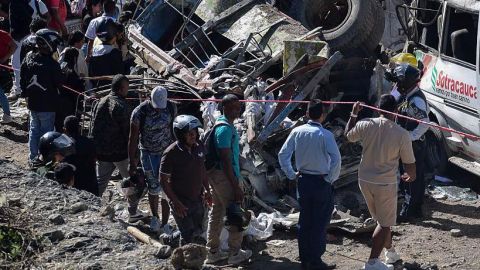
At least 14 people died in an attack with explosives in the department of Cauca, in southwestern Colombia, and 38 more have been injured so far.
According to the Reuters news agency, the attack occurred as part of a violent escalation that the department experienced on Saturday.
In the morning, an attack with an explosive drone on an aerial radar was recorded, and then another attack with explosives was reported that left at least 7 indigenous people from the area injured.
The second attack with explosives occurred on the Pan-American Highway, in the sector that connects the city of Cali, with the capital of Cauca, Popayán.
Colombian President Gustavo Petro attributed the attack to dissidents of the Revolutionary Armed Forces of Colombia (FARC) led by alias “Iván Mordisco.”
Peace talks between the FARC and the government in 2016 culminated in an agreement in which thousands of fighters demobilized, but some broke away and refused to lay down their arms.
“Those who carried out this attack… are terrorists, fascists and drug traffickers,” Petro said on his account on the X social network.
“I want our best soldiers to stand up to them,” he added.
In the attack, what is known in the Colombian conflict as “cylinder bombs” was used: a gasoline pipette loaded with explosives hit a bus.
“I want the maximum global persecution against this narcoterrorist group,” said the leader on his social networks, “I want the best soldiers to confront them, I want the Caucasian people to free themselves from this mafia.”
Also in X, Governor Octavio Guzmán referred to the attack as “a tragedy that tears us apart as a department.”
“Cauca cannot continue facing this barbarity alone. We are facing a terrorist escalation that demands immediate responses. We demand that the National Government take forceful, sustained and effective actions in the face of the serious crisis of public order that we are experiencing,” concluded the native president.
The attack is the most serious that has occurred so far in the electoral season that the country is experiencing. All candidates condemned the attack.
Eyewitnesses told the AFP news agency that the explosion was so powerful that it threw them several meters back.
The governor added that since Friday there have also been several smaller attacks in Cauca, including one directed against a military personnel in the city of Cali that left two people injured.
The Minister of Defense, Pedro Arnulfo Sánchez, declared that a bus loaded with explosives failed to detonate early in the day in the Cauca region, and stated that the attack was carried out by members of a drug trafficking cartel.
“We want to present our solidarity with all the victims and their families. While it is true that there are no words that can repair this pain, there is an absolute commitment to ensure that it does not happen again,” said the Minister of Defense in a press conference.
Sánchez said that of the deceased, 13 were “innocent victims.”
The other person belonged to the FARC dissidents. As the minister explained, this man was driving a vehicle loaded with explosives, “which exploded in the La Cabaña Padilla village and he lost his life there.”
The minister also pointed out that in all there are 47 injured, of them, 38 correspond to the attack in Cajibío. Among the injured there are five minors.
One month before the elections
The latest attacks occur one month before Colombia’s presidential elections, which will be held on May 31.
Petro, a former guerrilla, has promoted a controversial peace strategy with various armed factions, which has led to intermittent ceasefires and periods of relative calm. His term will end at the end of this year.
Several dissident factions of the FARC operate throughout Colombia, many of them with extensive involvement in drug trafficking. Efforts by Petro’s leftist government to begin peace talks with them have been unsuccessful.
Left-wing presidential candidate Iván Cepeda, who is backed by Petro, has called for intensifying negotiation efforts with the rebels.
Right-wing opposition candidates Paloma Valencia and Abelardo De la Espriella have promised repression against the insurgents.

click hereto ask more stories from BBC News World.
Subscribe hereto our new e-newsletter to receive a selection of our best content of the week every Friday.
You can also follow us on YouTube, instagram, TikTok, x, Facebookand in our whatsapp channel.
And remember that you can receive notifications in our app. Download the latest version and activate them.
- Petro visits Delcy Rodríguez in Caracas: what role does Colombia play in the transition in Venezuela


