
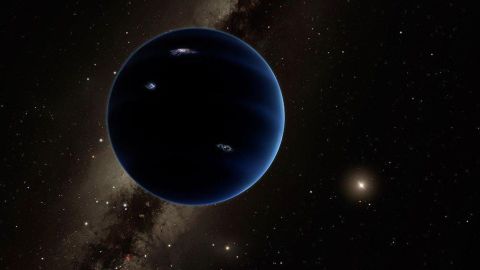
Since Pluto lost its planet status in 2006, we’ve been told we live in a neighborhood of eight planets. But some scientists believe there is a mysterious ninth member of the Solar System, and we could be on the verge of finding it thanks to a powerful new telescope..
Located on a mountaintop in northern Chile, the Vera Rubin observatory began its mission to revolutionize the way we see the Universe in June 2025.
And one of the things it hopes to shed light on is the makeup of our own backyard.
The existence of Planet 9 has been the subject of much interest and disagreement among scientists since 2016.
That was the year that astronomers Konstantin Batygin and Michael Brown, from the California Institute of Technology (Caltech) in the United States, published a paper arguing that a planet with about 10 times the mass of the Earth is located on the outskirts of the Solar System.

They stated that only the presence of a massive celestial body could explain the behavior of a group of six distant trans-Neptunian objects (TNOs), icy bodies that orbit the Sun beyond Neptune, in a region known as the Kuiper Belt.
These scattered TNOs have unusually inclined and elongated orbits that suggest they could be under the gravitational influence of a larger neighbor.
“If Planet 9 does not exist, we have no explanations for many strange events,” Professor Brown tells the BBC.
If you don’t follow the intricate twists and turns of astronomy, you may not notice the irony here: Brown, the leading proponent of a mysterious new celestial body, is the same astronomer whose work was instrumental in ruling out a previous ninth planet two decades ago.
Since its discovery in 1930, Pluto has been the smallest and most distant planet in our Solar System.

But in 2005 Brown and two colleagues found Eris, a Pluto-sized object orbiting the Sun beyond Neptune.
The discovery of Eris strongly influenced the decision of the International Astronomical Union (IAU) to change the definition of a planet the following year and expel Pluto from the family, demoting it to a dwarf planet along with Eris.
Abnormal, faint and distant
A big problem with the idea of another ninth planet is that to date no one has made a confirmed sighting, at least officially.
Batygin and Brown, for example, used computer models to make their claim.
That’s partly because Planet 9, if it exists, is really far away from us.
Caltech astronomers estimated that it is, on average, about 20 times farther from the Sun than Neptune.
That means it could take up to 20,000 Earth years just to orbit the Sun.
Something so far from our star reflects very little light, making it incredibly dim.
To complicate matters, they predicted that Planet 9’s orbit would be very strange.
While the eight planets revolve around the Sun in almost circular and flat orbits, the movement of the ninth celestial body would be highly elliptical and inclined.

But the prospects for seeing it may be about to change.
While powerful instruments like the James Webb Space Telescope are designed to focus on specific targets deep in space, the Vera Rubin observatory scans the entire Southern Hemisphere sky every few nights.
Equipped with features such as the largest digital camera ever made, it is expected to catalog billions of cosmic objects during its 10-year mission, including more than 40,000 new TNOs.
“Rubin [puede] “finding a large number of objects in space that are fainter and farther away than we have ever been able to see,” says Sarah Greenstreet, an astronomer at the observatory.
“If Planet 9 exists in its hypothetical size and location… the Rubin observatory will find it,” he says.
Neptune again?
Brown agrees that the Rubin observatory “will either find Planet 9 directly or find irrefutable evidence that it exists or not.”
If it exists, he believes it could be detected in a year or two, marking an enormous milestone.
“Planet 9 would be the fifth largest in our Solar System and the first found in 180 years!” he exclaims.
The astronomer refers to the formal discovery of Neptune in 1846.

Neptune’s existence had been predicted after astronomers observed irregularities in the orbit of its neighbor, Uranus.
The calculations were later used by German astronomer Johann Gottfried Galle to locate Neptune in the sky.
But it was later discovered that Neptune had already been observed in 1612 by Galileo Galilei, although not identified as a planet, because its movement relative to the stars was too slow and subtle for the telescopes of the time.
Could the same happen with Planet 9?
Assistant Professor Malena Rice, a planetary astrophysicist at Yale University, suspects this might be the case.
“I’m not convinced that Planet 9 is alone in our data. We have to look carefully,” she says.
Common elsewhere
In April of last year, a team of scientists from Taiwan, Japan and Australia may have done exactly that.
He analyzed surveys of the sky from two infrared space telescopes, launched in 1983 and 2006 respectively, and found a pair of matching faint spots that could represent an unknown planet moving over those 23 years.
The findings have been met with skepticism by some astronomers. Even the research team itself is cautious.
“It is too early to say that our study is a discovery of the Planet [9]“admits Terry Phan, lead author at National Tsing Hua University in Taiwan.
He prefers to consider it a discovery of “a possible candidate for the Planet [9]”.

But here’s the thing: The existence of Planet 9 wouldn’t be a shock to astronomers like Rice.
The hypothetical planet is predicted to be larger than Earth but smaller than Neptune, and Rice says this is the most common planet size in other systems.
“We see this type of planet around about half of the other stars, and we don’t have one within the Solar System,” he says.
If it’s not a planet, what’s there?
Detractors of the Planet 9 hypothesis have raised arguments ranging from observational errors in Batygin and Brown’s analysis to our previous history with a mystery planet: a theoretical Planet X pull on Uranus was proposed in the early 20th century but was later dismissed.
Another argument that fuels skepticism is the discovery, in 2023, of Ammonite, a trans-Neptunian object whose orbit does not coincide with the six TNOs originally analyzed by Batygin and Brown.

There is also a competing theory put forward by a team of astrophysicists at the Jülich Research Center in Germany.
In 2025, they ran computer simulations that suggested that a close pass by a massive star billions of years ago could have caused gravitational chaos that altered the orbits of the TNOs.
“I wouldn’t say that Planet 9 cannot exist,” admits Professor Susanne Pfalzner, who led the study. “But the probability is low.”
Greenstreet says the evidence for this additional planet “has been declining in recent years.”
But even if Rubin’s images don’t reveal Planet 9, she’s optimistic about what they might discover instead.
“There is a vast region of the outer Solar System that is still largely unexplored… who knows what else could be lurking there,” he says.
“With every question we answer, there are always new questions we ask.”

click hereto peek more stories from BBC News World.
Subscribe hereto our new newsletter to receive a selection of our best content of the week every Friday.
You can also follow us on YouTube, instagram, TikTok, x, Facebookand in our whatsapp channel.
And remember that you can receive notifications in our app. Download the latest version and activate them.
- The mystery of Planet 9: if it exists, why can’t scientists see it?
- “Farout”, the pink dwarf planet that is the most distant object ever observed in the Solar System
- Imprint Brown, “the man who killed Pluto” and left us with only 8 planets


