
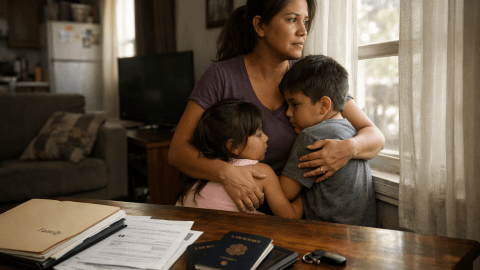
In many immigrant families in the United States there are a difficult conversation which is usually postponed. There is no talking at the table, no discussion in front of children and, many times, not even between adults. But it is present: What would happen to the children if one of the parents was unexpectedly detained by immigration agents.
In the midst of the tightening of controls and arrests in different states, several legal and community support organizations have been insisting on something simple but decisive: Having a clear opinion can avoid chaos, separation, and hasty decisions.

A silent concern that grows in thousands of homes
Concern about the future of children of parents detained for immigration reasons is not new, but, in recent months, it has regained strength as some states began to review or update their laws on temporary custody, emergency guardianship and family representation.
The starting point is practical: when a father or mother is taken into the custody of immigration authorities, many times the absence occurs suddenly and without time to organize who will care for the minors.
This void can generate immediate consequences. A child may be left without an authorized person to pick them up from school, receive medical care, sign essential documents, or make everyday decisions related to their well-being.. In more complex situations, and especially when there are no relatives available or papers prepared, minors may be referred to the state child protection system or foster care while the case is resolved.
You can see: Living in fear of ICE: what happens to the body and mind (and how to handle it)
What many parents don’t know: how to protect their children if they are detained by ICE
It’s a difficult talk to face, but the goal is to prevent children from ending up unnecessarily within the state system of foster care or are left without adults authorized to make basic decisions.
For this reason, some states began to promote more agile legal mechanisms so that parents can designate a responsible adult in advance if an arrest occurs.
- In CaliforniaFor example, legislators promoted measures aimed at facilitating family plans and temporary custody in immigration contexts. The objective is that a family is not administratively disarmed due to an unexpected absence.
- Snowfall It also advanced changes to expand existing provisional guardianship figures and adapt them to families affected by immigration actions.
- In New Jersey Similar proposals were discussed linked to “standby guardians”, that is, substitute guardians prepared to assume temporary responsibilities when a parent is unable to do so.
The background of these reforms is clear: avoid traumatic separations and reduce the unnecessary admission of children to state systems when there is an family or community network capable of caring for them.
Organizations such as the American Bar Affiliation and immigrant defense groups have been pointing out for years that lack of ethical planning It can complicate both the migration processes and the emotional stability of minors.
Another ingredient also influences: In the United States there is no detailed and public national registry that allows us to accurately measure how many children enter the foster care system. following the arrest or deportation of their parents. This lack of data makes it more difficult to measure the problem, although community organizations such as the Migration Coverage Institute assure that the impact is accurate and frequent in areas with a high immigrant population.
In simple terms, What several states are trying to resolve is not only an ethical issue, but an urgent urgency.: that an immigration detention does not leave a child without school, without medical care, without stability and without an adult authorized to care for him.

The first thing to understand: an arrest can occur without warning
An immigration detention can occur in different contexts: in a check-in, during an official appointment, at work or after an identity verification. When that happens, the immediate problem is not always ethical. Many times it is aquainted.
- Who looks for the children at school.
- Who takes them to the doctor.
- Who accesses medications.
- Who pays the rent.
- Who knows where the important documents are.
When those answers aren’t clear, the next few hours can become critical.

What do they recommend preparing before an emergency?
Immigration lawyers and community organizations usually agree on a minimum preparation schedule:
- Choose a trusted adult: It must be someone available, stable and willing to help. It can be acquainted or close friendship. The important thing is that you know the children and can act quickly.
- Leave written authorizations: In some states there are temporary guardianship mechanisms, substitute guardians or limited powers. The rules change depending on jurisdiction, so it is advisable to review local regulations with professional advice.
- Put together an essential folder– Keep copies of birth certificates, passports, school records, immunizations, health insurance, medications and prescriptions, emergency contacts, and numbers of attorneys or legal representatives.
- Talk to the school: Many parents do not know that the school needs authorized people to pick up minors. If they are not registered, there may be significant delays.
- Have telephone numbers memorized: Especially for teenagers. If a cell phone is lost or becomes inaccessible, knowing two or three key numbers can make a difference.
You can see: Children afraid to go to school: pediatricians warn about the impact of the raids in the US.
What not to do
In scary situations, a lot of misinformation circulates. Some common mistakes:
- Sign documents without understanding them.
- Deliver unique originals of important papers.
- Trust supposed “managers” without a license.
- Improvise who will take care of the children.
- Do not inform anyone where the minors are.
If the children are US citizens
Many children in blended families were born in the United States and are citizens. That doesn’t eliminate anxiety or automatically solve daily logistics. The minor’s citizenship does not replace a decision regarding care, transportation, school or health.
The hardest part: talking about it at home
No one wants to explain to a child that there could be a temporary separation. But childhood trauma specialists often point out that complete uncertainty can be worse than careful, age-appropriate conversation.
It’s not about alarming. It’s about knowing who they would go with, who would look for them, who to call and that they are not alone. An opinion does not mean resignation. Preparing is not equivalent to accepting the worst. It is equivalent to reducing damage if a crisis occurs.
Thousands of families organize savings for emergencies, medical insurance or hurricane evacuation routes. This topic falls into the same logic: foresee to protect.
Because when children are involved, waiting until the last minute is rarely the best strategy.
The most important thing today
If this fear exists in your home and you have never talked about it, perhaps the first step is not ethical. Maybe it’s sitting down this week and starting a simple list: who helps, where the papers are, what each child needs, and who to call first.
Sometimes peace of mind starts with something as basic as that.
Continue reading:
Raids in Texas for false documents: how networks that get jobs with stolen identities operate
Are there nationalities more controlled by US immigration authorities?
He lost a leg, built an altar to the Virgin and now the city wants him to tear it down: the case that moves Texas


