
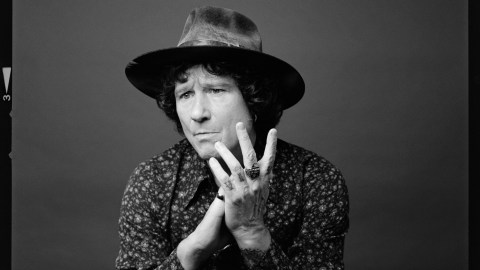
Enrique Bunbury gladly accepts any comments about his vast and varied musical production. Each stage responds, he says, to his quality as an artist, on the one hand restless, and on the other dispersed.
“I am interested in so many different things about music that it is logical that there are those who do not connect with some of my interests,” said the celebrated Spanish singer-songwriter during a round of interviews he did from Los Angeles. “I have to be very grateful that I have an audience that enjoys the fact that I change and that I evolve and that I search and that I get into swampy terrain.”
His newest album, however, is far from the heavy and sometimes dark tones and themes that once permeated the rocker’s productions. “From a previous century”, which has just been released, is an album that can be described as simple, digestible and even jubilant.
This is because Bunbury navigates many rhythms, many of them inspired and influenced by the music of different regions of Latin America.
Would this rocker be the same without the tours he made with a backpack on his shoulder through various Latin American countries in the late 90s and early 2000s?
“Obviously it would be another type of artist, totally different,” he said. “Of course it has enriched me on both human, professional and musical levels.”
From Los Angeles
Bunbury has lived in Los Angeles for more than 15 years, and has had a fairly close relationship with the countries south of the border since long before, since he was a member of the band of which he is the vocalist, Héroes del Silencio.
“From a previous century” is the artist’s fourteenth studio album, and he is currently promoting “The next time there will be no next time,” which addresses the moment when a decision marks a point of no return. Despite the title, the new album is not a production that appeals to nostalgia or a century that has already passed. The name was taken from a song included on the album.

“But it seemed to me that expertise was a way to synchronize a little,” he said.
The intention is rather to plant a seed for an interesting debate, he said. Which has to do with the generation that has lived both in the previous century and in the real one and that has the ability to compare with respect to what is being lost and what is interesting to recover or maintain.
“There is a lot of progress that is interesting and there is other progress that maybe doesn’t make us better as a race, right? As humanity,” he said.
“A Toast to the Sun” is an optimistic song that Bunbury composed around his birthday – he will turn 59 in August – and that celebrates each year of life. He believes that we currently live in a kind of “dictatorship of youth,” that being young is a privilege, when in reality the greatest privilege is one’s birthday.
“I don’t want to say anything against youth because it will seem like I’m envious, like I’m no longer the young person I know,” he said. “Then I’m going to speak well about my age.”
The tour he is preparing includes only 20 reveals and receives that name, “New Mutations”, because the rocker will review his entire songbook and will perform the most symbolic songs with specific arrangements made by the ten-piece band that will accompany him.
It is not a tour based on the new album, but that does not make it any less innovative, he promised.


