
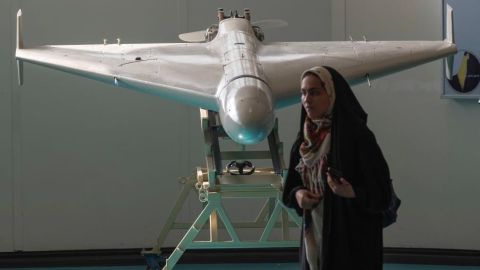
In the midst of the United States and Israel’s war against Iran, military expert Akram Kharief published a book titled “In the Shadow of the Shahid“.
In it he describes the formation and development of the drone industry in Iran and explains the strategy that has allowed the country to become a relevant player in the global military industry, despite US sanctions and restrictions.
Iranian drones have been mentioned in military reports about Hezbollah activities on Lebanon’s border with Israel. Later, after examining the remains of this equipment, experts established a connection between the drones used by the Houthis in Yemen and the Iranian industry.
In September 2022, many were surprised when it became known that Iran was supplying drone technology to the Russian military. This was followed by the first images of Geran-2 (Shahed 136) drones flying over Kyiv, the capital of Ukraine.
How has a country that has been subject to sanctions for four decades managed to change the rules of the game in international conflicts? What factors paved the way for this success?
The post-1979 sanctions forced Iranian leaders to look for options and ways to overcome the problems and make decisions to break the stalemate.
This situation also led them to rely on the expertise of their engineers, rather than relying solely on their allies.
As a result of the sanctions, Iran attempted to create networks abroad to meet its needs and, in some cases, turned to civilian technologies. But, above all, in the absence of sufficient resources, strategies were developed and implemented with patience and perseverance.
When Mohammad Reza Pahlavi, the Shah of Iran, left the country in January 1979, he left behind an army that was considered the most powerful in the region. The Iranian Air Force was equipped with F-14 Tomcat, F-4 Phantom and F-5 Tiger.
At the time, the Iranian army ranked fifth in the world in terms of equipment, after the armies of the United States, the Soviet Union, the United Kingdom and France.
Notably, the Iranian air force was considered even more advanced than its German, Chinese and Israeli counterparts, as it had access to the F-14 Tomcat fighter, the most advanced aircraft in the world at the time.
However, the operation and maintenance of these aircraft depended on the presence of a large number of American engineers and technicians in Iran, and spare parts were supplied directly from the American company Grumman.
For this reason, the air force was completely dependent on the American military industry.
After the fall of the Shah, the Army commanders fled the country, were killed or imprisoned. American engineers and technicians also left Iran, and American companies severed ties with the new regime.
Necessity is the mother of invention
In September 1980, Iraqi forces invaded Iran and a fierce war broke out between the two countries that lasted eight years. The most brutal means of destruction were used, including chemical weapons, and almost a million people died.
In the early stages of the war, Iraqi forces advanced due to their air superiority. The Iraqi army had acquired reconnaissance aircraft from the Soviet Union and also used Soviet satellite images to identify enemy positions and monitor their movements.
In contrast, Iranian forces were fighting under conditions of limited visibility and intelligence.
The Iranians desperately needed technology to survive a war that threatened their very existence. However, economic sanctions prevented them from meeting these needs. Therefore, they decided to invent and manufacture this technology internally, instead of purchasing it.
Figuring out was simple: if it was not possible to fly over enemy lines with reconnaissance planes to know their positions and movements, small remote-controlled devices could be sent. These devices are cheaper, harder to detect, and can provide valuable information.
Since 1981, the Iranians had been working on these small devices to install cameras on them. Figuring out emerged at the University of Isfahan, where a group of students and engineers were in charge of carrying it out. They began by designing and building prototypes, gradually testing and improving them, before presenting the design to the Revolutionary Guard.
The tools were simple and rudimentary: plastic parts and basic components, but the minds that worked with them were creative and skilled.
In a small workshop at the university, determined young people with great willpower were convinced of concepts such as “construction jihad” and “academic jihad”, proposed by the country’s authorities after the revolution.
Three young men were designing in the Isfahan University workshop and carrying out experiments on the plains of Khuzestan: Farshid, a civilian pilot; Saeed, a physics student; and Masoud, a skilled jeweler.
After years of trial and error, between failures and perseverance, when a prototype was first presented to military officials, some mocked it. It looked more like a child’s toy and was made of unusual materials. Its fuel tank was an IV bag and its propeller was handmade.
The first combat drone
In the fall of 1983, 40 kilometers from the front, the “toy plane” flew over Iraqi positions for the first time, returning with clear images of the military positions.
After this, the order was given to form the Thunder Battalion (Raad in Farsi) and start a formal program for the development of drones.
The program was transferred from a student workshop at the University of Isfahan to the Revolutionary Guard. To obtain the necessary components to develop the aircraft, they had to overcome the sanctions imposed on the country and access international markets.
The Revolutionary Guard created a network of companies in Dubai and used intermediaries in Singapore to acquire individual components from dozens of countries. These components were shipped to Isfahan and assembled there. This explains the presence of American-made chips in the Shahed 136 drones shot down in Ukraine.
Drones proved effective in reconnaissance operations and were used by Iranian forces in decisive battles against Iraqi forces after 1983.
However, engineers and soldiers from the Trueno Battalion began considering the development of combat drones in 1987.
A drone that flies over enemy positions and photographs their movements can, if equipped with weapons, attack and destroy said positions. But this required different capabilities and technology, something that the Trueno Battalion later developed into combat drones called “Mohajer.”
In 1988, Iran was one of the first countries to use an unmanned combat aircraft (UCAV), what is known today as a drone. Although the United States, Türkiye and Israel are known for producing this type of aircraft, Iran was a pioneer in this field.
At that first moment, in 1988, Iranian drones still had a primitive design, with a range of no more than 50 kilometers. But in 2026, advanced Iranian drones crossed the airspace of several countries to attack targets in Israel from Iranian territory.
In fact, Israel was the first to use drones for military purposes, even before the United States. He used them in the 1973 war to fool Egyptian surface-to-air missile systems and wear them out. This was the principle later developed by those involved in the Iranian drone program.
During the 1982 invasion of Lebanon, Israel used Scout and Mastiff drones for reconnaissance and to direct attacks on Syrian missile positions in the Bekaa Valley. This was the first use of military drones in an armed conflict.

Concept transformation
Iranian experts closely followed developments in Lebanon, and their allies in Hezbollah helped them gather detailed information about the Israeli drones. They concluded that the equipment was not very sophisticated and that their experts at the universities of Tehran and Isfahan were capable of building similar models.
Military analysts have also noted in numerous reports that the Iranian drone prototypes exhibited many similar features to the Israeli Scout and Mastiff drones. According to them, Iranian engineers were inspired by these features of Israeli models.
Since the 1970s, it has been known that the more technologically advanced a weapon is, the more valuable and effective it will be. For example, a guided missile capable of destroying a target 1,000 kilometers away with high precision is more effective than hundreds of unguided bullets. From this perspective, technology takes precedence over quantity.
The Iranians added a new approach to the equation: if a country cannot compete with its rivals in terms of technology, it can do so in terms of quantity and economic cost.
This is the principle on which Iran’s drone program was based. A drone that costs about $20,000 to manufacture cannot compete in precision with a $2 million cruise missile. But if 100 drones are deployed, the opposing side will have to fire 100 or more missiles to counter them.
Drones are not designed for precision or high destructive power, but rather to weaken the enemy’s defenses and deplete their financial resources. Drone strikes can therefore last longer, costing 10 to 20 times less than adversary missile defense systems.
A simple calculation shows that deploying 100 drones costs about $2 million, while the defending side must spend about $200 million on advanced missiles to counter them, regardless of the damage these drones cause.
Drones also have another characteristic: they are difficult to detect by radar, since they fly at low speed and altitude. Furthermore, the simultaneous use of a large number of them can disrupt defense systems and, in some cases, completely prevent detection.

The 2019 attack on Saudi Aramco’s Saudi oil facilities demonstrated the effectiveness of this feature, as US defense systems were unable to intercept the Iranian-made drones.
Although the Houthis claimed responsibility for the attack, it is widely believed that the drones were launched from Iranian or Iraqi territory.
The damage caused by the attack amounted to tens of billions of dollars, while the cost of the attacking drones was only a few million.
This difference is the facet that could ultimately determine the winner and loser in the drone war.

click hereto glimpse more stories from BBC News World.
Subscribe hereto our new e-newsletter to receive a selection of our best content of the week every Friday.
You can also follow us on YouTube, instagram, TikTok, x, Facebookand in our new whatsapp channel.
And remember that you can receive notifications in our app p. Download the latest version and activate them.
- Iran has a reserve of enriched uranium, but could it be used to make a nuclear weapon?
- Millions of workers in Iran lose their jobs due to war with the US and Israel


