
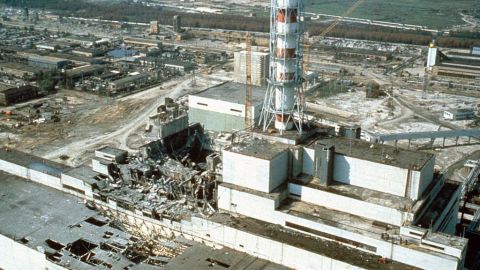
It is difficult to imagine a tragedy worse than that which occurred in Chernobyl 40 years ago. But it is even more difficult to get the idea of how the Soviet Union tried to prevent the greatest nuclear disaster in history from coming to light by all means.
When reactor number 4 exploded on April 26, 1986, spreading radioactive clouds throughout the entire northern hemisphere of the Earth – from Czechoslovakia to Japan – and releasing the equivalent of 500 Hiroshima bombs into the atmosphere, the Communist Party of the USSR tried to control the information and give its own version of the events.
“They hid the seriousness of the accident from the beginning and refused to evacuate Kyiv,” the current Ukrainian capital, said journalist Irena Taranyuk, from the BBC Ukrainian service, in 2019.
Taranyuk was a student and lived then in the western region of the former USSR. He remembers the fear and confusion he felt when the news broke.
“We were informed through the ‘enemy’—the Western media, such as the BBC—about what was happening. Meanwhile, many young people and university classmates were sent to work in the area as volunteers, exposing themselves to radiation.”
The USSR could not contain the news for long. “It was not possible to cover up something as big as that. Rumors began to spread like water,” Taranyuk said.
Four decades later, we still don’t know the full extent of the tragedy or how many people died from cancer or other diseases linked to it.
“According to official reports, 31 people died at the time and 600,000 liquidators involved in firefighting and cleanup operations were exposed to high levels of radiation,” details the United Nations about the disaster.
Furthermore, and also according to official data, “about 8,400,000 people in Belarus, Ukraine and Russia (…) were exposed to radiation.”
The organization even highlights that “if protective measures had been communicated earlier, it would very likely have prevented the population from being exposed to some radionuclides, such as iodine-131, which cause thyroid cancer.”
“An earlier evacuation would have been useful so that people would not be in the area where iodine-131 is most dangerous, between eight and 16 days after it was released.”
However, it took 18 days for the USSR to speak on television about the truth about Chernobyl.

From denial to irresponsibility
It was 5 in the morning when Mikhail Gorbachev, the last leader of the Soviet Union, received a phone call. An explosion had occurred at the Chernobyl nuclear plant. But the reactor was apparently intact.
“In the first hours and even the day after the accident it was not known that the reactor had exploded and that there was a huge nuclear emission into the atmosphere,” Gorbachev himself would later say.
The most powerful man in the Soviet Union at the time saw no need to wake up other political leaders or interrupt their weekend with an emergency session, Ukrainian historian Serhii Plokhii explained in his book Chernobyl: the history of a nuclear catastrophe (“Chernobyl: the story of a nuclear catastrophe”, 2018).
Instead, he created a government commission led by Boris Shcherbina, deputy chairman of the Council of Ministers, to investigate the causes of the explosion.
Meanwhile, citizens were in danger. But no one dared to order an evacuation.

The first helicopter approach, some 24 hours after the explosion, showed the magnitude of the catastrophe. “When they landed, they weren’t ready to accept it yet,” Plokhii said.
Shcherbina himself wrote in his memoirs that he had to force himself to assimilate what his eyes saw.
“At first, they were in a state of shock and denial. They did not want to accept what had happened. Later, they did not want to take responsibility for what happened,” Plokhii, who until 2025 was director of the Ukrainian Research Institute at Harvard University, in Massachusetts, United States, told BBC Mundo in 2019.
“There was denial on the part of those who worked in Chernobyl. And, furthermore, it was very difficult to affirm what was happening without putting oneself in an even more dangerous situation.”
Plokhii writes in his book that “as radiation levels increased, officials became increasingly nervous, but they did not have the power to decide to evacuate.”

“The immediate reaction was to hide the tragedy and then they tried to minimize the amount of information that was published,” journalist Adam Higginbotham, author of Tedious night in Chernobyl (“Midnight in Chernobyl, 2019), a best-seller from Contemporary York Cases that collects several testimonies.
The writer points out that there was a “psychological dimension” to that initial denial that is important to take into account: “The event was so catastrophic and the scale of the disaster was such that not even well-trained specialists, who exactly understood nuclear energy, could assimilate what they were seeing.”
“We need to understand that the scale of the accident was too big even for them, and not fall into the typical stereotypes about how the Soviet Union worked. The story is more complex and complicated than all that,” he warns.
Armen Abagian, the director of a nuclear energy research institute who had been stationed in Moscow, told Shcherbina that the city had to be evacuated: “I told him there were children running in the streets, people hanging clothes to dry. And the atmosphere was radioactive,” were his words, according to historian Plokhii.
While the commission was thinking about what to do, people began to leave the city.

The Soviet government was not willing to let bad news spread as fast as radiation.
For this reason, he cut off the telephone networks and the engineers and workers at the nuclear plant were prohibited from sharing news about what happened with their friends and family, Plokhii explained.
It was not the first time that the USSR faced this type of situation: “There was another nuclear disaster (much smaller) in September 1957 in Kyshtym, in the Ural Mountains, when some radioactive materials exploded. But there was no information anywhere,” he said.
“Keeping silence was a normalized protocol in the Soviet Union,” he added.
“The Americans found some signs that there was an explosion and contamination in that first disaster, but they didn’t say anything because they themselves were in the process of developing big nuclear plans and didn’t want to create an alarm.”
Higginbotham also evoked that Kyshtym accident, which the Soviets managed to successfully hide: “They simply took the same approach in Chernobyl, but in this case the border was closer to the West and the contamination and scope were much greater.”
How did the world find out?

“It was the Swedes who first detected that something was wrong. And then some British people who worked at another nuclear plant,” Plokhii said.
Higginbotham claimed that the Swedes began asking Soviet authorities if there had been a nuclear accident, “but even then they continued to deny that such a thing had happened.”
And in Sweden, high levels of radiation were detected in the days after the accident, the origin of which had no explanation.
“People in Europe warned about what was happening and the Soviet Union had to publish its information. They were telling more and more things, but only under pressure from the West,” agreed the Ukrainian, who added that the context of the Cold War is very critical to understanding how the events developed.
The historian maintained that the “dissatisfaction” of those who lived in the USSR at that time also played a key role, that they were learning about the events through foreign media and rumors – some true and others not – and not from their own government.
“It took weeks, months and even years before the truth gradually emerged. In part, that was because they captured the foreign correspondents who were based in Moscow and prevented them from leaving the city and approaching the crash site,” Higginbotham said.
“Many of these journalists began to publish any information they received, even if it was rumors. In the United States, the Contemporary York Put up even said that 15,000 people had died. That was exactly the opposite of what the government wanted.”

“They didn’t want the population to take precautions,” said Taranyuk. “It was ironic that we found out through foreign media.”
But Higginbotham warned that the story told in the West about Chernobyl is often incomplete and that “many things that were written are based on preconceived tips about what life was like in the Soviet Union that were very convenient,” forgetting the psychological and human dimension of those who made the decisions.
The fall of an empire
“Chernobyl is often linked to strategic changes in the Soviet Union and the beginnings of open politics. The beginning of everything is in Chernobyl,” Plokhii explained.
The historian stated that he wanted to write about the tragedy because it is part of his personal history: “I remember the terror of those days, we did not know what was going to happen and I tried to reconstruct the events in the best possible way.”
“The cloth I reconstructed led me to the conclusion that there was truly a direct link between Chernobyl and the fall of the Soviet Union.”

“The way the Soviet Union collapsed cannot really be understood without the story of Chernobyl.”
On the other hand, Higginbotham maintained that it was a key moment “in the disintegration of the USSR not only because of the economic cost or the increase in distrust of the institutions on the part of the Soviets, but also because of how it changed Gorbachev himself.
“The accident revealed that Gorbachev corrupted the empire he had inherited,” he said.
“But the most important lesson that Chernobyl leaves us is the problem of over-reliance on technology…. People believed that an accident of that magnitude was impossible even when it took place! And also that a culture that denies scientific evidence and is based on lies and secrecy is not safe for anyone.”
*This article is based on one written by Lucía Blasco and published in 2019.

click hereto survey more stories from BBC News World.
Subscribe and hereto our new e-newsletter to receive a selection of our best content of the week every Friday.
You can also follow us on YouTube, instagram, TikTok, x, Facebookand in our new whatsapp channel.
And remember that you can receive notifications in our app. Download the latest version and activate them.
- The protective shield of the Chernobyl nuclear plant no longer contains radiation from a drone attack, warns the UN
- The black mold of Chernobyl that seems to “feed on radiation”
- Ukraine denounces that a Russian drone hit the anti-radiation shield of the Chernobyl nuclear power plant


