
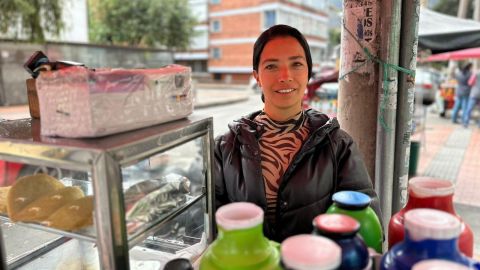
Paola Rosas, 41 years old, gets up at 3 in the morning. He leaves his house in a humble neighborhood in the southeastern mountains of Bogotá at 4 and arrives after 5 at the empanada stand he has in Chapinero.
Every day a distributor passes by and sells him about 70 empanadas. She resells them for 3,500 pesos (US$1) each.
He has to pay for his transportation and what they charge him to leave his spot in a parking lot at night.
With what he earns, he manages to pay for the university of the eldest of his two children.
Like Paola, Colombians usually work many hours a day.
According to data from the Organization for Economic Cooperation and Development (OECD), while a person in Colombia works on average 43.2 hours a week, in Germany they work only 25.6.
All those hours of work, however, do not convert into greater wealth.
In fact, among all OECD member countries, Colombia registers the lowest labor productivity, which means that for every hour that a person works in Colombia they make less money than in any other country on the list.
It is a delay that not only affects Colombia but all of Latin America.
In fact, the Economic Commission for Latin America and the Caribbean (ECLAC) has been warning for years that the region has not managed to increase its productivity in the last forty-five years, while countries like South Korea or Ireland multiplied it several times in the same period.
But, even compared to the Latin American average, Colombia is more unproductive. What is this situation due to?
Although there is no agreement among economists, the experts consulted by BBC Mundo point out that it is a problem in which factors such as the little access to capital, the problems of public infrastructure, the regulations that govern companies and the gap between the educational system and what the labor market needs.
Like the economists, the two presidential candidates who face each other in the second round on June 21 differ in their view of the problem.
Iván Cepeda, from the left, says he wants to implement productive capitalism through what he calls an agrarian revolution and the encouragement of the “current economy,” a term used by President Gustavo Petro to refer to people like Paola, who have microbusinesses.
The right-wing candidate, Abelardo de la Espriella, aims, for his part, to stimulate sectors such as oil (through fracking), mining and infrastructure, which require large capital investments but at the same time have the potential to produce a lot of money.
In any case, low productivity is a problem that, according to experts, should be on the mind of any president who wants to increase the income of Colombians and make the country’s economy more competitive in the world market.
“What we should worry about is that people are working more hours than they should, and are receiving little money,” says Ricardo Salas, professor of Economics at Dartmouth University. “The salaries are not enough,” he adds.
“Productivity is immediately reflected in salaries,” explains the dean of economics at the Universidad de los Andes, Hernando Zuleta.

Little accumulated capital
The OECD itself explains, in its productivity report, that the amount generated by each country per hour worked depends greatly on physical capital – buildings, machines, vehicles – and its intangible assets such as intellectual property – designs, patents, brands.
“The members of the OECD are generally much richer countries than Colombia, which have accumulated much more capital throughout history,” explains Hernando Zuleta. “There we have a differentiator.”
In Colombia, a large part of the businesses are informal, like Paola’s, and have little or no capital.
According to the National Administrative Department of Statistics (DANE), in the first quarter of 2026, 55.3% of the population was informally employed.
It is a percentage that includes everything from the miners who extract gold with a pan on the banks of the Atrato River to the families who grow potatoes on small plots in the mountains of Boyacá and the women who, like Paola, sell food on the street in Bogotá.
“Productivity in the informal sector is very similar to the productivity of the formal sector,” explains Zuleta. “We know this for two reasons: wages and added value, which are much lower in the informal sector than in the formal sector.”
“Subsistence businesses,” as economists call businesses like Paola’s, usually do not have access to credit, subsidies, or training, precisely because they are informal.
According to Salas and Zuleta, this is why they end up trapped in the trap of unproductivity.
They produce barely enough to survive, and usually fail to save to reinvest and grow.
But that is just one of the problems.
The infrastructure problem
Professor Salas explains that, even if the farming family managed to produce more potatoes, it would be very difficult for them to transport and sell them, largely because there is no public infrastructure that connects them with their potential market.
“Since Colombia does not have a good infrastructure given the geography it has, it is very expensive to move products through the country,” and to this is added the challenge that armed violence implies for agricultural businesses, says the expert.
As a consequence, products do not reach their potential markets.
“Much of our agricultural production does not reach the port, and therefore we do not export many things that we could be exporting,” says Salas.
And he adds: “It also does not reach wholesale markets, which increases prices and makes us less efficient.”
That is to say, since small potato growers cannot bring their production to Bogotá due to high transportation costs, they end up selling it cheaper in a nearby town. And then in Bogotá there are fewer potatoes and it is more expensive.
“If the agricultural sector does not work, it is very difficult for the other sectors to function, especially the industrial sector,” concludes Salas.

But the lack of infrastructure not only hinders the development of businesses in the countryside. It is also a challenge, for example, for Paola.
If she had a subway to get to her workplace and did not have to spend more than an hour on transportation, perhaps she would arrive less tired and could spend more time selling empanadas or doing other activities, analyzes Salas.
If she had access to a commercial location, for example through credit or subsidies, she would be more productive than having to drag her empanada stand when arriving and leaving.
All this without taking into account that, since there are so many people in her situation, Paola has a lot of competition and therefore it is very difficult for her to expand her market.
“The person who gets off a subway, buys a coffee at Starbucks and enters their office is very different than a person who spends hours on a Transmilenio and then has to drag a cart of empanadas,” says Salas.
Professor Zuleta, for his part, emphasizes that, apart from the richest large cities, Colombia is made up of a large number of poor municipalities.
“All of these municipalities are not able to provide the public goods that are required for business formation.”
The discussion about regulation
In addition to not offering the necessary conditions for businesses to function, some economists consider that the state makes companies more unproductive due to the tax and bureaucratic burden it imposes on them.
Colombia, in fact, is the OECD country with the highest corporate income tax rate.
Professor Zuleta argues that in the country there are very few large and productive companies and many small and unproductive ones, in part because the tax system rewards the latter more than the former.
“There is a belief that companies are rich” and that the bigger they are, the more taxes they should be charged.
“This obviously makes growth a bad strategy for certain companies,” says Zuleta.
Contrary to Zuleta, some studies suggest that large companies in Colombia end up paying less taxes in relation to their profits than small and medium-sized companies, because they benefit from exemptions and have greater capacity for tax planning.
That is, they can invest in a lawyer who will manage their accounts so that they end up paying less taxes, a phenomenon known as tax avoidance.
Regarding this, Zuleta says that Colombia must move towards regulation that makes companies invest less in lawyers, and more in machines, technologies or workers that really make them more productive.
The expert also points out that current laws place heavy barriers to international trade: “This country is as closed as skills in the 90s.”
According to data from The Observatory of Financial Complexity, Colombia exported much less in 2024 than comparable economies such as Chile, Argentina or Peru.
Salas points out that very few Colombian companies reach the international market, because “the big business community has profits for not being too ambitious.”
“Everything is designed so that it does not grow beyond certain limits,” he adds.
And what does education have to do with it?
Colombia’s productivity problem has everything to do with the educational system and we must start attacking it from there, defends Zuleta, dean of the Universidad de los Andes.
Both the quantity and quality of education that Colombians receive is, in general, lower than that of the other countries on the OECD list.
And to this is added that the educational system is not always well suited to the needs of companies.
That, according to Zuleta, ends up fueling informality, which, again, is more unproductive.
This is what happens, for example, when an accountant can’t find work and ends up working as a driver for Uber.

To resolve this gap, Zuleta believes that it is necessary to expand, for example, technical and technological higher education programs that meet real needs in the labor market.
A market that is also changing rapidly with the arrival of man-made intelligence (AI).
“In the US there are already companies that stopped hiring professionals who recently graduated in finance or accounting, because they managed to replace them with AI,” says Salas.
According to the most recent OECD report, man-made intelligence is expected to provide a boost to productivity in the coming years, as it theoretically would help more work be done in fewer hours.
That effect, however, has yet to be reflected in the statistics, the organization says.
According to the latest Microsoft report, 22% of Colombians use AI tools.
Salas warns, however, that the impact of these on productivity will depend on how they are used.
“I think there is an incredible possibility if we convince people to use man-made intelligence to be more productive,” he points out.
“But if we use AI to make our shopping list, to plan our trips and to tell us good jokes, we are using it for what we want. it’s not”.
* With additional reporting by José Carlos Cueto. Graphics by Laís Alegretti, from the BBC Data Mundo visual journalism team

click here to look more stories from BBC Data Mundo.
Subscribe here to our new newsletter to receive a selection of our best content of the week every Friday.
You can also follow us on YouTube, instagram, TikTok, x, Facebookand in our whatsapp channel.
And remember that you can receive notifications in our app. Download the latest version and activate them.
- 5 graphics that show the Colombia that the next president will inherit
- How the left of Iván Cepeda and Gustavo Petro in Colombia are similar and how they differ
- How the right that Abelardo de la Espriella represents compares with the one that always governed Colombia


