

By Evaristo Lara
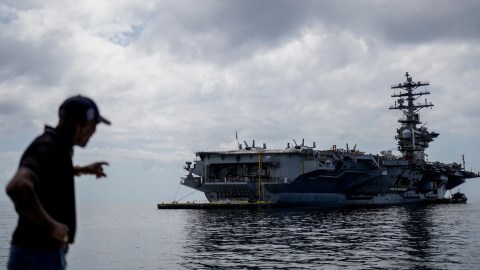
The arrival of the US aircraft carrier USS Nimitz to the Caribbean raised tension in Cuba in the face of the threat launched a few days ago by President Donald Trump about the possibility of implementing military action against him aimed at overthrowing the current government.
“All my life I’ve been hearing about Cuba and the United States. When was the United States going to do it? I think I will have… the honor of taking Cuba. Whether it’s liberating it, taking it. I think I’ll be able to do whatever I want with it, to tell the truth. They are a very weakened nation right now,” the Seventy-nine-year-old Republican said in mid-March during a meeting held at the White House with media representatives.
Later, the war waged by the United States in Iran and the meeting agreed with Xi Jinping, Chinese leader, captured much of the attention of the New York magnate.
Given the impossibility of reaching an agreement with Tehran to reopen the Strait of Hormuz and after his visit to Beijing, where he failed to convince China to act as a mediator with the Islamic Republic, Trump resumed his plan to replicate in Cuba an operation similar to the one implemented in Venezuela where he overthrew Nicolás Maduro from the presidency.

Under this approach, The first move he ordered was to move the American aircraft carrier USS Nimitz from the coast of Rio de Janeiro, Brazil, to Caribbean waters.an action interpreted by some analysts as a preliminary step to a hypothetical offensive against Cuba.
The United States Southern Command (Southcom), in charge of supervising US military actions in the Caribbean and Latin America, shared a message on the X platform, formerly known as Twitter, where it practically warns of the power contained in the aforementioned aircraft carrier.
“The USS Nimitz has demonstrated its combat prowess around the world, guaranteeing stability and defending democracy from the Taiwan Strait to the Persian Gulf,” the text indicates in relation to the gigantic warship in action since 1975.
It should be noted that, in less than a week, the Washington government demonstrated its intention to promote a large-scale change in Cuba, since Last Thursday John Ratcliffe, director of the Central Intelligence Agency (CIA), visited Havana to let the Cuban government know that the Trump administration demanded to implement certain changes on the island.
Subsequently, given the impossibility of reaching an agreement, six days later, the Department of Justice formally accused former Cuban president Raúl Castro of being responsible for the death of four people after having ordered the shooting down of two civilian small planes over international waters in 1996.
Keep reading:
• How the indictment of Raúl Castro in the US compares with the strategy that led to the capture of Maduro in Venezuela
• Trump insists on seeing Cuba as “a failed nation” where everything is lacking because of his government
• Director of the CIA visits Cuba and offers to end its shortage problems in exchange for reforms


