
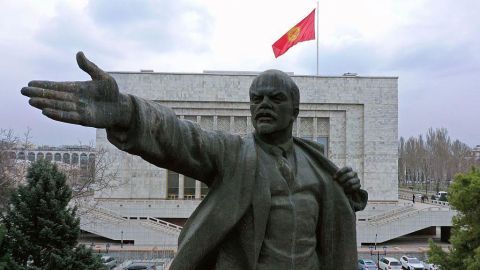
Kyrgyzstan’s capital is at the epicenter of a purge of its architectural past.
Bishkek, which until now was considered an example of Soviet urban planning, has lost several emblematic buildings and other monuments are threatened with demolition.
A few months ago, the president of Kyrgyzstan, Sadyr Zhaparov, participated in the inauguration of works designed to house 60,000 residents and with an estimated cost of US$3 billion.
The site chosen for construction was the land of the once legendary Soviet Ak Kula hippodrome. It was said that the city and the steppe, modernity and nomadic traditions met there.
For some analysts, Ak Kula was even a symbolic representation of an important part of the identity and history of Kyrgyzstan, this small former Soviet republic located in Central Asia.
But this complex built in 1947 was in a state of abandonment, had lost its monument status in the early 2020s and was eventually demolished to give it a new life.
In short, any racecourse is a huge wasteland. The arguments for using that space in the city more efficiently and profitably are quite simple and understandable.
The particularity of the new Bishkek building complex lies in the fact that the unique and recognizable structures of Ak Kula – the entrance complex, the administrative buildings and the stands – could have been preserved and integrated into the project as part of the urban and national history.
And this is not just one example.
In the past five years, Bishkek has lost at least nine important historical buildings, according to estimates by journalists and urban planners.
Most of the demolished buildings were built in the architectural style known as Stalinist imperialism.
“How would we be without these buildings?” says award-winning Kyrgyz artist Gulnara Musabai, 71.
“Now they are going to tear them down and build those buildings all the same. Again a reinforced concrete box and that’s it,” he adds.

“Disposable” city
The Erkin-Too printing house, built in 1931 and where Kyrgyzstan’s first newspaper was published, is one of the demolished buildings.
In 2015 the printing press was stripped of its monument status. The Ministry of Culture declared that the building had lost its architectural, urban and historical-cultural value and that it was not vulnerable to restoration.
The building of the Kurenkeev Music School, the oldest in the country, built in 1939, and the only one in charge of training professional musicians, was also demolished.
Three emblematic monuments have also disappeared, the dismantling of which had no clear practical explanation. Among them was “Reception of Guests”, one of the oldest fountains in Bishkek, and the bas-relief on the wall of the Aitmatov Russian Drama Theater.
Architecture professor Aigul Nasirdinova points out that this kind of attitude towards historical buildings turns Bishkek into a “disposable city”, which is losing its diverse cultural code.
“Cities that respect themselves do not tear down architectural monuments,” says Nasirdinova.
These works, he adds, “accumulate as capital that will provide income in the future.”
Architect and expert in strategic development of the urban environment Aibek Sydykov agrees: “There is a lack of understanding that the preserved identity is a long-term asset that, in the future, will contribute much more to the city through tourism and quality of life than accelerated construction.”
“We must stop considering old buildings as ‘ruins’ or a ‘brake to progress’. In international practice, these are emblematic buildings that create the spirit of the place,” he says.

History loses to business
The Law on the Protection of Monuments of Kyrgyzstan establishes that any property acquires that status definitively.
However, article 36 of the law clarifies that the demolition and reconstruction of objects of historical-cultural heritage are permitted with government authorization “in case of sudden destruction of the monument as a result of a natural catastrophe and in the face of the threat of loss of the historical, scientific, artistic and other value of the object.”
It is precisely this provision that is used by the government and special commissions to deprive an object of its status as an architectural or historical monument.
Nasirdinova says that when historic buildings are demolished, the first to benefit are construction companies. Many historic buildings in Bishkek are located in the city center, a densely built-up area with the highest prices per square meter.
“[A menudo] Architectural monuments are the property of the state and are not subject to privatization. They are located in the central part of the city and occupy large areas,” explains Nasirdinova.
But if a monument has collapsed and cannot be restored, you can do whatever you want in that place. “Architectural monuments lose to business interests,” says the professor.
Activists and analysts agree that one of the key factors of what is happening is corruption.
According to data from Transparency International (declared an “undesirable” organization and “foreign agent” in Russia), Kyrgyzstan is systematically among the countries with the worst results in this regard.

“The pragmatic logic of short-term economic benefit prevails here. Unfortunately, in this frame of reference, the value of the square meter continues to outweigh the intangible value of history and culture,” says Sydykov.
Over the past five years, the scale of construction projects has increased significantly in Kyrgyzstan. and the enhance Construction has become one of the main factors in the growth of the country’s GDP.
In the last three years, GDP has doubled, from 1 trillion som ($11 billion) to almost 2 trillion som ($22 billion). According to government data, in 2025 the country’s economy grew by 11%. In the construction sector, growth last year exceeded 21%.
Bishkek’s DNA
Bishkek (then Pishpek) gained city status in 1878.
Until the beginning of the 20th century it was a settlement with single-story buildings. The few two-story buildings that existed housed the administration offices or the residences of wealthy merchants.
The main development of the city took place during the Soviet period.

Sydykov explains that Bishkek’s landscape is characterized by Soviet modernism and Stalinist-imperialist style buildings, an architectural movement of the Soviet Union from the 1930s to 1950s.
“The Kyrgyz State Circus (1976) is one of the most recognizable examples of Soviet modernism in the city. It is a circular building with the characteristic ‘flying saucer’ dome,” explains the architect.
Sydykov highlights that what makes Bishkek architecture unique is not the so-called “Soviet boxes”, but Frunze’s modernism, which was from the 1960s to 1980s.
“It is an adaptation of the international style to the local context: lattices to protect from the sun, use of concrete, national ornaments,” he explains.
An example is the Kyrgyz State Philharmonic T. Satyganov: “It is a broad concert hall with an expressive façade, large geometric shapes typical of post-Soviet modernism and decorative elements again,” he says.
For all this and more, Sydykov states: “Our task is to learn to take advantage of history, instead of selling it at the price of bricks for demolition. The future of Bishkek lies in its uniqueness, not in imitating megacities without personality.”
And he continues: “The city is losing its DNA, becoming a set of standardized solutions.”

De-Sovietization?
Both Zhaparov and his followers often use the expression “New Kyrgyzstan”, which seeks GDP growth and tourism development, but also architectural reforms.
Upon assuming office as head of state in 2021, he announced the need to build a new building for the presidential administration.
The official opening of the new complex took place in August 2024. The building was built on the site of the former Issyk-Kul resort, which previously also had the status of an architectural monument.
The president’s then spokesman, Erbol Sultanbaev, responded to protests from citizens and the architectural community, saying that the construction of the new building was a matter of “prestige” for the country.
“When we visit foreign countries, we always observe with admiration their administrative complexes and architecture,” the spokesperson said. “I hope that now visitors to our republic look at us with the same admiration.”

Over the past five years, authorities have spent tens of millions of dollars constructing new administrative buildings.
The attention paid to symbols has also been reflected in the change of the national flag (although it has not been radical, it has provoked mixed reactions among citizens), and in 2024 the process for the adoption of a new anthem began (currently, a special commission is still studying the proposals).
On April 14, during a trip to the south of the country, Zhaparov also declared that next year the names of all towns in Kyrgyzstan that have Soviet or Russian names will be changed.
Later, however, his right spokesman, Askat Alagozov, reported that the head of state had been misunderstood and that it was only a temporary ban on naming towns after specific personalities.
When a 23-meter monument dedicated to Vladimir Lenin was torn down last year in Osh, Kyrgyzstan’s second largest city, some experts began to talk that a process of de-Sovietization had begun in the country.
At the time, it was the tallest Lenin monument in Central Asia. The street where it was located was also no longer named in honor of the revolutionary who founded the Soviet Union.

However, in the capital of Kyrgyzstan, the neighborhoods continue to bear Soviet names and the monument to Lenin is preserved in the center.
Furthermore, in his speeches, Zhaparov continues to mention, without leaving anyone aside, “the founders of the State, the heroes of the Soviet Union, the masters of prose and popular heroes.”
Therefore, to claim that the dismantling and demolition of Soviet architecture is part of some kind of ideological program is, to say the least, premature.
“The de-Sovietization process is not being carried out thoughtfully and consciously at the political level in Kyrgyzstan,” explains Elmira Abylbek, director of the historical research project Esimde.
“There are different debates and narratives, but not at the state level. We remain very loyal to our former metropolis. Instead, ‘return to self’ processes are actively developing: towards the conservation and development of language, culture and history,” he adds.
“It is not necessarily a process of opposition to something, much less aggressively, but rather the recovery of our own subjectivity.”
*This note is a condensed version of the article published by the BBC Russian Service, which you can read in its customary language here.

click hereto read more stories from BBC Info Mundo.
Subscribe hereto our new e-newsletter to receive a selection of our best content of the week every Friday.
You can also follow us on YouTube, instagram, TikTok, x, Facebookand in our new whatsapp channel.
And remember that you can receive notifications in our app. Download the latest version and activate them.
- 7 emblematic buildings by Chilean Smiljan Radić, winner of the Pritzker Prize, the “Nobel of architecture”
- 3 keys to understanding the historical importance of Lenin, the revolutionary who founded the Soviet Union
- The experiment of a Dutch reserve that went from being an animal sanctuary to a death camp


