
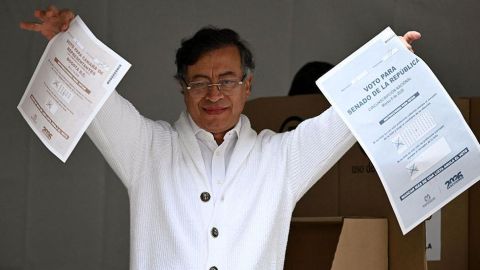
When the image of the president of Colombia, Gustavo Petro, was collapsing some time ago in different polls, he himself made a prediction that smacked of defiance.
“They tell you that the government is unpopular,” he wrote in November 2023 on platform X, his famous media outlet. “But look: if the elections were tomorrow, we would win again,” he said, citing a poll with more favorable numbers for him.
Now, on the eve of the first round of the presidential elections next Sunday the 31st, the moment of truth has arrived.
Despite the fact that the Constitution prohibits him from being re-elected, Petro attracted the spotlight of the campaign and made these elections also a kind of plebiscite on his government.
In fact, the fate of the ruling party’s candidate, left-wing senator Iván Cepeda, who leads the voting intention projections for Sunday, seems tied to the president’s popularity.
Polls still show that a portion of Colombians disapprove of Petro’s management, but also that the president’s approval ratings rose this year.
In some measurements, both postures were matched in almost equal halves.
This improvement in the image of a ruler at the end of his term has become unusual in recent years, both in Colombia and in other Latin American countries.
“It is more common for sitting presidents to undergo wear and tear,” explains Patricia Muñoz Yi, a political science professor at the Javeriana University of Bogotá specializing in public opinion and political marketing.
“However,” he tells BBC Mundo, “if there was a common point in different public opinion studies, it was precisely that President Petro had increased his levels of favorability and support.”
So, how did the Colombian president achieve this and how much can it influence the electoral result?
Fall and rebound
An economist and former guerrilla, Petro took office in August 2022 as the first elected left-wing president in the history of Colombia and had positive approval ratings in the polls in the following months.
Then his popularity began to collapse in different polls.

Two out of every three Colombians (66%) consulted in December 2023 for the traditional Invamer survey disapproved of his management, worried about insecurity or the cost of living, and dissatisfied with the lack of promised reforms in areas such as work, health or pensions.
Only one in four (26%) approved of the presidential performance.
Many then predicted that Petro would leave power with high levels of unpopularity, as happened with his immediate predecessors, Iván Duque and Juan Manuel Santos, despite the fact that the latter ended the long armed conflict with the FARC guerrilla and won the Nobel Peace Prize.
However, the same Invamer survey indicated that in February of this year Petro’s approval had risen to 49.1%, three points higher than disapproval.
And, although the latest measurement released last week shows that acceptance of the president’s work decreased somewhat (Forty five.8% versus 50.4% disapproval), it is still almost 20 points higher than at its worst.
Some polls such as Guarumo and EcoAnalítico show similar figures, while others place Petro’s approval level a few points above or below the disapproval level.

Experts conclude that there was an indisputable improvement in Petro’s image due to decisions he made in the right campaign, such as decreeing in December an increase of close to 23% of the minimum wage for this year, taking it to about US$460 in exchange.
Business sectors warned that this atypical measure would increase labor costs, reduce job creation and put upward pressure on inflation, which in April rose to 5.68% annually.
The Colombian economy grew 2.2% in the first quarter of this year compared to the same period in 2025 despite greater public spending and unemployment remained below 9%, the lowest rate in years.
Muñoz observes that Petro’s actions such as increasing the minimum wage, achieving a labor reform approved in a fight with Congress to give benefits to formal workers or promoting an agrarian reform to give land to low-income people renewed his connection with a part of society.
“Sectors of the left and center-left have seen some of the campaign promises fulfilled, or at least demands for social public policies that other governments did not attend to,” says the expert.

Petro’s party, Pacto Historico, established itself as the famous political force in the legislative elections of March 8 in Colombia and obtained 25 seats in a Senate of 103, five more than before.
But it will lack its own majorities in the next legislature and will have to negotiate with other parties the laws it wants to approve.
Shriek Trump
Petro may also have obtained benefits from his usual relationship with the president of the United States, Donald Trump, analysts point out.
The Colombian was one of the Latin American leaders most critical of Trump, either for his migrant deportation flights or his bombings of ships suspected of transporting drugs in the Caribbean or the Pacific Ocean, in which more than 190 people have died.
Trump, for his part, called Petro a “drug trafficker” and even hinted that he could order military action in Colombia.
However, then both met in February at the White House, appeared smiling in some images, and tensions decreased.

Yann Basset, a political science professor at the Universidad del Rosario in Bogotá, believes Petro benefited doubly from that.
“He won when he fought with Trump, because Trump is unpopular in Colombia as in many places,” Basset explains to BBC Mundo. “And when things got very tense for Colombia, Petro was able to go, negotiate and defuse relations a little. This was recognized.”
The US is a key ally of Colombia, its famous trading partner and its largest security financier.
And, according to surveys, the majority of Colombians want their president to have good relations with Washington.
Is it enough for you?
Petro’s rise in popularity undoubtedly helps Cepeda’s campaign. But the question is whether it will be enough to facilitate a victory and ensure the continuity of his political project.
With a less controversial style than the president, Cepeda leads the polls but it seems difficult for him to exceed half of the valid votes he needs to be elected in the first round without contesting a runoff.
It’s too early to project how he would fare in a June 21 runoff.

Some polls give an advantage and others a disadvantage to Cepeda in a hypothetical duel with one of the two right-wing candidates with the most voting intentions, the lawyer Abelardo de la Espriella and the senator Paloma Valencia, supported by former president Álvaro Uribe.
What is clear is that Petro is a key shriek of political polarization in Colombia, just as Uribe has been for a long time.
The latest Invamer survey showed that Colombians are also divided almost equally between those who would vote for a candidate to settle on the Petro government (47.9%) or against (forty eight.4%).
Just as the president has a firm base of support, there is also an “anti-Petrism” determined to stop his agenda, which includes calling a constituent assembly gathering citizen signatures to change the country’s Constitution and achieve reforms stopped in Congress, especially that of the health system.

Basset observes that Petro “has helped Cepeda stay in first place in the polls,” but “it is not that he convinces the majority of the population either.”
“In this campaign, Petro has chosen a quite harsh, aggressive speech about the Constituent Assembly in particular, which generates many doubts,” says the political scientist. “And this could be a problem for Cepeda’s campaign in the last stretch.”

click hereto see more stories from BBC Files World.
Subscribe hereto our new e-newsletter to receive a selection of our best content of the week every Friday.
You can also follow us on YouTube, instagram, TikTok, x, Facebookand in our whatsapp channel.
And remember that you can receive notifications in our app. Download the latest version and activate them.
- Why so many Colombians continue to leave the country despite the improvement in the economy
- Who are the winners and losers after the results of Sunday’s elections in Colombia
- What is known about the victims and 3 other questions about the attacks that left at least 20 dead and dozens injured in southern Colombia


