
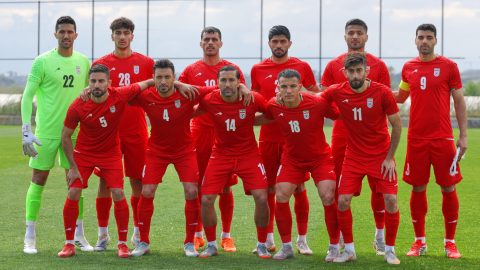
Iran has indicated that it will be in the World Cup this summer, but has demanded a series of guarantees from the International Association of Football Federation (FIFA) and the host country due to growing tensions surrounding their participation in the tournament.
Subscribe to DAZN here and don’t miss the UEFA Champions League.
The Iranian Football Federation (FFIRI) has made it clear that it will be in the World Cup, “without giving up our beliefs, culture and convictions,” while pointing out that the United States, the country where its matches will be played, “must take our concerns into account.”
These demands were made after FFIRI president Mehdi Taj was denied entry to Canada last month to participate in a FIFA congress.
Taj revealed that Iran had presented ten conditions to FIFA for its participation in the World Cup, which begins this June 11 in the US, Mexico and Canada.
Among the demands, which were published that weekend, is to ensure that all players, coaches and officials traveling with the team can receive appropriate visas, including those who completed their mandatory military service in the Islamic Revolutionary Guard Corps of Iran (IRGC).
This force is on the Canadian and US government list of terrorist groups, and Taj’s relationship with the IRGC was the cause of his being denied entry into Canada.

Iran is also seeking guarantees for the treatment of its team, such as respect for the Iranian flag and national anthem, as well as security at airports, hotels and stadiums during the World Cup.
Iran before the world
Some of the requests are probably easier for FIFA to handle than others.
FIFA can control the logistics of the event, the official protocols and the treatment given to delegations during the competition.
But issues such as visas, border control and security are under the purview of the host country, in this case the US.
Iran will play its matches in Inglewood, California and Seattle.
US Secretary of State Marco Rubio has already stated that Iranian soccer players will be welcome at the tournament, although he warned that people with ties to the IRGC could still face restrictions entering the United States.
That leaves FIFA facing a delicate balance between ensuring the participation of all qualified teams and navigating the political realities surrounding relations between Tehran and Washington.
Israel and the United States launched large-scale attacks against Iran on February 28. Iran responded with bombings against Israel and US allies in the Gulf. Since then, fighting has largely been suspended under a fragile ceasefire.
Some of the Iranian federation’s other requests may also prove difficult to implement in practice.
Iranian officials have reportedly asked journalists to avoid questions beyond “technical football issues.”
But in the case of Iran, the border between football and politics is often blurred.
Questions about team selection, public support for the national team or the atmosphere around matches can simultaneously have both sporting and political dimensions.

This was evident at the Women’s Asian Cup in Australia in March, when several Iranian players attempted to seek asylum, triggering a tense diplomatic standoff. Seven members of the team received humanitarian visas while in Australia, but five changed their minds and returned home.
Iran men’s coach Amir Ghalenoei recently acknowledged that politically charged atmospheres could surround some of Iran’s matches at the World Cup.
Despite the tensions, there is currently no indication that Iran intends to withdraw from the tournament.
Instead, the latest developments point to increasingly complex negotiations between FIFA, Tehran and US authorities over the conditions surrounding Iran’s participation in the biggest World Cup in history.
Absences in other world cups
Iran has made it clear that it will go to the tournament – although when the US and Israel attack began, it had indicated that it would not participate – and FIFA supports its participation, but in the history of the World Cups there have been special cases where teams have refused to participate or have not been allowed due to war conflicts or social issues.
For the 1938 World Cup, teams such as Argentina and Uruguay refused to participate because FIFA had promised the venue to a South American country, but finally gave it to France.
For the 1950 World Cup, India managed to qualify – due to the abandonment of the other teams in the qualifiers – but declined to participate because they did not consider the World Cup to be a tournament worth making such a long trip for.

For the 1966 World Cup, all African countries decided to boycott the event because they were only given half a place in the tournament: the team that won the continent’s qualifying round had to face an Asian team.
War conflicts have also had an impact on the history of this tournament.
The most recent case is that of Russia, which, due to the invasion of Ukraine in 2022, cannot currently participate in either FIFA or UEFA (Union of European Football Associations) tournaments.
In 1992, due to the Federal Republic of Yugoslavia’s (later known as Serbia and Montenegro) support for the Bosnia-Herzegovina conflict, the country was sanctioned and unable to take part in the 1994 US World Cup qualifiers.
And another similar case is that of South Africa, which was excluded from the World Cup for almost 30 years due to its Apartheid policy. It was suspended in 1961, and in 1976 it became the first country to be expelled from FIFA for the infamous Soweto massacre, in which 176 people were killed, most of them black students.
*With information from Pooria Jafereh of the BBC World Service.

click here to spy more stories from BBC Facts World.
Subscribe here to our new newsletter to receive a selection of our best content of the week every Friday.
You can also follow us on YouTube, instagram, TikTok, x, Facebook and in our new whatsapp channel.
And remember that you can receive notifications in our app. Download the latest version and activate them.
- Paralympics without Russia or Belarus: is it fair to ban athletes from international events for political reasons?
- Russia is banned from the Olympic Games and other major international competitions for 4 years for manipulation in doping tests


