
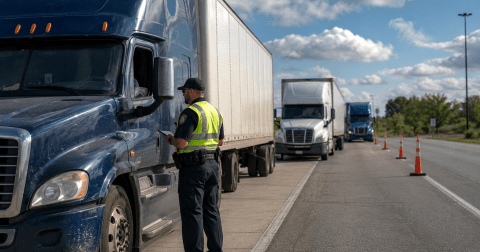
For three days, Thousands of commercial trucks can be stopped and inspected on routes, highways and checkpoints in the United States, Mexico and Canada. The operation is part of Global Roadcheck 2026, an annual road safety initiative that this year takes place from today, May 12, to May 14, and which aims to review both the state of the vehicles and drivers’ compliance with the rules.
The inspection is not formally aimed at migrants nor is it presented as an immigration operation. Its main focus is commercial transportation: trucks, drivers, documentation, hours of service, electronic recording devices and cargo security conditions.
However, Foreign or non-citizen drivers working in the United States should pay special attention. In recent months, the rules for certain non-domiciled business licenses have been tightened, and any issues with documentation, licensing or qualifying status can become a serious occupational hazard during a have watch over.
You can see: ICE raids: the states where arrests and fear among immigrants are growing
What is Global Roadcheck 2026
He Global Roadcheck is an inspection, compliance and data collection operation organized by the Commercial Vehicle Security Alliance (CVSA). For 72 hours, certified inspectors inspect commercial vehicles and drivers in North Americawith the participation of authorities from the United States, Canada and Mexico. The CVSA confirmed that operation 2026 takes place from May 12 to 14.
Although checks may include different levels of inspection, the most complete inspection is usually the North American Regular Level I Inspection, which covers both the driver and the vehicle.
What inspectors can check
At a roadside inspection, authorities may review the driver’s license, hours of service records, vehicle documentation, seat belt, possible signs of alcohol or drug use, medical certificate if applicable and vehicle inspection reports.
They can also observe mechanical and safety components such as brakes, tires, lights, steering, suspension, chassis, damage out systems, coupling, wheels, cargo and restraint devices.
For 2026, the CVSA put specific focus on two points: tampering with or falsifying ELDs—the electronic devices that record hours of service—and securing cargo.

The focus on ELDs: why it matters so much
The Electronic Logging Devicesknown as ELDs, electronically record driving and rest hours. They are key to controlling that drivers do not exceed the limits of hours of service and to reduce risks associated with fatigue.
During the operation, Inspectors can look for signs of tampering, inconsistent records, altered data, or problems transferring required information. The FMCSA indicates that drivers subject to ELD use must carry the device handbook, instructions for transferring records to law enforcement officials, ELD failure instructions, and enough paper forms to last at least eight days in the event of a malfunction.
This point is important because an unresolved fault or failure to submit records can result in penalties, delays, or even the driver or vehicle being taken out of service.
You can see: Texas tightens controls: why immigration arrests in May have another focus
Poorly secured cargo: another critical point
The other focus of 2026 is load securing. Inspectors can check tie-downs, chains, straps, anchor points and other elements used to prevent cargo from moving, falling or creating risks on the route.
The CVSA asked to pay attention to the wear and damage of the moorings, and recalled that the North American criteria for out of service include defects in chains, cables, synthetic straps, accessories, anchors and other fastening elements.
What can happen if they detect a violation
If an inspector detects a serious violation, the driver or vehicle may be taken out of service until the problem is corrected. This can mean delays, lost trips, costs for the company and employment consequences for the driver.
In the case of ELDs, the FMCSA warns that a driver who logs hours on paper for more than eight days without proof of an extension granted by the agency may be placed out of service.
The operation does not have immigration as its axis, but Foreign drivers may be more exposed if their business or employment documentation is not in order.
The reason is that in 2026 new federal rules on non-domiciled CDLs, commercial licenses for drivers who do not have a permanent address in the United States, came into effect. Under the FMCSA, eligibility to obtain a non-domiciled CDL was limited to certain classes of admission: H-2A, H-2B and E-2in addition to requiring verification of licensed immigration status.
This means that a foreign driver must check especially carefully that his or her commercial license, qualifying status and documentation are current and consistent with current rules.
What documents should always be on hand
Before and during these checks, drivers should review that they have complete business and operational documentation: valid business license, vehicle documentation, hours of service records, ELD documents, medical certificate if applicable, inspection reports and loading documents.
In the case of foreign or non-domiciled drivers, it is also advisable to verify that the commercial license is valid, that the status allowed to work and drive is correct and that there are no inconsistencies between the license, work documents and immigration documentation.
Continue reading:
The US withdraws licenses from immigrant truckers and hits the sector
CDL business license: what are the steps to apply for it in Novel York
The rural town in the US that refuses the construction of an ICE detention center for migrants


