

By Georgina Elustondo
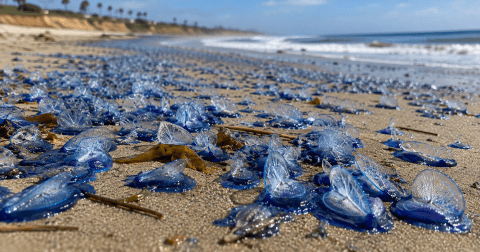
The Velella velella, known as “sea sailboats” or “sail jellyfish”are marine organisms that usually generate surprise when they appear in large quantities on the coast. Although many people confuse them with jellyfish, in reality they are not exactly jellyfish, but rather a type of colonial hydrozoa related to them.
What are they like and why do they attract attention?
Its most distinctive feature is a small transparent sail-shaped structure protruding from its blue body. This “sail” allows them to move, propelled by the wind, over the surface of the ocean.
When they reach the coast, they do so in large groups, forming blue spots on the environment that can cover kilometers of beach.
You can see: Alert in Los Angeles: they ask you to avoid these beaches due to high levels of bacteria
Why they are appearing in California
This phenomenon is not new, but it does occur cyclically. Massive accumulations are usually related to changes in ocean currents or wind patterns that push them towards the coast. Certain specific climatic conditions in the Pacific also influence.
In years with certain ocean conditions, it is more likely that these massive “strandings” will be recorded.
Are they dangerous?
In general, they do not represent a serious risk to people. Unlike other similar species, their tentacles do not usually cause significant stings in humans. However, specialists recommend not touching them directly, avoiding contact with your eyes or mouth, and washing your hands if there is contact.
This is as a precaution, as they can cause mild irritation in some cases.
You can see: Is it simply topless in the US? What changes between Florida, Texas and California
What happens when they invade the beach
When thousands of these organisms reach the coast, they quickly accumulate in the environment. They dry in the sun and can generate an odor as the days go by. Although the impact is visual and can affect the recreational use of the beach, it does not usually imply a serious environmental risk.
Continue reading:
Tick season appears to have started strongly in the US.
How to identify a spider bite and know when you should go to the doctor?
The most used plant in Texas to keep away rattlesnakes: myths and truths


