
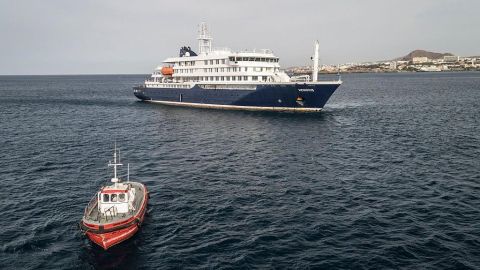
The MV Hondius cruise ship, affected by a hantavirus outbreak, set sail this Wednesday from Cape Verde bound for the Canary Islands, where it is expected to arrive in a couple of days.
Initially, the president of this region of Spain, Fernando Clavijo, refused to accept the cruise because, according to him, it represented a “very real” threat to the population.
Later he said that he spoke with the Minister of Health, Mónica García, who told him that the ship would not dock there, but would only drop anchor, and that the evacuated passengers would be taken out with the help of a boat.
While Ángel Víctor Torres, Minister of Territorial Policy and former Canary Islands president, reported that the Spanish government’s decision to accept the MV Hondius is related to a binding statute of the International Health Regulations.
“Spain has an ethical and legal obligation to help these people, among whom are also several Spanish citizens,” the Ministry of Health said in a statement.
For his part, Tedros Ghebreyesus, general director of the World Health Organization (WHO), commented this Thursday that he had asked the president of the Spanish government, Pedro Sánchez, to accept the ship and thanked him for his “generosity, solidarity and fulfillment of his ethical duty.”
The Spanish government insists that there is no risk for the population of the Canary Islands.

But residents of Santa Cruz, a port city north of Tenerife, express mixed emotions when asked what they think of the arrival of the MV Hondius to the islands.
“As long as it only docks here, there is no problem,” Rafael, a taxi driver, tells the BBC. “I imagine there will be a lot of security.”
Others express greater concern. “The mortality rate of this disease is very high,” says José Enrique, an ice cream seller. “Yes, it worries me. It’s normal to be afraid.”
The cruise ship left Argentina about a month ago on a trip across the Atlantic Ocean.
Three passengers have died and three others with symptoms were evacuated this Wednesday to receive medical attention in the Netherlands.
146 people on board
After the evacuations, 146 people from 23 countries remain on board the cruise ship, the operating company Oceanwide Expeditions confirmed to the BBC.
This figure includes a passenger who died on board on May 2.
The WHO confirmed this Thursday five infections of hantavirus associated with the cruise and specialists assure that it is a rare strain, known as the Andean strain, which can be transmitted between people who maintain close and prolonged contact.
García, Minister of Health, previously said that the ship would dock at the port of Granadilla, in Tenerife.
Located in the south of the island, it is mainly an industrial and commercial port, and has several docks for ships, according to the World Port Directory.
After the rectification of the minister, who stated that the ship would finally only anchor in the port of Granadilla, without docking, Clavijo celebrated it as “good news.”
The opposition of its native government to accepting the entry of the ship into the Canary Islands caused a political storm in Spain, but it could do little to avoid it: the central government is responsible for maintaining control of borders and managing health crises.
But could Spain’s central government have denied the cruise ship entry into its territory?
The International Health Regulations
The Spanish government defended its decision by claiming that the Canary Islands “are the closest place with the necessary capabilities,” after the WHO explained that Cape Verde did not have the resources to carry out this operation.

Torres, Minister of Territorial Policy and former Canary Islands president, explained that in the WHO’s request to Spain to accept the cruise there was a binding order that made reference to four express articles of the International Health Regulations.
Article 44 of this regulation establishes that the States Parties undertake to collaborate with each other to the extent possible for the detection and evaluation of public health events, and the response to them, as well as to provide and facilitate technical cooperation and logistical support.
On the other hand, article 28 stipulates that access to a point of entry to a vessel may not be denied for public health reasons.
Both articles are part of a binding treaty, although article 28 is not always interpreted as an absolute prohibition on denying docking, but is conditioned by public health measures.
The nearest port for safe disembarkation
Although Cape Verde could claim that it did not have the capacity to host the cruise ship, and the Regulation itself recognizes that not all countries have the necessary infrastructure, in the case of Spain it would have been difficult to claim a lack of capacity or resources to manage the hantavirus outbreak.

The Spanish Minister of Health, Mónica García, insisted that the Canary Islands host the closest port with full technical capacity “for safe disembarkation and for the protection of public health.”
When the ship arrives in the Canary Islands, health authorities plan to carry out medical evaluations of the passengers on board.
If they do not present symptoms, foreign citizens will be repatriated, while Spaniards will be transferred to a military health center in Madrid, where they will be monitored.
With additional reporting by Man Hedgecoe.

click hereto stare more stories from BBC Files World.
Subscribe hereto our new newsletter to receive a selection of our best content of the week every Friday.
You can also follow us on YouTube, instagram, TikTok, x, Facebookand in our whatsapp channel.
And remember that you can receive notifications in our app. Download the latest version and activate them.
- Andean strain of hantavirus that is transmitted between humans is identified in the deadly outbreak on the cruise ship that set sail from Argentina
- Hantavirus outbreak: why cruise ships are ripe for the spread of infectious diseases
- “We are people, not just news”: the clamor of passengers trapped on the cruise ship affected by the hantavirus


