
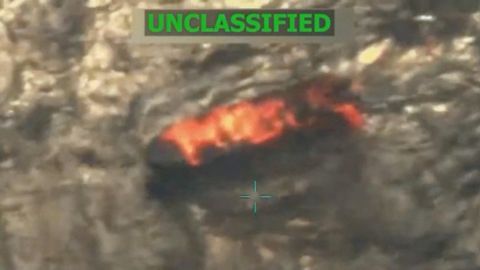
The United States attacks against boats in the Caribbean are beginning to have a considered effect, but not necessarily the desired one.
Although it seems that less drugs are leaving directly from Venezuela, experts warn that the business is not reducing: it is simply happening through other routes and methods that are more difficult to detect.
For decades, Venezuela has been one of the main outlet points for cocaine in South America, due to its strategic geographical position, and its proximity to both producing countries such as Colombia and Peru, as well as large consumer markets in the US and Europe.
However, the recent intensification of US operations in the Caribbean, with interceptions and even attacks against suspected drug trafficking vessels, has significantly increased the risk of operating from its coasts.
This change is pushing traffic towards other countries in the region, according to experts.
In September 2025, Washington reinforced its naval presence in the Caribbean, under the pretext of launching a new campaign against drug trafficking led by the US Southern Command.
Since then, the US military has carried out dozens of attacks against suspicious vessels in both the Caribbean and the Pacific, with around forty-five operations recorded through March 2026 that have left more than 150 dead.
Although US officials present these actions as part of the anti-drug fight, some analysts point out that they also had a political objective.
The military operations coincided with an escalation of tensions with the Venezuelan government that culminated in the January 2026 capture of deposed President Nicolás Maduro, who was transferred to New York to face drug trafficking charges.
Legal experts and international organizations have questioned the legality of these operations, pointing out that they could violate norms of international law and constitute an extrajudicial use of force.
Despite the aggressive campaign, Adam Isacson, director of the defense oversight program at the Washington Office on Latin America, says the flow of drugs to the US has not stopped.
In fact, he claims that data provided by US border authorities show that in the seven months since the attacks on boats began, slightly more cocaine has been detected than in the previous seven months.
“That means that cocaine is reaching the United States regardless of these attacks,” he tells BBC Mundo.
“The fact that the Southern Command has destroyed several vessels in recent months seems to indicate that they continue to see almost the same level of traffic on that route as before,” he adds.
“We’re not seeing a decline right, but probably less visibility due to changes in tactics.”
Other routes
Alex Papadovassilakis, researcher and journalist from InSight Crime, assures that, for now, there is no evidence that the flow of cocaine in the Caribbean has decreased.
“We have not seen any evidence of a sustained decrease in cocaine moving through the region in total,” he tells BBC Mundo.
Your team in InSight Crime consulted sources in key transit countries such as Venezuela, the Dominican Republic, Trinidad and Tobago, and several Caribbean islands, to analyze the impact of US operations.

From this work, begun after the first US attack in early September, they concluded that the impact exists, but is limited and very localized.
The attacks have focused primarily on speedboats operating in the maritime corridor between Venezuela and nearby islands, and the possibility of a lethal attack undoubtedly represents a new deterrent for traffickers, raising the risk of using that method on that specific route.
But Papadovassilakis warns that drug trafficking does not depend on a single route and assures that there are indications that point more to a displacement than to an interruption of traffic.
“One of the things we have seen since the attacks began is that there has been an increase in unregistered flights heading east through Guyana’s airspace,” he notes.
“This could indicate an increase in drug flights leaving Venezuela and heading to Guyana, Suriname or Brazil, which is a common exit route for cocaine shipments bound for Europe,” he adds.
Papadovassilakis points out that another focus where an increase in trafficking has been observed is the Amazon between Colombia and Venezuela. It is a region with an extensive network of rivers and dense jungle vegetation, which makes it a corridor most likely to move drugs discreetly.
“If only one form of transportation is attacked on a specific route, a door can be closed,” he says. “But there are many others open that criminal networks can exploit simply by diverting shipments through other routes.”
The researcher also highlights that, even before the US attacks in the Caribbean began, most of the drugs arriving in that country were already transiting through the Pacific, not the Caribbean, and much of that trafficking moves in containers inside commercial ships, a method that has not been affected by US operations.
Diversification of tactics
But the change is not only geographical. Tactics have also had to be diversified.
Adam Isacson, of the Washington Office on Latin America, says that drug traffickers are possibly using a greater number of small boats making stops along the coast in Central American countries such as Costa Rica.

“They could also have resorted to greater use of cargo containers, such as those used to transport drugs to Europe, as well as land routes. They could be using more semi-submersible narco-submarines, torpedoes operated by drones and even aircraft,” he adds.
Narco-submarines are semi-submersible vehicles that barely rise above the water and allow tons of drugs to be transported over long distances with less risk of being intercepted.
This type of boat is usually used to try to transport cocaine across the Atlantic from South America, establishing itself as an alternative to speed boats.
However, he clarifies that the most common method is still the one known as rip-on/rip-off in which cocaine is loaded into containers after passing security checks at ports and removed shortly before it reaches its destination.
This allows criminal networks to avoid drug detection without having to resort to more complex techniques.
Still, he adds, criminal groups are increasingly experimenting with advanced chemical methods, such as cocaine camouflaged in legal shipments, dissolved in liquids or mixed with cement or metals, which are more difficult to detect.
Geoff Ramsey, an analyst at the Atlantic Council, says that one of the main problems in assessing the impact of US operations in the Caribbean is the lack of solid data, but agrees that the bulk of drug trafficking continues to move through larger and less visible shipments.
“It is difficult to get a full picture of the impact of these operations without understanding how much of the cocaine is moving outside of these small vessels, especially in traditional maritime trade.”
“It applies friction, but it is not the solution”
Experts agree that operations in the Caribbean are not hitting the core of drug trafficking.
“Ultimately, it’s more about sending a message than completely stopping the flow of drugs,” Ramsey says.
Isacson goes further and lists them as “a minor nuisance” for criminal networks, which have enough margins to adapt, assume higher costs and redirect their shipments.

The emphasis on the Caribbean could also be ignoring more relevant routes. Even before the start of the campaign, only around 20% of the cocaine destined for the US transited through this region, while the majority did so through the Pacific.
“This applies friction, but it is not the solution,” summarizes Isacson, citing US military authorities.
In the long term, both agree that the problem is structural and requires another type of response.
Ramsey points to the need to strengthen controls on maritime trade and international cooperation, while Isacson places the focus on corruption.
“Drug trafficking thrives thanks to uninvestigated and unpunished complicity between officials and criminal networks,” he says.
He specifies that in countries like Venezuela there are key points, such as roads, rivers and transit areas, that could be controlled, but where conspiracy between officials and criminal networks facilitates the passage of drugs.
Without addressing these factors, they conclude, the routes may change, but the flow will hardly stop.

click hereto come across more stories from BBC News World.
You can also follow us on YouTube, instagram, TikTok, x, Facebookand in our new whatsapp channelwhere you will find breaking news and our best content.
And remember that you can receive notifications in our app. Download the latest version and activate them.
- Why US military attacks on Venezuelan ships are seen as a “radical” escalation of its drug war (and what they mean for Mexico)
- Are US attacks against vessels from Venezuela in international waters legal?
- BBC World Special | The ghost oil towns in Venezuela that await Trump’s promise: “There are no children here, there is no youth”
- How prisoners sent secret messages from the infamous Helicoide prison in Venezuela


