
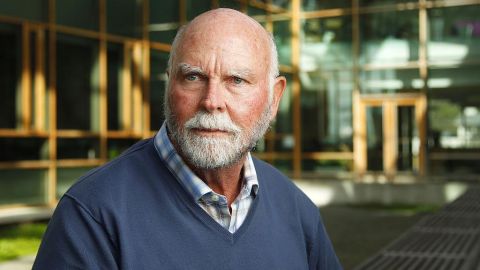
Possibly the best word to define Craig Venter, the American scientist who helped decipher the human genome who died this Wednesday, is mavericka term in English that could be translated into Spanish as nonconformist, rebel. Someone who thinks and acts differently from others, ignoring the norms, or the rules established by a group.
It was this irreverent attitude that made many consider him one of the most important scientists of the century for his invaluable contributions to genomic research and the advancement of synthetic biology.
But it also made others despise him for having commercialized the results of his research and promoted the idea of science as a competition.
Opinions aside, the truth is that his career and legacy have been surrounded by controversy from the beginning.
The first time the world heard about it was when, in the 1980s, Venter decided to abandon the publicly funded human genome project to establish a privately funded program that would compete directly with the US government initiative.
For Venter, the methods used by the official Human Genome Project (HGP) were too slow, which is why he decided to accelerate the process by founding the commercial company Celera with the same purpose: to sequence the complete genome of the human being (the extensive sequence of nearly 3,000 million letters of DNA that contains the book of instructions necessary for life).
His bet paid off. The researcher managed to design a much less precise, but much faster method for sequencing DNA.

In 2000, Celera made a joint announcement with the government project saying that both had obtained the first draft of the human genome, a truly worthy step toward discovering the genetic basis of diseases and human origins.
The following year, the PGH published its results in the journal Nature. Venter’s team did the same in the magazine Science. However, while the official project made all of its data available to the public, Venter initially withheld some of his own so Celera could profit from it financially.
His efforts in the field of genomics accelerated the entire process of the human genome, while turning him into a wealthy scientist who moved comfortably around the world on private jets and yachts.
There were no shortage of occasions in which Venter had to come out to defend himself before the media that accused him of being more interested in financial gains than in extending the limits of scientific knowledge.
His lack of modesty did not contribute to his reputation either. Venter not only commented that his academic level was equal to that of any Nobel Prize winner, but he also later let slip that the anonymous donor whose genome Celera had sequenced was none other than his own.
Even so, his talent and passion for what he did made it possible for him to surround himself with brilliant scientists who, working as a team, achieved one achievement after another.
synthetic life
After the publication of the genome, the researcher focused his attention on another major project: the creation of synthetic life forms.
With that objective he established the J Craig Venter Institute, in Maryland, where some 400 scientists dedicated themselves to this enterprise.
Their first great “achievement” in this field was when the team of scientists produced the complete genome of a micro organism.
The result of this research -published in the journal Science– was an organism, a “synthetic cell”, totally controlled by that man-made genome.

Again, this research was mired in controversy. Some biologists specializing in the same field were unsure of the purpose of the study, other than to serve as a proof of concept, and argued that less flashy experiments would probably bring more benefits.
On the other hand, from an ethical perspective, many have always been concerned that Venter’s scientific innovations have occurred under a cloak of commercial confidentiality.
Some scientists accused him of carrying out his research in a very undemocratic way, contrary to the openness and transparency that underlies “good science.”
young rebel
Born in 1946 in Salt Lake City, Utah, Venter showed no explicit aptitude as a child for studies or science.
His youth was dedicated more to girls, drinking and surfing on the beaches of California, as he commented in his autobiography published in 2007. A Life Decoded — My Genome: My Life (A life decoded, my genome, my life).
But his carefree life on the sunny Californian beaches was abruptly interrupted in 1967, when he was called up to fight in the Vietnam War, where he worked as an assistant in a naval health center.
That experience made him realize that if he survived the war, he wanted to become a doctor.
Venter graduated from the School of Medicine at the University of California, San Diego, preferred research to practice, and began teaching at New York University.
At the National Institutes of Health, where he began working in 1984, he realized the importance of decoding genes and, frustrated by the slow progress of the government project, began to design his own technique to speed up this process, as we mentioned before.
For his contributions to the sequencing of the human genome, Venter received the Nierenberg Prize for Science in the Public Interest, awarded by the Scripps Institution of Oceanography, in 2007. In 2009, then-President Barack Obama presented him with the National Medal of Science.
It will take time to analyze the full legacy of Venter’s research, but it is evident that beyond the controversy, his impact on science has been enormous.

- How the human genome was sequenced 100% for the first time (and what implications does it have)
- What secrets can a genetic analysis reveal about your health?
- What the first complete sequence of the “strange” Y chromosome reveals about the genetics of men


