
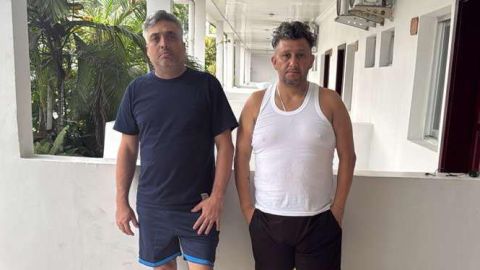
For eight years, Jorge Cubillos struggled to build a new life in the United States after fleeing threats in Colombia.
He claims he had a work permit, an asylum process underway and expectations of staying in the country.
But he was suddenly deported to Africa without further explanation.
In an interview with BBC Mundo from the small room of his resort in Kinshasa, the capital of the Democratic Republic of the Congo, he assures that he is sick and disoriented, far from everything he knows and from his four children and his wife, whom he left in the state of Florida.
“I never thought I would end up in Africa. I thought they were just threats,” he says.
Cubillos is part of a group of 15 Latin Americans who were deported last week from the US to the Congo, within the framework of a controversial agreement with third countries signed by the government of US President Donald Trump.
The migrants and asylum seekers are originally from Colombia, Peru and Ecuador. It is the first group to arrive in the Congo since the agreement was signed.
The government of the African nation has defended its decision to receive migrants from third countries as a commitment to human dignity, the protection of migrants’ rights and international solidarity.
He has also reiterated that the stay of these people in the country is temporary and that the reception, support and care are being financed by the US.
But migrants and asylum seekers interviewed by BBC Mundo say their conditions in Congo are far from optimal and that their health is rapidly deteriorating.
Marta, who did not want to reveal her real name for fear of reprisals, says that her ordeal began with the visit of a group of agents from the Immigration and Aid Service to watch on Customs Enforcement (ICE).
He relates that on February 13, after a long battle during which he spent 14 months in detention and which included a habeas corpus granted by a federal judge, she was released. He claims that he had a work permit and was following his immigration process “correctly.”
“Our human rights have been violated”
But on April 2, his destiny suddenly changed.
She says that that day ICE agents came to her home in Texas, knocked on the door and showed her, through the glass, a supervision order with which she had previously been released. They told him they just needed to verify his address.
“I didn’t see any problem and opened the door,” he remembers.

Minutes later, they asked him to accompany them to an office to install a GPS visual display unit. She didn’t suspect anything until they handcuffed her.
She was transferred to the Bluebonnet detention center in Texas, where she remained for three days. She was then taken to the Prairieland Detention Center in Alvarado.
There, according to her testimony, she was held incommunicado for almost two days.
“They locked me in a room, they didn’t give me food or water. It was very cold,” he says.
During that time, her relatives were unable to locate her in official records.
“It didn’t appear in the system, because I was never prosecuted,” she says.
After she was vaccinated against yellow fever and flown to Louisiana, she was told she had a flight to the Congo the next day.
“I told them that I was afraid because of the insecurity and they didn’t answer me and here I am, in the Congo. How do I feel now? Well, I feel that our human rights have been violated,” he says.
“There is a lot of misinformation on social media, they say that we are criminals and that we deserve what is happening to us, that is not right. The lack of information in this place and not knowing what is going to happen to us is affecting us emotionally and psychologically.”
BBC Mundo contacted the ICE agency to request comments on these accusations, but until the time of publication of this article we had not received a response.
“We have had fever, vomiting and diarrhea”
Hubert Tshiswaka, director of the Human Rights Research Institute (IRDH), harshly criticizes the agreement between the Congo and the US, and considers it contrary to international commitments on the protection of refugees.
“There is no contaminated beauty to bring people from other countries to the Congo, especially from the US,” the human rights lawyer tells BBC Mundo.
“In addition, these people have not done anything wrong here, so there is no reason to keep them detained,” he adds.

The IRDH denounces a violation of the principle of non-refoulement, forced transfers contrary to international law and the externalization of the United States’ obligations regarding asylum.
It also urges the Democratic Republic of the Congo to suspend the agreement with Washington.
In a statement, the International Organization for Migration (IOM) assured that the Congolese government asked them to provide humanitarian assistance to 15 migrants deported by the United States on April 17.
“IOM can also offer assisted voluntary return to those migrants who request it, in accordance with its mandate and applicable legal frameworks,” he added.
The group of deportees claims that on some occasions they have been prevented from leaving the resort facilities and report difficult conditions, such as lack of drinking water and electricity outages.
“We are sick. We have had fever, vomiting and diarrhea. They tell us that it is long-established and that the body is simply adapting to Africa,” says Jorge.
The IOM declined a request for an interview with BBC Mundo.
“By hook or by crook”
Carlos Rodelo had been in the United States for three and a half years, when on February 4, 2025, a judge in Maryland granted him protection under the Convention against Torture (CAT).
According to him, the judge had ruled that he could remain in the country and would not be deported, although he could not leave United States territory.
Months later they notified him that he had to appear at an immigration office on August 4 to sign some documents.

It was not the first time he had been summoned to an immigration office, so he did not see anything strange.
“But when I went to the office as soon as I entered, I saw that there were three ICE agents literally hiding, waiting for me. They told me that they were going to detain me and possibly deport me. I honestly didn’t understand and I told them that I had an approved asylum, that I had protection under the CAT,” he says.
That same day he was transferred to an office in Baltimore, where he was held in a room, before being sent to Louisiana. He spent eight months in detention there.
During that time, he claims, he filed additional requests for protection. However, he was deported before a federal judge could rule.
He knew his final destination hours before the flight.
“When they told me that they were going to send me to the Congo, I told them that I didn’t know what that was, or where it was,” he says.
“They responded that they were going to take me by hook or by crook.”
“More than 25 hours tied up”
Migrants also describe the journey as “inhumane.”
“It was overwhelming. It was overwhelming because we spent more than 25 hours tied at the waist, hands and feet with a paper bag that had an apple, some potatoes and water inside,” says Jorge Cubillos.
Another Colombian who also preferred to remain anonymous claims that she was deported after spending several weeks in the Eloy detention center in Arizona.
“They summoned me to an office supposedly to remove my GPS and when I arrived they informed me that I was going to be detained because they had found a third country for me,” she says.
She has doubts about whether she would like to return to the US.
“I don’t know, because after everything that has happened and what I have suffered, who can assure me that I will not go through this again and that in the future they will send me to another country?” he adds.
He affirms that living in the United States today “is scary” and that President Donald Trump’s government acts in an inhumane manner.
“It seems to me that what not only the president is doing, but also the people who are allowing themselves to be manipulated by him is inhumane,” he says.
“Because I feel that in that government there are puppets manipulated by this person, who are detaining people for no reason, without any motive, just because they want to do it and that’s it,” he continues.
“Spending so much time in detention without having committed any crime is something hard and the conditions within the detentions, the truth is, are not the best.”
Far from their countries, without a clear route and with little information about their future, the group portrays a growing sense of abandonment.
“We feel completely adrift. We don’t know what is going to happen to us,” says Marta.
Jorge Cubillos shares that uncertainty and fears both for his future and that of his colleagues.
“Asylum seekers are at risk in our countries,” he explains. “If they gave me a choice between the Congo and Barranquilla, Colombia, which is where I’m from, I would choose Barranquilla, because I’m not doing anything here.”
“But returning to Barranquilla is putting my life at risk.”
The uncertainty, added to the conditions in which they find themselves, has been wearing down the group. The feeling, increasingly widespread, is that of being trapped in a limbo from which they do not know how to get out.

click here to search for more stories from BBC Data Mundo.
Subscribe here to our new newsletter to receive a selection of our best content of the week every Friday.
You can also follow us on YouTube, instagram, TikTok, x, Facebook and in our new whatsapp channel.
And remember that you can receive notifications in our app. Download the latest version and activate them.
- The rural town in the US that refuses the construction of an ICE detention center for migrants
- What is ICE and what powers does it have, the US agency in charge of the mass deportation of migrants promoted by the Trump government?
- “The history of the United States has from the beginning been a history of deportations”


