
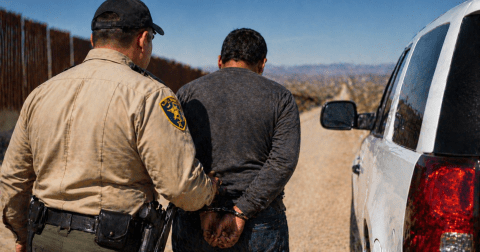
Texas achieved a high-impact judicial victory on immigration matters. A federal appeals court this Friday allowed the controversial SB4, a state law that authorizes Texas police to detain people suspected of having entered the border illegally with Mexico. The decision reactivates one of the toughest immigration rules approved by a state in years.
The ruling was issued by the Court of Appeals for the Fifth Circuit, based in New Orleans. The vote was 10 to 7. The judges have not yet resolved the constitutional merits of the case, but they lifted the court order that kept the law blocked considering that the plaintiffs did not have sufficient legitimacy to stop it at this stage.
What SB4 allows in Texas
The law, signed by Governor Greg Abbott in December 2023, makes irregular entry or re-entry into Texas from another country a state crime. In addition, it grants new powers to state police and judges.
In practice, the norm allows Texas police to arrest people suspected of entering the country illegally. Specifically, authorities can:
- Detain people suspected of having crossed the border illegally.
- File state charges.
- Order departure from the country in certain court cases.
- Impose greater penalties on repeat offenders or those who do not comply with court orders.
You can see: Hispanic drivers appear as “white” in Florida: the data that reopens the police debate
Why this decision worries thousands of immigrants
Civil organizations and immigration lawyers have long maintained that immigration is a federal, not state, jurisdiction. They fear the law will lead to racial profiling and/or wrongful arrests.
It also causes stress and fear in Hispanic communities. There can be confusion for legal residents and citizens and even clashes between local and federal authorities.
The dissenting judges precisely warned that Texas cannot create its own immigration system parallel to the federal one.
Can the police stop you just for looking like an immigrant?
That will be one of the most controversial points. The law speaks of suspicion linked to irregular crossing, but in real life the way it is applied will be decisive and will surely generate new demands.
Lawyers recommend anyone in Texas carry valid identification and not sign documents without proper advice.
What happens to residents, tourists and people with papers?
The decision does not eliminate visas, green playing cards or citizenship. But experts anticipate that it may increase controls, interrogations and tensions in certain areas, especially near the border and in counties with a strong state police presence.
For those who have correct status, it is advisable to carry updated documentation.
What’s next now
The legal battle was not over. The case may return to lower courts and eventually escalate again. New challenges could also be filed if arrests begin or if law enforcement leads to abuses.
But the issue matters beyond Texas. What happens with SB4 could influence other states seeking to adopt similar measures. If the rule survives future judicial reviews, it would open a new stage in the relationship between federal immigration and state power.
Meanwhile, for many immigrant families, the immediate impact is not technical: it is emotional. The fear of an arrest during a traffic stop or a routine shield-to-watch may grow from now on.
Continue reading:
Raids in Texas for false documents: how networks that get jobs with stolen identities operate
Houston considers repealing ordinance that limits its cooperation with ICE amid threats from Abbott
What does it mean that the Mexican government joins the lawsuit against ICE for deaths in a US detention center?


