
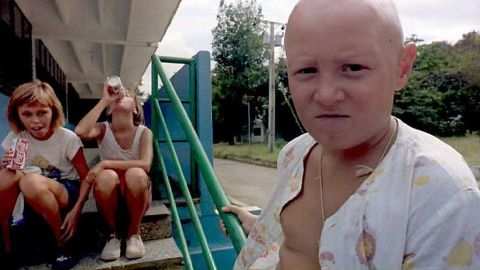
This story was originally published in 2019. We are reproducing it again on the occasion of the 40th anniversary of the Chernobyl nuclear disaster.
“It wasn’t like being in a sanatorium. Even the sickest children had a good time.”
Ukrainian Roman Gerus has very fond memories of an experience that had its origins in a catastrophe.
We are talking about the explosion of one of the reactors at the Chernobyl nuclear power plant on April 26, 1986, a tragedy that marks 40 years this week.

Gerus was one of the more than 23,000 minors affected by the accident who received medical attention in Cuba.
The program sponsored by the Cuban Ministry of Health was developed between 1990 and 2011.
What did that experience consist of?
On the seashore

“I was in Cuba three times,” Roman Gerus tells BBC Mundo.
“The first one was 12 years old, I stayed six months. The second one was 14 years old and I stayed three months. The last one was 15 years old and I only stayed forty-five days.
“Each time was different, but I enjoyed all of them. It’s something I remember fondly, I want to return to Cuba with my family to show them the island,” he says.

Gerus emphasizes the beauty of the setting where he came to recover from the skin disease he developed many years after the Chernobyl accident.
This young man, now 27 years old, was not even born when the disaster occurred, but his family lived relatively close to the nuclear plant.
“When I was about 10 or 11 years old, the doctors detected white spots on my skin, it was vitiligo. We tried to treat it in Ukraine, but the doctors said it was not that easy, that I needed very expensive medications and they did not guarantee that they could help me,” he says.
“Someone told my mother that there was a program to go to Cuba. She didn’t believe it at first because they told her it was free, but she found out the details and filled out the documents.
“We waited at least half a year. Suddenly they called to say I was leaving in two weeks. I couldn’t believe it. My parents were worried because Cuba is very far from Ukraine and I was little, but we decided to move on and I left.”

More than 25,000 patients
The place where Gerus landed was a spa located on Tarará beach, about 30 kilometers east of Havana.
Founded in the 1950s as an upper-middle class urbanization, after the Cuban Revolution it became the headquarters of the children’s camps of the José Martí Pioneros organization.
The Cuban government rehabilitated the area to accommodate the thousands of patients who participated in the “Children of Chernobyl” program for more than 21 years: from March 29, 1990 to November 24, 2011.

According to data from the Cuban Ministry of Health, a total of 26,114 patients (84% children) came mainly from Ukraine, Russia and Belarus.
The serious difficulties that Cuba went through during the so-called “special period” in the 90s after the dissolution of the USSR did not cause the program to stop.
Different diseases
The Tarará complex had residences for children and their companions, two hospitals, a clinic, an ambulance park, a kitchen, a theater, schools, parks and recreational areas.
Without forgetting the two kilometers of beach about 15 minutes away.
Patients arrived on the island with ailments of varying severity, from cancer, cerebral palsy and dermatological problems to malformations, digestive diseases and psychological disorders.
The program was under the direction of Cuban doctors Julio Medina and Omar García, who classified the patients into four groups depending on their condition:
- Children with oncohematological conditions and serious illnesses who needed hospitalization and remained on the island for several months depending on their recovery.
- Children with various pathologies that required hospitalization but were not considered serious. Their stay was 60 days or more.
- Children with pathologies susceptible to outpatient treatment. Their stay was between forty five and 60 days.
- Relatively healthy children whose stay was also between forty-five and 60 days.
Two zones
The case of the Ukrainian Khrystyna Kostenetska, who participated in the program when she was 12 and 13 years old, corresponds to the fourth group.
“I went to Cuba in 1991 and 1992,” Kostenetska tells BBC Mundo.
“Both times I was there for 40 days. That’s supposed to be the period in which the human body has the ability to recover from a low dose of radiation.”

Kostenetska explains that there were two different areas in Tarará: the lower camp, where children with more serious health problems were housed, and the upper camp, intended for minors without health problems but who had been in the vicinity of Chernobyl.
“We lived in small independent houses, about 15 children in each one. The minors in the high camp did not have specific medical treatment, but they did check our vision and took us to the dentist,” he details.
Kostenetska has conflicting memories of the seasons she spent in Tarará.
“I remember an incredible sea, the waves, the sunsets, nature and ice cream, but I also remember children with serious health problems,” he explains.
“They were children with vitiligo who had to wear long sleeves and cover themselves from the sun. Despite that, Cuba’s climate healed some of them and accelerated the recovery of many others.”

healing sun
Gerus was one of the children who fully recovered.
“After the second time I went, all the spots turned gray and disappeared. I took some medications, but the predominant medicine was the sun,” he says.
“We swam a lot. The ocean was beautiful. We went with the teachers to the beach, it was part of the treatment. We always wanted to go,” recalls Gerus, who remembers that some nights they participated in recreational activities such as going to the movies or the disco.

Unclear elements
Beyond the good memories of Gerus and Kostenetska and the generally positive view of the work carried out by the Cuban government, there is no doubt that dramatic situations were also experienced in Tarará, especially if one thinks about those who arrived with more serious ailments or those who were left out of the program.
In that sense, the selection process of the participants was not without controversy.
That was a time of deep crisis in Ukraine in which families could not afford to pay for plane tickets for children to travel to places where they could recover from the effects of radioactivity.
And when the Cuban government’s program was announced, many thought they would have the opportunity to send their children.

But it was not very clear what the process was for choosing the participants. And some criticized that the participants were not exactly from the most humble families.
Despite these doubts, the perception of Cuban collaboration in Ukraine and other former Soviet republics is positive and a feeling of gratitude prevails. Furthermore, there is no public evidence that corruption occurred.
“Although he was small, he was able to understand that the situation of the Cubans was difficult, there was a lot of poverty. Even so, they were always very pleasant, from the kitchen workers, to the teachers, the security officers, the doctors,…” Gerus recalls.
“They were very good-hearted people and that was the most important thing.”

click hereto search for more stories from BBC Recordsdata World.
Subscribe hereto our new newsletter to receive a selection of our best content of the week every Friday.
You can also follow us on YouTube, instagram, TikTok, x, Facebookand in our whatsapp channel.
And remember that you can receive notifications in our app. Download the latest version and activate them.
- The protective shield of the Chernobyl nuclear plant no longer contains radiation from a drone attack, warns the UN
- The black mold of Chernobyl that seems to “feed on radiation”


