
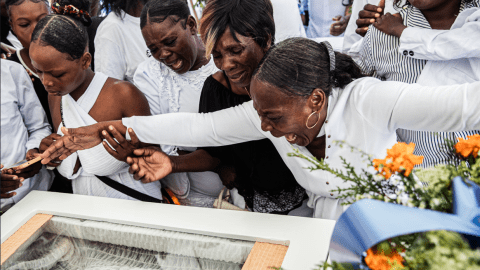
This story is part of “The Fall of Port-au-Prince”, a project by Dromómanos and Global Initiative.

Little Prince Benson has fallen ill.
His father is King Micanor, self-proclaimed last monarch of the Caribbean, master of the docks of Port-au-Prince, “lord of war.” from the Wharf Jérémie neighborhood and Viv Ansanm, the gang confederation that controls the capital of Haiti.
And he is convinced that he has discovered the cause: in the area there are werewolves, a type of elderly sorcerers with the power to transfigure themselves into animals to attack at night and with a special weakness to sicken and kill children.
The king then states that, to save his son, his hosts must go out to hunt them.
In a house, Sébastien, a strong and tough 32-year-old man, sees from under his mother’s bed how two men take her away.
In another, Evelyn’s grandmother tells her: “No one says anything. Everyone hide.” The old woman then opens the door and they kidnap her.
They also take Sheila’s grandfather. When he wants to find out about his whereabouts, the old man is already a corpse.
Manú also looks for his parents. They don’t answer the phone. The next day he discovers that his father was dismembered with machetes.
Micanor’s bandits also murder Dustin’s uncle and cousin. He says he has two bullet holes in his body.
In the early morning of December 7, 2024, Prince Benson Altes dies. I was six years old.
Over six days, his father kills 207 people. Most were over 60 years old. He cuts them up with machetes, makes them disappear with fire or sends their remains to the bottom of the sea.

At the end of February 2025, three months after the massacre in Port-au-Prince, I made an appointment with Rosie Auguste Ducéna, a lawyer at the head of the National Pink for the Defense of Human Rights (RNDDH, for its acronym in French). But it is difficult to move.
90% of the capital of Haiti, the most violent city in the most violent and poorest country in America, has been under the control of Viv Ansanm for more than a year, the largest confederation of criminal gangs ever seen in the region.
Since February 29, 2024, the bandits have taken over neighborhood after neighborhood, burning police stations, local radio stations, schools, government buildings, cemeteries, roads… They have devastated the city.
The 10% that resist the offensive are defended by what little remains of the Haitian State, an international mission commanded by Kenya, civilians and the men of some leaders, such as the former police officer Samuel Joasil, the most recognized of all.
These brigades set up barricades almost every day, placing burned cars, improvised gates, spiked fences or burning tires to prevent the bandits from entering, and to ensure that, if they do enter, they move slowly. This way they can hunt them, kill them and, on many occasions, burn them.

Mobility is also difficult for those of us who are in this kind of fortress.
I have spoken by phone with Rosie Auguste since my arrival in Port-au-Prince at the end of February 2025, but it is in mid-March of that year when I finally manage to sit across from her in her office.
“I don’t know, no one knows why the bandits do what they do,” he responds when I ask him the reason for the massacre at Wharf Jérémie.
Rosie Auguste, one of the leading specialists on gangs and violence in Port-au-Prince, believes it is a form of pressure to make the city fall faster. “Terrorists,” he calls them.
Also consider that the warlords (warlords) They design the strategy, but they do not control the hordes of teenagers who, drunk with adrenaline and power, end up devastating the population in chilling ways. And also that years of living among violence deform those boys.
But, like the rest of the experts, he believes, suspects, intuits, but does not know.
Rosie Auguste is upset, you can tell. He calls Viv Ansanm’s bandits cowards. He realizes that they attack the populations before the government.
“They know where the prime minister is, where the officials live, but they prefer to attack unarmed women and children. They carry out mass rapes in front of everyone and kill babies,” he says with a frown.
This woman has spent years documenting and denouncing not only the barbarities of the gangs. He also accuses the Haitian State of passivity, permissiveness and collusion. That’s why he believes his life is at risk. He wouldn’t be the first person to be murdered for documenting these things.

Since my arrival I have sought to interview survivors of the massacre.
A local journalist tells me that it is impossible. He realizes that entering Wharf Jérémie is not an option because King Micanor has become paranoid and his men have become paranoid with him.
He also assures that the survivors will not be able to leave the neighborhood either. Micanor has set up checkpoints that control people’s exits and taken cell phones away from residents, and those who have managed to flee to other neighborhoods or to improvised refugee camps would have to risk too much.
I ask Rosie Auguste and she promises to try, but adds that for them to move around the city would be almost suicide. He asks me to return in early April 2025.
For this second interview I arrive at his office on Ivander’s motorcycle, my local guide.
This day the city burns, Viv Ansanm has bitten the boundaries of the fortress at night, the shots continue to ring out and the brigade of the leader Samuel Joasil is in the streets with their weapons and their fire.
Rosie Auguste explains to me that the devastation of the city began with the assassination in 2021 of Jovenel Moïse, the then president of Haiti, and tells me about the ant work that her team had to do, risking their lives, to prepare the report on the Wharf Jérémie massacre.
At the end of our conversation he gives me a very detailed document with more than 120 testimonies.
And then he asks me: “Where do you want to do the interviews?”
To my astonishment, he opens a door and points out five people sitting on a bench, looking scared.
In an unusual act of bravery, they crossed a city at war, going through barricades, fire and bullets, risking the same fate as their relatives, to tell me how they died and prevent their story from ending up in the same place as their bodies: at the bottom of the Caribbean.
At the end of the interviews, everyone claims to remain in contact with their loved ones, they say they talk to them in their dreams, and see them living in the house, taking care of their children, cooking their food, running away with them through the city.
Their testimonies, a report from the network of local organizations and another from the United Nations are the imperfection of this reconstruction of what happened between December 6 and 11, 2024, when King Micanor perpetrated the largest massacre committed by a prison gang in America in the 21st century. Those days when the survivors began to dream.

The Killer King and the Curse of the Elders
On the morning of December 6, 2024, Evelyn and her family hear some motorcycles, men talking loudly, and knocks on the door. They ask from the street about their grandmother.
“Hide and be silent,” the grandmother asks her relatives, as she opens the door.
One of the men enters with a gun, the other with a machete and they take her away on one of the motorcycles. It is the last time Evelyn will see her alive.
At the end of the Wharf Jérémie neighborhood, near the sea, gunshots can already be heard. Nobody in the house dares to go out.
The next morning Evelyn and her sisters, in an act of great recklessness, sneak to Nan Mangue, a small sandbank next to the port of Wharf Jérémie, and there, in the middle of a great bleeding puzzle, divided by the machete, they find their grandmother.
For a few days now, King Micanor’s 6-year-old son, Benson Altes, has had a fever. None of my informants are clear about the cause—a condition associated with the lungs or stomach—but it is getting worse by the minute.
Port-au-Prince has lost almost all health facilities, public and private, to bandits. Even the ambulances of Doctors Without Borders refrain from reaching the domains of King Micanor, as they have been attacked with bullets on more than one occasion.
Given the child’s discomfort, Micanor calls his houganhis voodoo priest, to save him.
The priest determines that Benson is sick from voodoo. It turns out that this is some kind of spell cast by a loup-garou or werewolf, a type of sorcerer greatly feared in Haiti since the colonial years.

This anonymous priest (no source or report mentions his name) also says that it is the old men and women of the neighborhood who are responsible not only for the little prince’s illness, but for other deaths due to illness in Wharf Jérémie.
For gang members, the elderly have become a kind of pest, and that is how they will be treated.
On the morning of December 6, 2024, after a long meeting with the houganKing Micanor mediates ending the curse: he gathers his troops at the gang’s headquarters known as the Training Center, and orders them to bring all the elders of the neighborhood.
That day Sébastien has lunch with his mother at home. He doesn’t remember what they ate, he assumes it was rice, because for many in the city it is practically the only food.
The neighborhood is tense, the common denominator of the days in Port-au-Prince. They hear gunshots, the background music of the city for the last five years.
Then the bandits arrive.
They ride a motorcycle, they are young, they knock on the door, they shout from outside that they love their mother. She tells Sébastien to hide; He doesn’t ask for it, he orders it.
Sébastien is big, with strong features, a deep voice and wide arms. His neck looks like the trunk of a sturdy tree and the top buttons of his shirt do their best not to fly off every time he breathes.
But on December 6, 2024, this man crawls under his mother’s bed as best he can and covers himself with her blankets.
He believes they are coming to rob him, because he and his mother are merchants and have cash.
Since King Micanor is his neighbor and they have known him for two decades, he does not think that they are going to kill anyone in the neighborhood. Maybe his mother does, and that’s why she orders him to hide.
So Sébastien sees from his hiding place how two boys take her away and put her on a motorcycle. Hours later he will be part of the human puzzle of which Evelyn’s grandmother is also a part.
That day, King Micanor kidnaps 127 elderly people, 90 men and 37 women, and takes them to Nan Mangue.
There, when the night darkens everything, his men kill them with shots and machetes.
He hougan He collects blood from those sacrificed and keeps it in containers along with some parts of their bodies.
In the voodoo tradition, this is a way of preserving the essence, of staying with someone, of enslaving them beyond the barriers imposed by death. In voodoo terms, that man keeps the souls of the elderly.
The death of the prince and the torture of the king
In the early morning of December 7, 2024, Benson Altes, the son of King Micanor, dies.
But the blood spills mada the night before is not enough for him hougan. The king sends his men with the clear order to kill all those close to the elders.
They spread out throughout the neighborhood, trapping entire families.
About 50 people have planned to flee by sea and have assembled a boat with boards and plastic to do so.
But before going up and venturing into the Caribbean, they organize a ceremony to ask for protection from the praisethe voodoo deities.
The music and songs alert Micanor’s men and they are soon surrounded.
They beat and stabbed them without killing them, and took away 57 people in total at gunpoint.
Some are transported on motorcycles, others in vehicles. webcrowded and tied.
At the Training Center, King Micanor himself tortures them for hours, testimonies say.
He cries, he is suffering, hurt, paranoid. He wants to know who cast the curse and where those sorcerers who killed his little boy are. But no one gives him a satisfactory answer. They don’t tell him where the monsters are hiding.
In the early morning of December 8, they begin to cut the throats of the hostages and dismember them. When the sun rises, his men throw what pieces they can into the flames.
The remains that the fire does not advance are thrown into the sea.

Kings and voodoo
In the church of Saint Michel, on the outskirts of Pétion-Ville, inside the small fortress that survives in Port-au-Prince, dozens of women and men raise their hands and wave them in the air. Drums sound like thunder, smoke rises and deep voices escape from a wooden cabin.
They look at me with distrust, but no one dares to kick me out or hurt me. It is a sacred place and they will not stain it, especially with white blood.
It is March 5, 2025 and on this hounforor voodoo church, a ritual is celebrated to Ezili, the family of praise associated with fertility, the strength of motherhood, sensuality, the feminine, dance and protection.
A group has carried a young woman with Down syndrome. Motionless, it looks like a large bird with half-grown wings. He doesn’t speak, just makes a kind of painful grunt and drools.
They have picked her up from the street, where she lives next to a garbage dump. They have dressed and shod her the best they can, and have organized this event for her.
The objective is to ask Ezili to protect her, to accompany her, to forgive. The woman is pregnant and will give birth in the next few days.
The devotees also cry out for peace, they ask the praise that give them hope, that help them survive. They pray that Viv Ansanm does not enter and that if he does, they can defeat him.

Voodoo is one of the most stigmatized religions in America.
According to Alfred Métraux, one of the pioneer anthropologists in his study, it is a set of hybrid beliefs between African creeds, in the first instance, and the Catholic faith of the slavers who arrived in America in the second.
It would be very difficult to explain the profound keys to voodoo in this article. I will say, then, that it is a religion created from below, with a deep and tender relationship with nature and with the dead.
In this tradition the dead do not leave, they stay and are an important part of daily life. They return in dreams, comfort the living, and over time they become deities and thus the Haitian pantheon grows until it becomes impossible to list.
Voodoo has nothing to do with violence, or no more than the Judeo-Christian or Muslim faiths. It also emerged as the ideological and spiritual driving force of the Haitian revolution at the end of the 18th century.
It was after a ritual organized by a woman that slaves destroyed the French slave hacienda system in 1791. This is how Haiti was founded, after the first successful slave revolution in America, the first independence of Latin America and the second of the continent after that of the United States.
Voodoo was, and in some ways still is, an eminently anti-imperialist religion.

Like all religions, however, it has also been used to further oppress the already oppressed.
Using voodoo as a weapon to subjugate people is not something that King Micanor has patented; dozens of warlords they presume to be hougan and to have the protection of praise.
Perhaps the first to see the potential of faith to repress Haitians was François Duvalier, the dictator known as Papa Doc.
His chilling regime from 1957 to 1971 had two pillars. The first was the formation of the Tontons Macoutes, a paramilitary group that murdered opponents and imposed fear in the neighborhoods, and the second was voodoo.
Duvalier himself boasted not only of being a houganbut to be a loa; specifically Baron Samedi, the lord of the cemeteries, who guards the entrance to the world of the dead.
He appeared in the classic clothing of this spirit and spoke—according to the Haitians—as the Haitians speak. praise and the dead: with a nasal tone.
He ruled Haiti for 14 years and left a trail of death and established a way of doing politics that still prevails today.
In a simplistic way one could say that Viv Ansanm is Papa Doc’s heritage and that those warlords paranoids and mystics are his legacy.
When on December 6, King Micanor plans to murder his neighbors, he is not innovating in the forms of barbarism; He is following a political tradition that began before his birth.

The paranoia of the king and the “werewolves”
On December 9, people are held incommunicado at Wharf Jérémie.
Given the coverage of the massacre in the local media and social networks, King Micanor has ordered the confiscation of the phones of the entire population.
His men kidnap another 60 people and take them to the Training Center, where they torture and interrogate them. The leader wants to know who leaked the information to the press and the human rights organization with which I will speak months later, in March and April 2025.
A curfew is imposed in the neighborhood. “No one comes out, no one comes in!”, the bandits order shouting through the streets.
Manú clashes with the archetypal conception we have of a refugee. He wears a button-down shirt, United States. glasses and his shoes look shiny. He speaks English and I can talk to him without a filter.
He tells me that he lives in another neighborhood whose name we will omit for safety and that he visited his parents in Wharf Jérémie frequently, being able to come and go without being bothered by the king’s bandits. This is a rare privilege.
His parents had a good business there. Because it was a port, there was a lot of movement and the possibility of obtaining products before they rose in price when entering the mainland.
On December 6, Manú called his parents and they did not answer.
As some rumors were already circulating that something strange was happening in the neighborhood, he ventured out and managed to enter Wharf Jérémie on December 7.

At home his mother greeted him with the news that the day before some men on a motorcycle had taken his father.
Despite the curfew, he went out to find out what had happened to him.
He learned that they dismembered him, burned his parts and threw what was left into the sea.
They also told him that they were killing everyone over 60 years of age.
His mother was over 70. So he hid her as best he could and on December 9, he sneaked her out. But he got sick, stopped eating, and on Christmas Eve, he died. “He died of sadness,” says Manú.
At his funeral, next to his mother’s coffin he buries another one with his father’s things. Thus he says goodbye to them, while explaining that they have returned to a world to which the king’s rage can no longer reach: the world of dreams.
“My children are very young and they won’t remember them, but they take care of my children,” he says, and crying breaks his cold bureaucrat’s composure.

On the afternoon of December 9, King Micanor’s bandits capture three men and two women trying to flee from Wharf Jérémie and shoot them on the spot.
These shots no longer have anything to do with voodoo and werewolves. The king wants to prevent by all means from knowing more about the massacre and, for this reason, he prohibits leaving the houses and talking among neighbors.
But hiding more than 200 murders, even having fire and the sea as allies, is very complicated.
The news leaks, some people send videos to relatives outside the neighborhood and they share it with local journalists or on social networks.
Jimmy Chérizier, known as BBQthe man who has become known to the world as the spokesperson and leader of Viv Ansanm, and other bosses of the confederacy demand answers. Although each warlord has autonomy over “its” territory, carrying out a massacre of this caliber requires at least an explanation.
The specialized analysts of the United Nations intercepted a message from the king to the senior staff of Viv Ansanm in which he refers to the events:
Hello Viv Ansanm colleagues. Greetings, I am King Micanor.
I will tell you about the incident in my area.
Many people say that I committed a massacre and talk about murders. The victims are sorcerers (werewolves). The Viv Ansanm coalition does not collaborate with these types of people.
Can you imagine that I have a son who was born healthy and that the local elders conspired to kill him by casting mystical spells on him? In this case, I cannot remain impassive; I must take revenge. In all Viv Ansanm bases, we will exterminate the sorcerers and cleanse the areas.
I have heard many messages in the press and from human rights organizations.
You know my lair, who I am. You must come for me, you are cowards, I am waiting for you, come for me. I take full responsibility for what I did.
The elders killed my son, do you think I wouldn’t react? A son I love so much. You are not the parents of the child, and that is why you are insensitive to pain.
I myself, King Micanor, committed no abuse; the people who were killed are really dead. If others must be killed, they will die. All Viv Ansanm gangs will hunt werewolves (sorcerers).
Given the explanation, he continued with the massacre.
“You kill mine, I kill yours.”
The neighborhood dawns in silence. No one wants to speak loudly so as not to alert the bandits to their presence.
“The most dangerous are the children, because they want to demonstrate their power and they can hurt you just for that,” Evelyn, the first survivor I interview, tells me.
The king’s men have taken over the streets and are looking for someone to kill. Among them is Dustin.
Thin and about 30 years old, he limps, with one leg bandaged, helped by a crutch.
He worked with his uncle and cousin in a small workshop in the neighborhood, which allowed him access. Although he also confesses to having good relations with King Micanor’s band.
When he arrived there on December 7, his uncle and his cousin had been murdered. Even so, he decided to stay with the band—he says—for fear of being mistaken for an informer.
But he claims not to have been involved in the massacre and, as proof, shows the two bullet holes in his body.
He says that the bandits complained that he had not complied with the king’s order: everyone had to kill. Some even made a deal to save themselves from shedding their own blood: “You kill mine, I kill yours.”
That Dustin was saved from that sentence, apparently, was not fair to them.
On December 10, one of King Micanor’s men, of medium rank, asks him to extend his hand and as punishment shoots him in the center of the palm. Another points at his head. Dustin moves, the bandit pulls the trigger again and hits him in the leg. But he keeps running and manages to escape.

Now he lives as a refugee somewhere in the fortress that still stands in Port-au-Prince. His wounds appear to have become infected.
If the men of the self-defense brigades catch him and discover his connection with Viv Ansanm, they will take him to the delicacieson the corner of rue 27 and Bois Patate, in front of the abandoned Tag Grocery store, in the Canapé Vert neighborhood, the fiefdom of the leader Samuel Joasin and his brigades.
They will hit him enough with machetes so that he cannot move and then they will put tires on his neck and set him on fire. Bwa kalethat practice is called, and it is the fate of the bandits that the brigade catches.
The king’s paranoia and his obsession with ensuring that the news of his massacre does not continue to spread makes him even more distrustful.
He finds eight men and five women who still have their phones, accuses them of being the ones who have spoken to journalists and takes them to Nan Mangue, where he killed the first groups.
There he tortures them, murders them and their bodies have the same fate as the rest: machete, fire and salt water.
The mad king and dreams
The leader’s head is a tombola.
News of the massacre spreads throughout Port-au-Prince. “King Micanor went crazy,” it is said in the neighborhoods controlled by the bandits, even in the fortress.
Someone who has foreign intelligence information explains to me that Viv Ansanm considered overthrowing him and putting someone more reliable, less unpredictable, in charge of the Wharf Jérémie.
This same source tells me that the king knew about this or sensed it, and then wanted to demonstrate that he had the control of the neighborhood and his own head.
On December 11, he frees the 60 people he kidnapped two days before and orders his men to prepare bags with rice, beans, sanitary towels and little else.
He forces people to leave their homes and distributes groceries.
He orders them to shout his name, to thank him because, although he did not manage to save his son, he did protect the other children in the neighborhood from the werewolves.

“Long live King Micanor!” Sheila has to shout while showing a bag of rice to a bandit’s phone camera.
On December 5, this woman had gone with her grandfather to the market, they bought chaco, a vegetable similar to cassava, and they cooked it to eat together.
There was a little left over, which is why she believes that when they took him away to kill him on the afternoon of December 6, along with 126 other elderly people, her grandfather would have had the chaco they prepared together the day before for lunch.
On December 11, King Micanor has already killed 202 people, but despite his kidnappings, torture and murders, the curfew and the rice delivered, his bandits tell him that there is a new video on the networks where women’s voices narrate what has happened in recent days.
Given this, he has five captured and takes them to the Training Center, where they are tortured, and then taken to Nan Mangue.
These five women already share the sea with the remains of Jacinthe, Marcel, Grette, Magarette, Mimose, Ellionise, Montellas, Charita, Marthe, Adeline, Amadide, Charléus, Euvanie, Milou, Immacula, Olympia, Umaliance, Milot, Jacqueline, Dieuvé, Bénita, Roosevelt, Jean, Rosiane… and 173 other people whose names are not recorded in the reports for safety reasons.
In this city of bandits, the false king massacred the elderly and with them the memory of the neighborhood.
But the survivors say that their loved ones continue to return every night, in dreams, and with them the past also returns.
The false king and impunity
Micanor is not a king, he is just a man who rules with impunity a piece of the world on an island in the Caribbean.
He’s not even the founder of his band. According to a person who belonged to that group, Micanor is the third in command, a very violent and trigger-happy element. That’s why they never trusted him, because he was always paranoid, impressionable and unstable, they say.
In 2008 this lord of misery murdered his own mambo or voodoo priestess, to, according to him, obtain his power. In 2012 he killed 12 people whom he accused of being sorcerers.
The two leaders who preceded him died around 2015 in the fratricidal wars of the capital’s gangs, when they fought among themselves for the modification of those miserable spaces and the poor people who inhabited them, before Viv Ansanm.
The afternoon of this day in April 2025 is fading in Port-au-Prince. Viv Ansanm attacks the boundaries of the fortress.
While I am doing the fifth interview of the afternoon, in the distance gunshots are heard and through the window you can see columns of smoke rising towards the sky.
The brigade will close the streets soon to protect themselves from the rabid packs of the great bandit confederation.

Dustin speaks slowly, in slang and with a thick accent. It’s difficult to understand him.
But the man is telling me about the death of his uncle and cousin, and how he had to walk for more than an hour with his injured leg and shattered hand to tell me this story, so interrupting him is not an option.
When the interviews are over, we fly on guide Ivander’s motorcycle. Some barricades are already in place, but we manage to get around them.
The fortress draws out its thorns and prepares to survive one more night.
The witnesses of the “grandparents massacre” will sleep here now, they can no longer return to their places. Tomorrow they will try to return without being killed or captured by Viv Ansanm or the vigilante brigades.
Almost a year and a half later, as I write this chronicle, the Wharf Jérémie massacre remains unpunished despite all the testimonies and evidence that point to the person responsible for the murder of 207 Haitians, mostly elderly: the self-appointed last monarch of the Caribbean, the lord of the docks, a simple bandit named Monel Félix Altes.
Mo yo pa janm ale
I la toujou
I dòmi nan dlo
I mache nan rèv nou
(The dead never go away.
They are always here.
They sleep in the water.
They walk in our dreams).
Traditional Haitian voodoo funeral song
*The names of the survivors have been changed in this chronicle for security reasons.

click hereto seek knowledge from more BBC News World stories.
Subscribe hereto our new publication to receive every Friday a selection of our best content of the week.
You can also follow us on YouTube, instagram, TikTok, x, Facebookand in our whatsapp channel.
And remember that you can receive notifications in our app. Download the latest version and activate them.
- “Hospitals and the elderly need you”: the profound impact on the US of deporting hundreds of thousands of Haitians
- Looking for anything to eat on the streets: desperation in Jamaica after the devastation caused by Hurricane Melissa


