
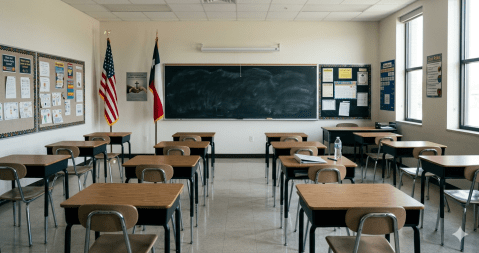
A federal ruling reignited one of the most sensitive debates in the United States: religion, public school and parental rights. The Fifth Circuit Court of Appeals allowed Texas to move forward with a law that requires displaying the Ten Commandments in public school classroomsa measure that would impact millions of students if it remains firm.
The Fifth Circuit Court of Appeals ruled 9-8 to allow Texas to require display of the Ten Commandments in public classrooms, reversing a previous block. The case will likely escalate to the US Supreme Court.

The limits between state and religion: the axis of a controversy
The decision revives a historic discussion about the boundaries between church and state and could end up in the Supreme Court. For many Hispanic families in Texas—a state with one of the largest Latino populations in the country—the question is concrete: what their children will see in the classroom and how far the state government can go on religious issues.
Texas is one of the states with the most students in public schools in the country. Therefore, any educational change usually has a national impact.
You can see: “He was about to graduate”: the story of Mauro Henríquez, the deported student in Texas
What the federal court decided
The New Orleans-based Court of Appeals voted splitly to temporarily allow Texas law continues while legal dispute continues. The measure reverses a previous blockade and represents a victory for the state at this stage of the case.
The law requires a visible copy of the Ten Commandments to be posted in every public school classroom. Its defenders maintain that it is a document with historical and cultural value in the honest American tradition.
Opponents argue that imposing religious texts in state schools violates the separation between church and state protected by the Constitution.
What’s changing for parents and students in Texas
If the rule stands, school districts would have to comply with the display in classrooms. That does not involve mandatory religious classesbut a permanent presence of biblical content in public educational spaces.
For many Latino families the issue is not only religious. It also involves cultural diversity and freedom of conscience. In Texas, Catholic, evangelical, independent Christian, Muslim, Jewish, families without religious affiliation and other spiritual traditions coexist.
The debate also reaches parents who, even though they are believers, consider that religious education corresponds to the home or private institutions, not the State.

Why this case matters throughout the United States
Texas often sets legislative trends that are then attempted to be replicated in other conservative states. If the court ends up supporting the measure definitively, similar initiatives could appear in other jurisdictions.
In recent years, legal disputes linked to religion in public spaces, education and freedom of religious expression have grown. The current Supreme Court has issued several rulings in favor of a greater religious presence in certain public spaceswhich makes this case especially relevant.
Can it reach the Supreme Court?
Yes. Given the constitutional weight of the issue, specialists consider it doubtless that the dispute will continue to the United States Supreme Court, especially if there are contradictory decisions in lower courts.
A final ruling from the highest court could redefine how far states can go when incorporating religious symbols or messages in public schools.
For Latino parents with children in Texas public schools, the process is not over yet. The judicial battle remains open and new decisions could come.
Meanwhile, the case has already left a clear signal: cultural and educational issues will continue to occupy a central place in American politics, especially in states with a large Hispanic weight such as Texas, Florida and Arizona.
Continue reading:
How networks that offer employment with false documents act in Texas
Court blocks Louisiana law that requires schools to post the Ten Commandments in classrooms
What are the 5 most determining verses in the Bible, according to AI


