
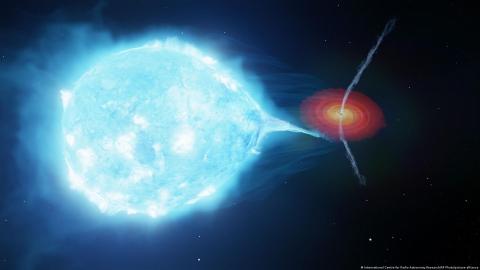
For the first time, a group of scientists managed to measure the astonishing instantaneous power of jets emanating from a black hole.
The discovery, detailed in the magazine Nature Astronomyconfirms key theories about how black holes help shape the universe.
What are black hole jets?
Black holes “are among the most extreme objects in the universe. They are capable of expelling matter outwards at speeds close to that of lightin powerful plasma jets known as jets,” explain the authors, in an article published in The Dialog.
“These jets are believed to be among the most energetic phenomena in the cosmos,” although this recent research “could call this into question,” they warn.
The binary system studied was Cygnus X-1formed by the first black hole identified in history – discovered more than half a century ago – and a blue supergiant star orbiting next to it.
It is located 7,200 light years away.within our Milky Way, in the constellation of Cygnus. It weighs approximately 21 times the mass of our Sun, compressed into a region about 100 kilometers in diameter.
The supergiant star It supplies field material to the black hole, giving it “something to ‘eat’ and send out in the form of jets,” explains lead researcher Steve Prabu, from the University of Oxford.

The “dancing jets” generated by stellar wind
The authors based their findings on 18 years of high-resolution radio images obtained by a global network of telescopes. Their calculations combined the degree of jet deflection caused by the stellar wind with computer models.
What they observed were so-called “dancing jets”: a pattern in which the jets are repeatedly deflected in different directions by the supergiant star’s powerful winds, as both bodies travel in their orbits.
“We have discovered that the wind from Cygnus X-1’s companion star is strong enough to deflect the jets launched by the black hole. This shows how powerful the winds of massive stars can be,” the researchers highlight.
A power equivalent to 10,000 soles
The results of the measurements are conclusive. Cygnusapproximately half the speed of light.
“One of the key conclusions of this research is that about 10% of the energy released when matter falls toward the black hole is carried away by the jets“, indicates Prabu in a statement from Curtin University.
“This is what scientists typically assume in large-scale simulated models of the universe, but until now it has been difficult to confirm by observation,” he adds.
What these jets reveal about the universe
These emissions allow us to understand how much of the energy released around black holes is deposited in the surrounding environment, with the ability to modify or influence it.
That is, on a large scale, the jets could generate shocks and turbulence that could shape galaxies and other cosmic structures, a mystery for astronomy.
“We can now use this measurement to strengthen our understanding of jets, whether they are black holes with a mass 10 times that of the Sun or 10 million times greater,” says co-author James Miller-Jones.
“We hope to detect jets from black holes in millions of distant galaxies, and the reference point provided by this new measurement will help us calibrate their full power,” he added.
“It would be exciting to measure the power of the jets in many more systems,” concludes Prabu.


