

By Ramon Castro
Moving packages in congested cities has become a race against the clock. Between saturated streets, restricted areas and customers expecting increasingly faster deliveries, companies are looking for solutions that really make a difference.
Read also: BMW iX leaves the US and makes way for new skills
Over there, Honda decided to break out of the mold and go for a vehicle that doesn’t look traditionalbut that responds exactly to what modern logistics requires.
You can see: There is an alert in Honda family minivans due to a failure
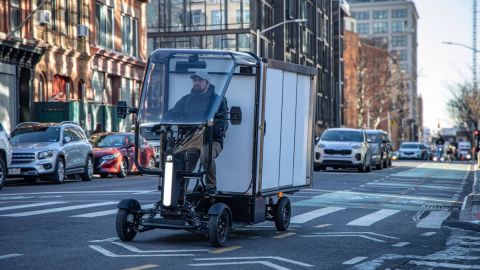
The eQuad Fastport does not come as an easy experiment. It is the concrete answer to a problem that grows every day, especially in large cities where traffic conditions each operation. Its compact size and electric focus make it a tool designed to move where other vehicles simply cannot.

A concept designed for the current city
The growth of electronic commerce has led to the last mile becoming the most complex section of the entire logistics chain. That’s where Honda sees a clear opportunity.
This four-wheeled vehicle is designed to move easily in narrow streets, pedestrian areas and areas where a traditional van wastes valuable time.
The bet is not alone. Honda partnered with Third Lane Mobility, a company linked to Bird and Bound, to promote the implementation of the model in multiple cities. The experience of these firms in urban mobility plays a key role so that the eQuad does not remain in theorybut rather that it reaches the streets with precise impact.

Technology at the service of efficiency
Beyond its design, The eQuad Fastport stands out for its technical approach. Incorporates an electric propulsion system with pedal assistancewhich allows maintaining energy efficiency without sacrificing performance on demanding urban routes.
One of its strong points is the use of interchangeable batteries Honda Mobile Energy Pack e. This detail, which may seem minor, eliminates downtime associated with loading and allows the vehicle to be kept in continuous operation. Added to this is regenerative braking, which helps optimize energy consumption on routes with constant stops.
The set is completed with a compact design that facilitates quick maneuvers and access to areas where other vehicles have no room for action. In dense cities, that agility can make the difference between on-time delivery or a delay.

Smart fleet management
Honda did not stop at the vehicle alone. It also developed a comprehensive management system under the Mercurial-as-a-Service concept.designed for companies to control every aspect of their operation.
This system allows you to monitor fleets in precise time, adjust routes according to traffic and improve delivery times. In addition, it integrates remote updates, data analysis and connection with external platforms through API, which opens the door to much more flexible and scalable logistics.
For delivery companies, this means something concrete: lower operating costs and greater ability to adapt in a constantly changing market.
Continue reading:
Different: new electric SUV that does not seek to please everyone
China again: this hybrid sedan surprises with 1,260 km
BYD’s new electric taxi aims directly at Toyota


