
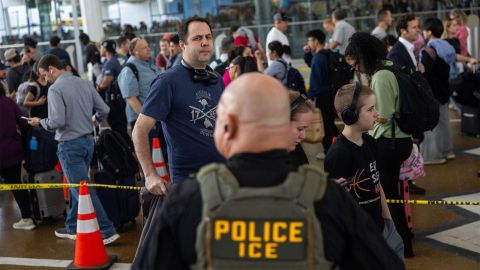
Travelers at U.S. airports across the country recently experienced wait times of up to four hours, the longest in the Transportation Security Administration’s (TSA) 24-year history.
This was due to a partial government shutdown, which is now seven weeks old and the longest in US history.
The shutdown left TSA agents without pay for more than a month, causing thousands of them to miss work and more than 500 to quit.
While a presidential directive signed on March 30 seeking to significantly reduce wait times at airports restored pay for TSA workers, headlines and photos of long lines are the latest example in a series of obstacles facing the US travel and tourism sector.
This global transportation disruption could not have come at a worse time. The country is co-hosting the FIFA World Cup this summer, celebrating the centenary of Route 66, and commemorating its 250th anniversary of independence in 2026.
In a normal year, any of these milestones would be cause for celebration for the American tourism industry. Instead, the country faces a combination of poor image and unpopular policies that caused a 5.4% drop in its tourism in 2025, while the rest of the world saw a 4% growth in its international tourism, according to the World Tourism Barometer.
Visits by Canadians to the US decreased 22% in 2025 compared to 2024, the largest decline on record in any market.
ICE presence at airports
The continued presence of ICE agents at US airports also does nothing to improve the country’s image. Initially deployed to alleviate the TSA’s internal shortage, the US Secretary of Transportation declared that the agents will remain there “as long as necessary.”
Because ICE agents are not trained in airline security, some travelers are wary.
Sandra Awodele, born in Nigeria but a naturalized US citizen, said she was more alert with the new presence of ICE.
“Because ICE detains people who may or may not be citizens and apologizes later if they make a mistake, I have had to change my travel plans several times if the airport I arrive at has a heavy ICE presence,” he said.
“I’ve never had any problems, but now I’m afraid I will because of procedures and protocols I’m not familiar with. That scares me.”

The deployment of ICE agents at airports is just one of many constantly changing policies that confuse some international travelers.
A Trump administration proposal, introduced in December 2025, would require visitors from 42 visa-exempt countries (including the United Kingdom and most of Europe) to submit their social media history from the past five years to enter the country.
The proposal has not yet been implemented, but some travelers believe it is already in effect.
“The law hasn’t changed, but the environment has,” says Evan Oshan, civil rights attorney and managing partner of Oshan & Pals.
“When federal officials feel they have the power to exceed their duties, that constitutes a change in policy, even if it does not require an act of Congress.”
Long lines and anti-American sentiment
The combination of anti-American sentiment sparked by some of President Trump’s policies, along with the long waits some travelers still experience at many U.S. airports, has led some to question whether now is the right time to visit the country.
Johan Konst, director of a public relations firm in Amsterdam, usually travels to the US three or four times a year to attend conferences and meetings. He comments that he still plans to go, but now he is more selective with the dates.
“The current situation seems to treat Europe more like an adversary than an ally, whether due to tariffs, NATO rhetoric or the customary tone towards European countries,” he declared.
“That change in dynamic is what makes you feel less welcome, even though no American has ever made me feel that way personally.”

Konst said that feeling alone has been enough to change his habits.
“Now I pay attention to which trips are really necessary and which are not,” he said. “I am more selective than before, since I can also work remotely.”
He added that flights from Amsterdam to the US have been noticeably emptier in recent months. “I’ve had a whole row to myself several times in a row.”
Germany-based Anita Shreider, marketing director of bike rental platform Bikes Reserving, is also planning a trip to the US this year, combining business meetings with sightseeing in Chicago and a trip to admire the giant sequoias on the West Coast. However, he admits he understands why some travelers are choosing not to go.
“I have acquaintances who decided to cancel their summer trips to the United States because they do not agree with the country’s actions internationally,” he commented.
For those who canceled, “it wasn’t so much about specific political changes, but rather a customary concern. They just didn’t feel comfortable traveling to the US at this time.”
Do things on time
Some American tour operators say that once international visitors arrive, they are surprised by what they find.
“People come expecting hardship, but instead of chaos, they find a system that, while far from perfect, is very manageable,” said Paul Whitten, founder and historian of Nashville Adventures.
“Process your documentation in advance and allow enough time to travel. The difference between a stressful trip and a great one is usually in the preparation, not the policies themselves.”
Oshan agrees and recommends that international travelers carry documentation that proves the purpose of their trip and that they know their rights before boarding.
Although CBP (US Customs and Border Protection) has broad authority at the border, you retain your constitutional rights once on US soil,” he stated.
“Those rights are worth asserting, and when they are violated, legal action is worth taking.”

Erik Hansen, head of government relations at the U.S. Travel Association (the U.S. travel industry’s lobbying group), said the industry recognizes the need to bridge the gap between travelers’ fears and their exact experience.
However, he also noted that many airports have implemented expedited customs processes that have reduced queues for international passengers.
Whitten agrees: “Policies adapt, but they are often not indicators of massive cultural change, at least not radical changes that affect the daily experience of the average traveler,” he stated.
“Ultimately, the US remains one of the most accessible and welcoming destinations in the world.”
For now, the gap between official tranquility and traveler concern persists.
TSA officials have warned that it takes four to six months to train new agents, meaning the World Cup could begin before the workforce is fully recovered.
It is not seen as a solution to the government shutdown and the US-Israel war with Iran, which is fueling anxiety and driving up flight prices, shows no signs of abating.
For Konst, the appeal of the US remains strong, even as the signals around it become more complex.
“I still love the US and its people,” he said. “It’s just the policies that make me rethink flying there as frequently as before.”
*This note was published on BBC Plug. Click here if you want to see the accepted version (in English).

click hereto look more stories from BBC Files World.
Subscribe hereto our new e-newsletter to receive a selection of our best content of the week every Friday.
You can also follow us on YouTube, instagram, TikTok, x, Facebookand in our whatsapp channel.
And remember that you can receive notifications in our app. Download the latest version and activate them.
- Why there is chaos at US airports (and Trump’s controversial decision to send ICE immigration agents)
- “Please come, we need you, we miss you”: what the drop in visitors to Las Vegas says about US tourism in the Trump generation


