
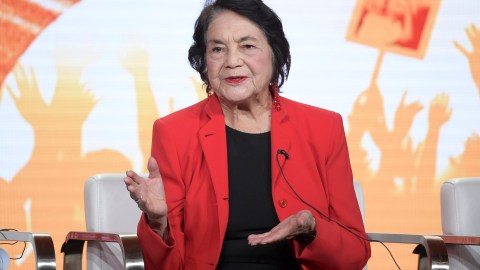
The renowned activist Dolores Huerta This Friday he turns 96 years of life, most of them dedicated to fight for the civil and labor rights of Hispanics and farm workers in the US, a commitment she put above herself as a victim of sexual abuse.
Considered one of the women most influential Latinas in the country, The union activist was born in the small mining town of Dawson, in the state of New Mexico, on April 10, 1930, although she soon moved to the agricultural town of Stockton, in California, a state where she has carried out her battles, the last since her Dolores Huerta Foundation.
His name and his sharp criticisms have been heard with greater force in the midst of the immigration raids of the White House, but last month the public gaze fell on her when the allegations of sexual abuse against his fellow fighter César Chávez (1927-1993), with whom he founded the United Agricultural Workers union (UFW) and of whom he was also a victim.
An investigation by The Recent York Times revealed the testimonies of several women who accused the deceased leader of abusing them when they were minors, which caused the collapse of one of the greatest Latin figures in the United States and the cancellation of dozens of celebrations in honor of Chávez.
After the investigation, Dolores Clara Fernández, as she was baptized, also brought to light the sexual abuse he suffered from Cháveza secret he kept for the last 60 years because he believed that exposing the truth would “harm” the peasant movement for which he had fought his entire life, as he declared.
The abuses resulted in two pregnancies that Huerta kept hidden and then gave up the girls she had for adoption, although she has maintained very close ties with them all her life.
Under the weight of patriarchy
After breaking his silence, has been embraced by a large number of leaders who have shown their support. Likewise, there was no shortage of criticism on social media for not having spoken out sooner, especially at the height of the ‘Me Too’ movement, which she advocated at the time.
In that sense, the writer Yurina Melara, who knows Huerta’s career, tells EFE that he does not You can judge what was happening in 1960 with the standards of 2026. “What she did as a woman (maintain silence) was what she considered was right at that time. Now she is reevaluating her story and dares to show her face.”
In one of his first interviews after the revelations, Huerta explained his decision. “I really believe that yes, that (reporting the rape) would have meant the end of movement; practically from its very beginnings.”
Stephanie Lemus, professor of Ethnic Studies at Orange Flit College, points out the crossroads that the union leader experienced: on the one hand, the movement that externally sought social justice and workers’ rights, but internally had many problems, such as patriarchy, “with men being revered and obeyed.”
“Within an intersectional framework, we have to see the power dynamics of the sixties, where Latina and shade generation women were relegated,” adds the professor.
A thought that Huerta herself grew up with. In an interview for his 90th birthday, he told EFE that in His youth believed that in situations of discrimination nothing could be done to change things. “That’s life.”
But at the age of 25, already linked to agricultural workers in California, Huerta met a farmer who did not want to be granted medical disability and she decided to intercede so that his rights were granted. “I realized that everyone can do somethingand that it is a matter of organizing ourselves,” he assured.
After Chávez’s death, Huerta gained greater recognition and He became an icon in the Hispanic communitybeing recognized by the motto that she herself created: “Yes we can!”
Both Lemus and Melara agree that their story has been rewritten and will now emerge stronger.
“Generation my pain personl. Generation my problem inside of most. And, you know, I think it was worth it, because it was a price that I had to pay… a sacrifice that I had to assume,” Huerta said in the first interview he gave after the first allegations became known.
Keep reading:
- César Chávez under scrutiny: cities remove statues and tributes
- Public voices condemn abuses attributed to César Chávez


