
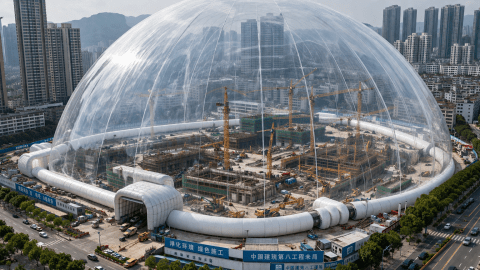
Living near a construction site can become a daily nightmare: dust that gets into the house, constant noise from early in the morning, and air that feels increasingly heavy. In United States cities such as New York or Los Angeles, this problem is part of the urban landscape and one of the main complaints of residents.
But in China they are testing a solution that seems straight out of the future—and that is already attracting attention around the world: covering entire construction sites with huge inflatable “bubbles” that enclose pollution before it escapes to the outside.
The result, according to pilot project reports, is impressive: up to 90% less environmental impact during construction.
This is how giant bubbles work in construction sites
These structures are literally inflatable domes that completely cover the construction site. They can reach up to 50 meters in height and extend over more than 10,000 square meters, the equivalent of covering an entire urban block.
Within these “bubbles” something key happens: the environment is controlled. Dust is not dispersed, noise is contained and polluting particles are trapped inside. Additionally, many of these systems include real-time monitoring of air quality.
The concept is straight forward, but powerful: if you cannot prevent the work from generating pollution, prevent it from going outside.

on construction works, especially in urban areas such as Jinan.
The problem it seeks to solve (and that the US views with interest)
Pollution generated by construction is not just a nuisance. It is a public health problem.
According to the Environmental Security Company (EPA), fine particles in the air—especially those known as PM2.5—are directly linked to respiratory illnesses, heart problems, and worsening asthma.
In dense cities, where construction sites coexist with residential buildings, the impact is constant and cumulative. Added to that is noise: drilling, heavy machinery and vibrations that can last for months or even years.
Therefore, a technology that drastically reduces both factors not only improves the environment: it reduces urban conflict.
You can see: UN protects 40 new species in the face of global biodiversity crisis, alert for risk of extinction
Could it be implemented in the United States?
That’s where innovation meets reality. China has the advantage of being able to apply large-scale solutions quickly, with more centralized regulations. In the United States, the scenario is more fragmented:
- Stricter local regulations.
- Higher installation costs.
- Slower approval processes.
However, interest is growing, especially in sustainable construction projects and in cities with high environmental pressure. Because, beyond the initial cost, the benefit is clear: fewer complaints, less impact and a more “invisible” work for the community.
The fundamental change: build without disturbing
What these bubbles propose is not only a technical improvement, but a change in logic. For decades, cities accepted that building meant inconvenience. Dust, noise and chaos were part of the process. Today, that begins to change.
In a context where it is increasingly difficult to approve new developments due to neighborhood resistance, technologies like this can become a key tool to unblock projects.
The future of cities?
Construction “bubbles” are not yet the norm, but they mark a clear direction: carry out works without passing the environmental cost on to those who live around them.
And in a world where cities continue to grow, the question is no longer whether solutions like this will be adopted, but when and where the next test will be.
Continue reading:
They are building a floating airport: it will be the largest in the world and will receive 80 million passengers
A building that combats loneliness won the most important architecture award
They build the deepest Metro in Latin America: stations 65 meters underground


