
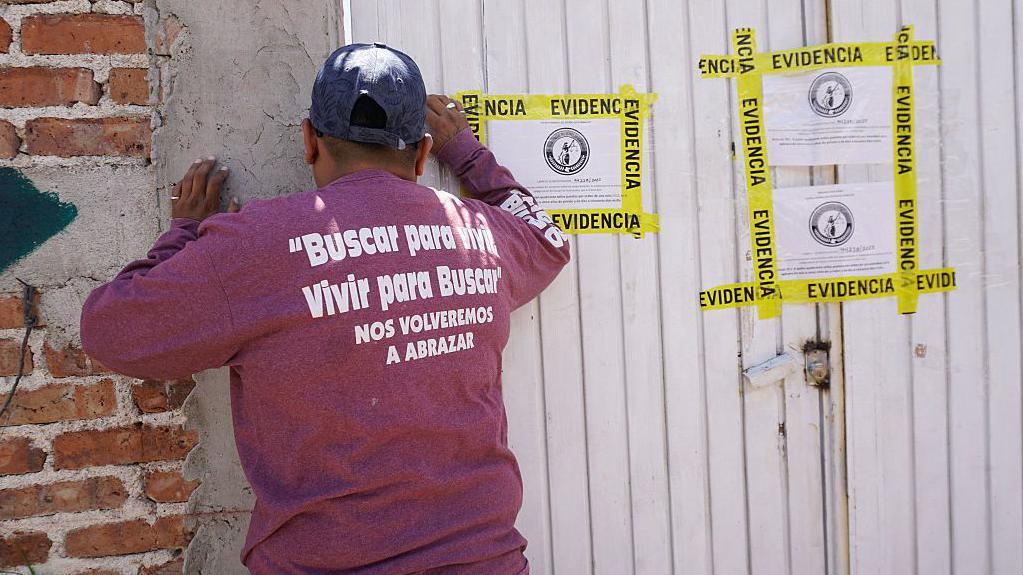
José González* knows that they are watching him.
In his hometown, a rural ranch of 500 inhabitants in the Michoacan Bajío from which he emigrated almost three decades ago, he is practically a stranger and also – he says – an “easy prey.”
For this reason, although four months have passed since he arrived deported from the United States, he prefers to “acclimatize” and make himself known before starting the business with which, at 44 years old, he hopes to be able to rebuild his life in Mexico.
“In the community there are what are called hawks, vigilantes who work for evil,” explains Óscar Ariel Mojica, a researcher at the Center for Rural Studies of the College of Michoacán who does field work in the area and is familiar with the case.
By “maña” he refers to the criminal elements at the service of the powerful Jalisco Nueva Generación Cartel (CJNG), whose leader, Nemesio Oseguera Cervantes, alias “El Mencho”, died in a Mexican army operation at the end of February.
The organization that controls the most money, weapons, men and drugs in the country also rules in this region of northern Michoacán. Although, as it borders Guanajuato, it is “outpost” territory for rival groups, the professor clarifies.
“From the moment you arrive at the (bus) station, they already know that you are here,” explains Mojica, who was already warned not to ask “too many questions” and who gave up recording the interviews or carrying notebooks with notes so as not to put his sources at risk.
And the thing is that there the drug trafficker dominates everything: he knows the entrances and exits of the area, decides who can plant the fields, controls the price of the basic basket or sets the “floor fee” that must be paid to open a store in the town, González’s understanding had been woven with the experience accumulated in the US after working in a hardware store and as a manager in a restaurant.

It is the reality that locals face every day, who deal with curfews, roadblocks and occasional armed confrontations, while losing count of those who have been killed or disappeared.
“But when someone arrives after decades in the US, without family or social ties, they are more susceptible in these environments,” highlights researcher Mojica.
“At the end of the day, what these groups, which are partly dedicated to extortion, think is that it must bring an income. Returnees are an easy target.”

Extortion and ‘payment of flat’
About 100 kilometers from González’s ranch, in the bordering state of Guanajuato, Sergio Segovia* also put his plans on hold.
He decided to settle in his native Irapuato, where he left when he was barely two years old, after his fourth deportation; the most traumatic.
“As I grew up next to Tijuana, in Ensenada, until I left for Los Angeles at the age of 18, every time they deported me I returned there. I stayed with an uncle for a few days and then I crossed the border again” into the US, he tells BBC Mundo.
“But the last time I tried to cross to Texas from Ciudad Juárez (Chihuahua, Mexico), Immigration caught me and I spent 10 months in federal (prison),” he remembers.
After testing positive for tuberculosis – he says by mistake – he was kept in isolation. “On the third day I had a nervous breakdown and from then on everything was an ordeal. So when they released me on the other side, I no longer wanted to know anything about that country again,” he says bitterly.
Things have not been easy for him in his city of origin, the epicenter of the territorial dispute between the Santa Rosa de Lima Cartel (CSRL) and the powerful CJNG.
In August the authorities found a clandestine grave there with 32 bodies, just two months after a shooting during the patron saint festivities left 12 dead. Between January and July of last year, 1,500 homicides were recorded in the state.

Trying to navigate that reality and fed up with precariousness, Segovia decided to allocate his savings to a business that he saw as having a future: buying strawberries from local farmers to sell them in supply centers in the northern part of the country.
“A neighbor who believed in me was going to rent me a house.” select-up“I started making calls and tying everything up, but I started to see that the strawberries from Irapuato were not going there,” he says.
It became clear to him who was in charge when his sales contacts warned him: “From Zacatecas up, your merchandise cannot cross. Either they stop you and take it away from you, or you pay for it.”
Similar testimonies are shared by lemon, avocado or tequila producers, industries to which the tentacles of drug trafficking reach.
“Traditional cartels focused on drug trafficking diversified their income, in the face of internal wars and pressure from state authorities, incorporating extortion, kidnappings and fuel theft – known as ‘huachicoleo’ in Mexico – to finance their operations and the political withhold watch over,” explains security expert David Saucedo.
“Wars between cartels are costly and criminal organizations look for secondary activities to be able to pay for men, weapons, positions and bribes.”
“They were kidnapping me”
For other deportees, their run-ins with organized crime had more serious consequences than extortion.
For Israel Concha, the memory of his experience, even though he lived it more than a decade ago, still makes him cry.
He was deported in 2014 from Texas, where he had been residing undocumented for 30 years. There he grew up, studied business administration, got married and set up his own private transportation and chauffeur company.
Intercepted by the police on the highway for speeding while going to pick up a client, he was arrested for not carrying an identification that would prove his good status in the country and taken to a detention center. He appealed the case, and after two years of fighting in court, on July 3 he was left on an international bridge that connects Texas with Mexico.
Already on the Mexican side, accompanied by eight other men who had suffered the same fate, he began to walk towards the bus station. “On the second block, the police stopped us; or what we thought was the police,” he says.
They separated him from the rest, hooded him and put him in a truck. “When they discovered my face, I realized that the place they had taken me to was not the Technology headquarters. It was a safe house and they were kidnapping me,” he remembers.
Due to the carelessness of the person who brought them the food, he managed to escape from the room where he was kept with other migrants by jumping out of the window. And a family who found him running “all bleeding, like a zombie” down the road picked him up and helped him get to Mexico City.

There he started his life from scratch, working in a name heart in Dinky LAa few blocks around the Monument of the Revolution where deportees from the US look for job opportunities, start businesses and generate networks.
In that area he also founded Unusual Comienzos, an organization that assists and guides those who voluntarily or forcibly return to Mexico, connecting them with each other, offering them food vouchers, emotional and work support, acting as a bridge with shelters and other entities in the field.
They also created Dream in Mexico, a box containing bilingual guides and information about local support.
Now, in addition, as part of a mentoring program, they are teaching a class on how to protect themselves in Mexico and navigate realities that for many of those who return are now more violent than when they emigrated.
“Today we have 28 people from our support network missing, 10 of them last year and the last one, in May,” he says with regret. This is a man who had recently returned and who disappeared without a trace after leaving work at a resort in the central state of Querétaro.
With its offices in Mexico City and Las Vegas (Nevada, USA), Concha assures that since Unusual Comienzos in 11 years they have assisted more than 100,000 people and that today they are following up on 5,800 cases.
“We see that the understanding México Abraza te really does not work and that we need something better structured, that supports in the short term, but above all in the medium and long term,” he says about the federal government’s returnee support strategy.
Does he hug you?
Launched in January 2025, with the arrival of Trump to the White House, México te Abraza was designed to include consular assistance in the US, care centers in border states and help for reintegration, through days of social services, employment offers and incorporation into welfare programs.
“To our countrymen and women, tell them that, first, that they are not alone; and, second, that we must also remain calm, that we must also see how the process develops during these weeks,” said President Claudia Sheinbaum when presenting “Mexico embraces you.”
Knowing the exact number of expelled people to Mexico since Trump returned to the presidency is not easy.
According to the Department of Homeland Security (DHS), during the first year of government, more than 675,000 deportations were registered, a figure similar to that of Joe Biden’s last two years as president.

According to data presented during a Mañanera by President Sheinbaum in December, between January 20 and December 17, 2025, the US deported 145,537 Mexicans.
The head of the Ministry of the Interior, Rosa Icela Rodríguez, explained that more than 130,000 received consular attention prior to repatriation, 116,000 were returned by land and 29,000 on flights.
“Mexico has created a migration policy in reaction to the US policy and it is, at first, humanitarian aid,” says Israel López Ibarra, academic head of the Observatory of Migration Policy and Human Rights at the Colegio de la Frontera, Nogales section.
“The deportees are received in shelters (close to the northern border) and Mexican policy is to move them to the states where they originate,” the researcher continues.
“And that is where the serious situation begins, because we have states under the withhold watch over of organized crime, territories that were already causing internal displacement due to threats, extortion, recruitment, disappearances,” he explains.
For the researcher, this adds to the classic challenges of the returnee, from the difficulty in obtaining documents and employment, the lack of family support networks or the identity crisis.
“Someone who returns and does not even know how the gangs operate, who has absolute ignorance of how the system operates, is in the same or perhaps greater vulnerability than the rest” of the inhabitants, explains López Ibarra.

“And then there is the fact of the skills they may have. Logically, someone who masters both languages can be a convenient element for members of organized crime. These are skills that they can take advantage of,” he adds.
Sergio lives it (and suffers it) firsthand.
“I spent so many years in a country where they told me: ‘You can’t do this because you’re an immigrant, because you don’t have papers.’ Now I want to start a business but I can’t because of how bad things are, and I feel very frustrated.”
*Fictional names to protect your identity d.

click hereto check more stories from BBC News Mundo.
Subscribe hereto our new e-newsletter to receive a selection of our best content of the week every Friday.
You can also follow us on YouTube, instagram, TikTok, x, Facebookand in our whatsapp channel.
And remember that you can receive notifications in our app. Download the latest version and activate them.
- How the Jalisco New Generation Cartel became the most powerful in Mexico and what can happen now without “El Mencho”
- Who are now the most wanted drug traffickers by the US after the fall of “El Mencho”
- The end of “hugs, not bullets”: how Trump’s pressure influences Sheinbaum’s reinforcement of the fight against drug trafficking in Mexico
- “Killing ‘El Mencho’ can have effects that go against President Sheinbaum’s objective of pacifying Mexico”


