
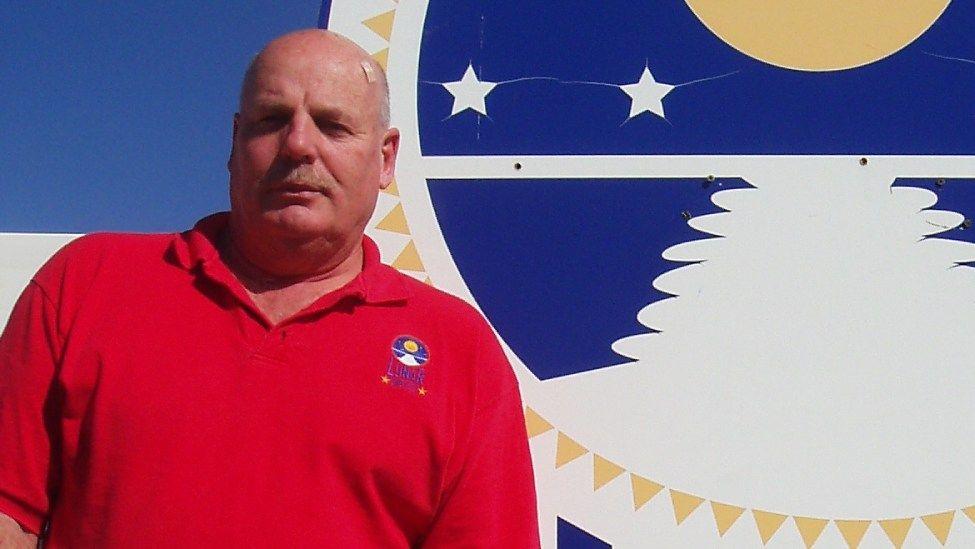
Imagine that you just got divorced, you have no money and you think that you could earn something if you had a property to profit from. So, you look at the window and say: “Eureka! I’ll sell the Moon.”
Sounds a bit incredible, right?
Well, that’s exactly what Dennis Hope, an American, says he thought in 1980 who, after that moment of inspiration, became a millionaire selling plots of the Moon.
How did he do it? Taking advantage of the “legal grays” of international treaties.
And, without a doubt, with great expertise.
To the library!
After tremendous thought, he decided to look for information about it.
He said in an interview granted years ago to Vice who went to the library and looked up the 1967 Outer Space Treaty.
What does this United Nations document say? Well, outer space is an international common good, “province of all humanity”, and, therefore, any nation is prohibited from claiming its territorial sovereignty.
Specifically, article number 2 says that “the Moon and other celestial bodies are not subject to national appropriation by claim of sovereignty, through use or occupation, or by any other means.”
Hope interpreted it like this: if it belongs to everyone, it belongs to no one. And, even if a country could not claim it, why not an individual?
“Abilities land without an owner,” he said in an interview with the BBC.

So he appropriated it just as “our ancestors did when they arrived in the New World from Europe.”
The big question is how the Moon is “acquired.”
Again, Hope was gripped by a sort of most piquant emptiness or, rather, a lack of response.
He sent the United Nations a claim of ownership over the Moon, the other eight planets and their moons.
In it he explained that his idea was to subdivide and sell the property to whoever wanted it. And he had the detail to tell them that, if they had any major problem, to let them know.
Nobody ever answered him.
Give him the Moon
Since then, he has sold plots of the Moon by the hectare. And not only the Earth’s satellite, it has also sold land on Mars, Venus and Mercury.
Among the buyers are Hollywood stars, deceased former US presidents such as Ronald Reagan and Jimmy Carter, and large hotel chains such as Hilton and Marriot.
George W. Bush is also said to own a lunar lot.
Hope told the BBC in 2007 that he sold an average of 1,500 properties a day, and said that the way to choose the lots was to close your eyes and point with your index finger at a point on the map of the moon.
“It’s not very scientific, but it’s fun,” he said.
It seems to be as fun as it is expensive, since it is said that he has earned about US$12 million in this job, which, he claims, is the only one he has had since 1995.

“The smallest property you can buy from us is one acre. The largest property we sell is what we call a ‘continental size’ property of 5,332,740 acres, which costs $13,331,000,” he told Vice.
“We haven’t sold any of those yet, but we have sold many 1,800 and 2,000 acre parcels (between 728 and 810 hectares). We have 1,800 large corporations on the planet that have bought properties from us for a specific purpose, including the Hilton and Marriott hotel chains,” he said.
An intergalactic Constitution
If you have come this far, you are surely wondering how this is sustained or how it is guaranteed that the owners of those lands are not, suddenly, expropriated.
Obviously Hope and all the owners thought the same. And, of course, they found a solution.
As Hope himself explained, they decided to establish a democratic republic called the “Galactic Government.”
“It took us three years to write the Constitution and we published it online in March 2004, when we had 3.7 million owners and 173,562 votes for its ratification. So now we are a sovereign nation with a fully ratified Constitution,” he said.
“We currently maintain diplomatic relations with 30 governments on the planet and we are trying to get as many as possible to recognize us, because our intention is to join the International Monetary Fund.”
The BBC has not been able to independently verify this claim made by Hope.
The Chilean who tried to possess the Moon
Long before man even thought about the trusty possibility of setting foot on the Moon, the issue of ownership of celestial bodies was already being discussed.
In 1936, Dean Lindsay claimed ownership not only of the Moon, but of all extraterrestrial objects. At that time he also received purchase offers.
And Jenaro Gajardo Vera did the same.
Lawyer and born in Chile in 1919, he claimed that on September 25, 1954 he obtained this possession as recorded in the official documentation signed before a notary, where he appears as “owner of the Moon.”
The proof of this asset is a paper signed by a notary office in the agricultural city of Talca, in the center of Chile, about 255 km from the country’s capital, and of which today there is a record in the Judicial Archive of Santiago.
It says the following:
“Jenaro Gajardo Vera, lawyer, has been the owner, since before 1857, joining his possession with that of his predecessors, of the star, the only satellite of the Earth, with a diameter of 3,475.00 kilometers, called LUNA, and whose boundaries because it is spheroidal are: North, South, East and West, sidereal space. He establishes his address at Calle 1 Oriente 1270 and his marital status is single. Jenaro Gajardo Vera. Card 1,487.Forty five-Okay. Talca, September 25, 1954.

Although Jenaro’s case is more of a joke.
According to what he himself told the American newspaper in 1969 The Night Justwanted to get the Moon to join a local association: the Talca Social Club.
According to their statements, the club’s rules established that the members of the society had to prove that they owned some property.
Lacking means, and eager to be part of this society that brought together the wealthy people of the town, the lawyer decided to buy the Moon.
It cost him US$1, according to what he told the American newspaper.
An ethereal business
Hope maintains her intergalactic real estate business but, despite this, experts say that the Moon belongs to no one. At least not legitimately.
The 1967 international treaty further establishes that the exploration and use of this space must benefit and be of interest to all countries.
Can someone then, in a private capacity, declare themselves the owner of the Moon?
“No,” Claire Finkelstein, a law professor at the University of Pennsylvania and an expert in international law, told the news portal WHY in 2019, associated with NPR, the public radio station in the United States.
The answer is not so clear, however, when it comes to commercial activities in space, such as resource exploitation.
“International law is ambiguous about private companies setting up mining operations in space,” Ian Crawford, professor of planetary science at Birbeck College, London, told the BBC for an article published in 2016.
“It is necessary to review the Outer Space Treaty and update it,” he said.
But until then, and according to space law, the Moon belongs to no one and belongs to everyone at the same time.

click hereto find more stories from BBC Information Mundo.
Subscribe hereto our new publication to receive every Friday a selection of our best content of the week.
You can also follow us on YouTube, instagram, TikTok, x, Facebook and in our whatsapp channel.
And remember that you can receive notifications in our app. Download the latest version and activate them.
- Why will the Artemis II astronauts not set foot on the Moon as in the Apollo missions despite the enormous technological advances of the last 50 years?
- Atenea: what the microsatellite developed by Argentina that participates in the historic Artemis II mission to the Moon is like and what it will do
- What was the historic launch of Artemis II towards the orbit of the Moon like?


