
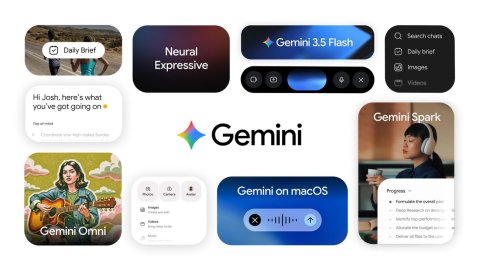
Google did not come to play at its I/O 2026. The technology giant presented one of the most ambitious launches in its recent history, and as we have already been telling you in La Opinión, the company is building an artificial intelligence ecosystem that no longer looks anything like what we knew just a year ago.
In the midst of a cascade of advertisements, there was one that stole all the attention from the first moment it appeared on stage: Gemini Omnithe new model that promises to completely redefine how users interact with Google AI.
And it is not an exaggeration. This is something genuinely different.
What makes Gemini Omni different from everything before it
To understand why Gemini Omni matters so much, you have to understand the problem that existed before. The generative video modelslike Google’s own Veo, worked with “text in, video out” logic. You wrote something to it, and the model tried to create it. Useful, yes. But limited compared to what’s coming now.
Gemini Omni is what Google calls a “natively multimodal” modeland that means you can receive text, images, audio and video clips simultaneously to generate much richer and more precise content. We are not talking about combining one or another type of input, but rather mix all at the same time within a single instruction to obtain a result that no previous model could produce with that cohesion. Sundar Pichai himself summed it up during the event: “Gemini Omni is our new model capable of generating samples in any output mode from any input data.”
Plus, the model comes bundled with all of Gemini’s knowledge and reasoning, meaning it doesn’t just “generate pretty pictures.” Understand the context, reason about it and then create the content. That’s a huge leap from generative video tools that simply interpret keywords.
And the icing on the cake is that Google confirmed that Gemini Omni will replace Veo within the Gemini app. Veo’s reputation as the company’s stellar video model has come to an end, and its successor is considerably more powerful.
Create, edit and clone yourself: the three superpowers of Gemini Omni
Once you dive into what Gemini Omni can do, the model reveals itself to be a kind of audiovisual production studio tucked inside an app. Its capabilities are grouped into three large areas that, together, change the creative experience radically.
The first thing is the multimodal video generation. You can combine written instructions, reference photos, music, and previous clips to build entire scenes from scratch. The result is much more realistic than what previous generations produced, with special precision in elements that have historically been the Achilles heel of generative AI, such as posters, captions and people writing text on screen.
The second is the advanced editing of existing movieswhich is perhaps the most disruptive use case. Gemini Omni doesn’t just create new content; It can also take a recording you made with your cell phone and modify it in depth. From changing the camera angle to generating new characters, altering the sequence of scenes or adding details that completely transform the visual narrative. We talk about professional video editing with pure languagewithout having to touch a traditional editing tool.
The third thing is the function Avatarwhich is where the model gets truly futuristic. With just a text prompt, Gemini Omni can generate videos using the user’s voice, appearance and style without the user having to record themselves in front of any camera. This feature is already launching this week for YouTube Shorts users, turning anyone with an account into a potential video content creator – no camera, no plot, no handbook editing.
Google Gemini Omni availability
Initial access is not universal, but it is not reserved for an unattainable elite either. Google has already activated Gemini Omni Flash —the first model in the Omni family—in the Gemini app, on Google Waft and on YouTube Shorts. Full access in the Gemini app is available for users with plans Google AI Plus, Educated and Ultraall over 18 years old.
However, Google is clear that it needs to bring this to as many people as possible, so some Omni features, especially those related to the creation of Shorts, They will arrive for free on YouTube in the coming months. Developers and companies will also have access through APIs that will be opened in the coming weeks, which opens a huge field of possibilities to integrate this technology into external products.
What must be kept in mind is that Gemini Omni is just getting started. For now the focus is on video generation and editing, but Google announced that later the model will also be able to create images and audio with the same multimodal logic. In other words, what we saw at Google I/O 2026 is just the initial version of something that will grow in capabilities steadily.
The big question is no longer whether generative AI is going to transform the way people create content. That’s already happening. The question now is how quickly the Gemini Omni will get into the hands of everyday users.and how long it will take for creating a quality video without technical experience to become as fashionable as posting a photo on Instagram. Based on what Google showed this week, that time isn’t that far away.
Keep reading:
• Google announces I/O 2026 and puts AI at the center of the first major event of the year
• Gemini is renewed at Google I/O 2026: faster, smarter and more integrated
• Google I/O 2026: now you can create an Android app with a single instruction thanks to AI


