
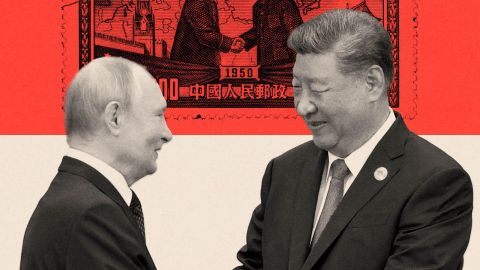
While strolling through Tiananmen Square in Beijing last September, Chinese President Xi Jinping and his Russian counterpart, Vladimir Putin, appeared to be reflecting on the possibility that organ transplants could dramatically prolong human life.
“Human organs can be transplanted continuously. The longer you live, the younger you become, and even immortality can be achieved,” Putin’s interpreter was heard saying.
“Some predict that in this century humans could live up to 150 years,” Xi’s interpreter responded.

It was a fitting conversation for two strong leaders, who have described themselves as best friends and who, after a combined 39 years in power, show no signs of stepping down.
This was a rare glimpse into what is a largely misunderstood partnership.
That fragment of unscripted conversation is one of the few windows into a highly secretive relationship.
Putin returns to Beijing this week, coinciding with the 25th anniversary of the Treaty of Good Neighborhood and Friendly Cooperation between Russia and China.
When US President Donald Trump arrived in Beijing last week, he was greeted with a spread of gold-plated banquets and a visit to an ancient temple.
Putin’s trip is much more discreet, with little information disclosed beforehand.

The Kremlin spokesperson stated that they hope to obtain first-hand information about the meeting between Trump and Xi.
Xi reportedly mentioned his friend Putin to Trump last week, as the two leaders walked through Zhongnanhai — where foreign visitors are typically barred — and joked about how Putin had visited the political shrine before.
Although some in Washington may have hoped that Trump would succeed in distancing Beijing from Moscow, such expectations appear to be little more than wishful thinking.
China and Russia have in recent years described their ties as a “boundless friendship.” What is this based on? Will their relationship last?
China marks the times
The relationship is highly unequal and any agreement between the two countries will probably be established in the Chinese way, says Alexander Gabuev, director of the Carnegie Russia Eurasia center.
“Russia is completely in China’s pocket, and China can dictate the conditions,” he stresses.
This dynamic persists in many areas, especially in the economy.
China is Russia’s largest trading partner, while Russia accounts for just 4% of China’s international trade.
China exports more than any other country to Russia, and its economy is significantly larger than Russia’s.
Years of Western sanctions have gradually pushed Moscow into greater trade dependence on Beijing.
The technology giant Huawei, sanctioned by the US and excluded from 5G networks or restricted in almost twenty countries, has taken advantage of the absence of Western companies to become a key pillar of Russia’s telecommunications industry.
With increasingly fractured ties with the West, China has become the vital reference point for knowledge, whether technological, scientific or industrial.

Since the full-scale invasion of Ukraine in 2022, Moscow has become more reliant on Chinese components for its war machine.
A recent report from Bloomberg found that Russia imported more than 90% of its sanctioned technology from China, an increase of 10% from the previous year.
Russia is well aware of the risks of this imbalance.
In a recent essay titled “We Bow to No One,” Dimitri Trenin, president of the Russian Council of International Affairs, made it clear that Russia does not want to become a vassal state.
“[Es] “It is absolutely essential for us to maintain a relationship of equality and remember that Russia is a great power that cannot be a subordinate partner,” he said when speaking about China.
Moscow has few viable alternatives to Beijing, a buyer that offers a scale of demand and a market essential for its survival.
If China were to reduce its trade with Russia, given deteriorating relations with the West, it would significantly complicate Moscow’s foreign policy objectives.
However, Russia’s great advantage—and its defense against potential pressure from Beijing—is its ability to stand its ground.

According to Marcin Kaczmarski, professor of security studies at the University of Glasgow, China is aware of this asymmetry and avoids generating negative reactions within Russia or among its elites.
“In my opinion, Chinese policy towards Russia boils down to moderation,” he adds. “China is not putting pressure on Russia,” he maintains.
This is partly because it would be an unwise strategy: Russia may be the junior partner, but it is also a proud partner.
Gabuev indicates that even if China tried to impose conditions on Russia, “it is not exactly the type of country that would accept them immediately.”
The Carnegie expert cites the example of Xi’s trip to Moscow in 2023, when the Chinese leader allegedly urged Putin not to use nuclear weapons in Ukraine.
A few days later, Russia announced that it would deploy nuclear weapons in Belarus, a move that some interpreted as a sign of resistance to external pressures and a reminder to the world of its independence.
Russia’s war of attrition in Ukraine may be a burden in many ways, but also an asset for Beijing as it evaluates a possible invasion of Taiwan.
“Russia contributes a lot in terms of military technologies, such as specialized equipment that it can still sell, and it also serves to test Chinese equipment or components,” explains Gabuev.
Russia also possesses vast energy resources strategically important to China.
At a press conference in May, Putin stated that both countries are very close to taking “a very significant step in oil and gas cooperation.”

The Russian president may have meant to refer to the Siberian Power 2 gas pipeline, for which Gazprom and China National Petroleum Corporation reportedly signed a preliminary agreement after years of stalled negotiations.
The pipeline will be a significant game changer if built, transporting 50 billion cubic meters of Russian gas to China via Mongolia.
And for China, as the crisis in the Strait of Hormuz continues, its commitment to Russian energy appears to be paying off.
It is not just about prices, but about guaranteeing internal energy security in an increasingly unstable world.
Partners, not allies
Every time China and Russia appear to diverge, a simple truth at the heart of their relationship becomes clear: neither should follow the other, because there is no formal alliance.
Bobo Lo, former deputy chief of mission at the Australian embassy in Moscow, points out that this strategic flexibility – and not the rigidity of a military alliance – gives strength to the relationship.
“It is not an alliance, but a flexible strategic partnership,” he explains; one that has endured despite repeated predictions of collapse.
Western analysts have tended to describe the relationship in two ways: as an “axis of authoritarianism” united largely by its desire to defeat the West, or as a fragile brotherhood constantly on the ledge of collapse.
Neither fully reflects how this has become a relationship that has become essential and increasingly difficult to replace between two neighboring countries that, despite their asymmetries and differences, share vital interests.
Bobo Lo maintains that even if they improve their ties with the West, both countries have enough reasons to get along.

Above all is its long border, 4,300 kilometers long, which in the past was a source of insecurity.
There are also its complementary economies: Russia as an exporter of oil, gas and other raw materials, and the Chinese industrial economy that provides a vast market for them.
Furthermore, their shared opposition to a US-led world order cannot be ignored.
Unlike Western countries, which impose sanctions based on values on which they differ such as human rights, Russia and China do not judge each other’s actions.
Recurring accusations of abuses in Xinjiang – denied by China – or the death of Russian opposition leader Alexei Navalny have increased caution in some Western nations when engaging with these countries, but Moscow and Beijing ignore these issues.
“They do not criticize each other about Xinjiang, the poisoning of the Russian Navalny and so on,” says Gabuev. “And they agree on many local government issues at the UN (…) That creates an organic and symbiotic relationship.”

There is also a long tradition of improving relations between both countries, he adds.
“This tendency towards a more pragmatic relationship (…) goes back to Andropov, Chernenko, Gorbachev, Yeltsin,” he points out. “And I think the Chinese have also been the same way.”
As to whether the romance will endure, a Chinese analyst, who requested anonymity, acknowledged that the public presentation of the China-Russia relationship as an inseparable duo by both countries is partly performative, with the aim of projecting unity and stability.
In reality, it is a useful political tool for smoothing out occasional differences of interest.
Although both governments oppose what they consider a “Western hegemony,” their approaches may differ.
Russia, the analyst suggests, wants to build an order that completely bypasses the US, but China remains more cautious and pragmatic.
Beijing is often seen as avoiding hasty decisions and prioritizing patience and gradual progress to ensure long-term results.
The analyst points to China’s reaction to US actions in Iran; He says Beijing was restrained in its response and did not cancel its preparations for Trump’s visit.
“This clearly shows Beijing’s willingness not to provoke or close doors,” he adds.
China, he says, still wants to keep channels open with Washington and avoid unnecessary provocations, a markedly different approach from Russia.
The human side
The partnership is often analyzed through a geopolitical and security lens, but another key element is the depth of the ties between the people of both societies.
From the highest levels, Putin and Xi have tried to project an unparalleled friendship between them.
This is Putin’s 25th trip to China, and Russian officials are likely to interact more with their Chinese counterparts than with those from other countries.
Despite the camaraderie that exists at the highest political levels, Charles Parton – former British diplomat in China – is skeptical about the pure cultural affinity between ordinary Chinese and Russian citizens.
“Do the Chinese want to study in Moscow, stable? go there and buy apartments in the Russian capital? No,” he assures.
He believes that, given the choice, Russians would prefer to invest in the West – and buy homes in Paris, London or Cyprus – rather than, for example, in Beijing.

Not everyone agrees.
Gabuev argues that direct contact between people is growing rapidly, driven in part by Western sanctions and stricter European visa policies, which are pushing Russians toward China.
For Russians, traveling to China has become much easier.
A mutual visa-free regime is in place and it is possible to take any of the various daily flights from Moscow to major Chinese cities and arrive within hours.
More and more Russians use Chinese-made phones and drive Chinese cars, a trend that has been accentuated by Western sanctions imposed on Moscow.
“So interconnectivity, visa-free travel, and the ease of both making payments and getting around make China feel much closer than it used to be,” says Gabuev.
“In addition, all exchange programs, scholarships and joint research projects contribute to strengthening ties between both societies,” he continues.

While the growing imbalance in the relationship between Moscow and Beijing represents a long-term weakness, predictions of collapse seem distant, at least in the short term.
Despite the differences between the two, Lo points out: “The Sino-Russian partnership remains resilient. Both sides recognize that it is too important to fail, especially since there are no viable alternatives to continued cooperation.”

click hereto stare more stories from BBC News World.
Subscribe hereto our new newsletter to receive a selection of our best content of the week every Friday.
You can also follow us on YouTube, instagram, TikTok, x, Facebookand in our new whatsapp channel.
And remember that you can receive notifications in our app. Download the latest version and activate them.
- What is the Thucydides trap and why Xi believes it accounts for the US relationship with China
- China, Russia and India: the triangle of powers that unites in defiance of Trump


