
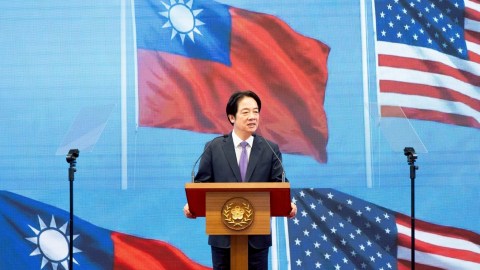
The president of Taiwan, Lai Ching-te (William Lai), assured that the security of the island “cannot be the subject of negotiation” and defended the purchase of weapons from the United States as a key measure to maintain stability in Asia.after recent comments by US President Donald Trump about Washington’s future military support for Taipei.
Lai’s statements come after the meeting held in Beijing between Trump and Chinese President Xi Jinping. in which the Taiwan issue occupied a central place in bilateral talks.
In a message spread on social media and in official statements, Lai affirmed that Taiwan “is at the core of global interests” and maintained that peace and stability in the Taiwan Strait “will never be sacrificed or negotiated.”
The Taiwanese president also responded to growing unrest within the island after Trump noted, in an interview with Fox News, that US arms sales to Taiwan represent “a very good bargaining chip” against China.
“Taiwan will not provoke conflicts or increase tensions, but neither will it give up its national sovereignty, its dignity and its free and democratic system under pressure,” Lai declared.
Fresh: President Lai Ching-te spoke back to most up-to-date feedback made by President Donald Trump earlier this day, discussing the following factors:
• The Republic of China (Taiwan) is a defender of the plan quo and is now not going to abandon its sovereignty and dignity under stress.
• The PRC is… pic.twitter.com/3eha3lNWs8— Taiwan Safety Video display (台灣安全觀測站) (@TaiwanMonitor) Can also 17, 2026
Taiwan insists on maintaining military support from Washington
The Taiwanese government considers that military cooperation with the United States is essential in the face of pressure from Beijing, which claims the island as part of its territory and does not rule out the use of force to achieve eventual reunification.
Lai defended US weapons acquisitions and assured that they represent “the most important deterrent” to avoid a military escalation in the region.
During his current administration, Trump approved an $11 billion arms package for Taiwan, including missiles, drones, artillery systems and military software. However, the US president recently acknowledged that he has not yet decided whether he will authorize another additional package of $14 billion.
“It depends on China,” Trump said during the television interview, while making clear that he is not seeking a formal declaration of independence from Taiwan or direct military conflict with Beijing.
The Republican president’s words provoked immediate reactions in both Taiwan and Washington, where Republican and Democratic legislators reiterated their support for the island.
Mr. Trump’s feedback is inclined to be considered as a setback for President Lai of Taiwan, who had pushed strenuously for more defense drive spending and purchases of American weapons.
When Taiwanese voted in the destruction voted for $25 billion in special funding to pay for the two weapons…
— William Yang (@WilliamYang120) May 16, 2026
Tension grows between Washington and Beijing
China raised its tone after the presidential summit and called Taiwan “the most important issue” in the bilateral relationship with the United States.
Xi warned Trump that incorrect handling of the situation could lead to “clashes and even conflicts,” according to versions published by official Chinese media.
Meanwhile, advisers close to Trump expressed concern about a possible increase in military tensions in the coming years. According to reports published by US media, some officials believe that China could increase pressure on Taiwan after the meeting in Beijing.
US Secretary of State Marco Rubio attempted to reduce uncertainty and stated that Washington’s policy towards Taiwan “remains unchanged.”
Taiwan and China have been governed separately since 1949, when the Communist Party took power in Beijing after the Chinese civil war. Although most countries, including the United States, do not formally recognize Taiwan as an independent state, Washington remains its necessary military and political ally.
Keep reading:
- Trump’s advisors fear China’s attack on Taiwan in the next five years after meeting with Xi Jinping
- What was Mao Zedong’s Cultural Revolution and how it marked the history of China 60 years ago
- Xi Jinping warns Trump that “mismanagement” over Taiwan could lead to a “clash or conflict”


