
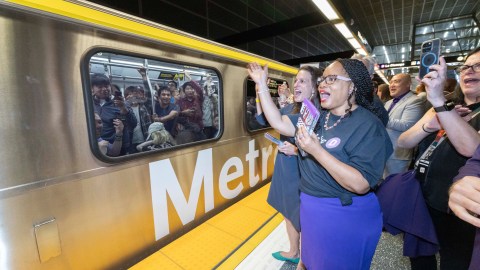
After years of construction and rising expectations, the long-awaited extension of the Metro D Line officially opened to passengers last Friday, offering riders a faster connection between downtown Los Angeles and Beverly Hills.
The newly opened section adds three underground stations along Wilshire Boulevard: Wilshire/La Brea, Wilshire/Fairfax and Wilshire/La Cienega.
Metro officials say the expanded route allows passengers to travel from downtown Los Angeles to Beverly Hills in about 20 minutes, dramatically reducing travel times through one of the region’s busiest traffic corridors.
“Today we are changing the way Los Angeles moves by closing a critical gap between downtown and the Westside, reducing congestion, shortening commute times and connecting more people to jobs and opportunities,” said Mayor Karen Bass, who also serves on the Metro Board of Directors.
“This is the type of infrastructure that defines the future of a city. We are making it easier for people across Los Angeles to get where they need to go, and do it faster.”
The Wilshire Runner
The D Line, formerly known as the Purple Line, now extends further west, from Koreatown to Mid-Wilshire and Beverly Hills, connecting passengers to museums, restaurants, shopping areas and entertainment destinations along the Wilshire corridor.
At the Wilshire/Fairfax stop, passengers can easily access Museum Row, which includes attractions such as the Los Angeles County Museum of Art (LACMA) and the La Brea Tar Pits, both nearby. The Wilshire/La Cienega Station offers direct access to the dining and famous shopping areas of Beverly Hills.


The street is among the busiest in Los Angeles; It winds through Westlake, Koreatown, the famous Miracle Mile, Beverly Hills, Century City, Westwood and Santa Monica before ending at the Pacific Dart with the circulation Freeway, a journey that previously could take an hour.
According to Metro, by bringing people closer to the places and services they depend on, the Metro D Line Extension will help strengthen neighborhoods, support working families and build a more connected, equitable and resilient Los Angeles for future generations.
Like any big Los Angeles premiere, Friday’s celebration featured Hollywood celebrities, the flash of press cameras and a purple carpet to walk down. There was even a full-size saber tiger puppet, created by the Jim Henson Creature Shop, and the entire Metro system offered free rides over the weekend. Many fans also wore their Metro T-shirts reading “Mosey the D.”
People who usually use Metro will now also be able to enjoy entertainment. In an effort to energize these seasons, activities will be held during May and June including salsa dancing, farmers markets and basket weaving classes.

Great events and the future
Metro officials reported that each new station will feature public art installations and full accessibility, along with enhanced security measures that include surveillance and deepest transportation systems.
The project is also the only new underground subway to open in the United States this year and comes as Los Angeles prepares to welcome the world to major international events, including the 2026 FIFA World Cup, the 2028 Olympic Games and the 2028 Paralympic Games.
The celebration marked the first phase of the D Line. Two additional D Line extensions are currently scheduled to open in 2027, adding four stations throughout Beverly Hills, Century City and Westwood Village. The third phase, tentatively scheduled for fall 2027, will add stations at UCLA and the VA hospital.
“This train will open new doors to some of the most emblematic places in our city,” said Bass during the inauguration ceremony. “It connects the residents of Miracle Mile to their workplaces, to museums, to different neighborhoods and to each other. It makes our huge city seem smaller and much more connected.”


