
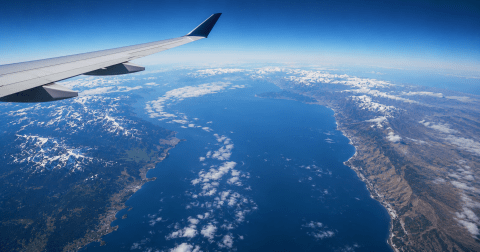
The same thing could have happened to anyone who has followed a flight in real time: looking at the airplane screen or an app like FlightRadar24 and thinking that something doesn’t close. If the destination is on the other side of the Pacific, why does the route seem to divert towards Alaska? Why don’t some flights from the United States to Asia cross the ocean “down the middle,” as a school map would suggest?
What’s more: on some routes another surprise still appears: longer itineraries, strange detours or paths that seem illogical. The explanation is nothing mysterious, although it is quite counterintuitive.
The reality is that Commercial airplanes do not fly following straight lines drawn on a flat map. They do this following much more complex calculations where the actual shape of the planet, winds at altitude, the availability of alternative airports and, of course, the operating cost of each minute in the air come into play.

Continue reading: The giant of the skies: this is the most ambitious plane ever designed
The map deceives us
The first trap is in how we see the world. Most of us grew up looking at rectangular mapispheres where the continents seem arranged intuitively. But The Earth is not flat, and translating a sphere to a two-dimensional map distorts distances and trajectories. That’s why many routes that seem absurd on paper are, in reality, the shortest possible.
In commercial aviation, calls are used great circle routeswhich represent the most efficient path between two points on a curved surface. It is the reason why a flight between Los Angeles and Tokyo it may rise northward and approach Alaska instead of crossing the middle of the Pacific as one would imagine.
Seen on a globe, it makes perfect sense. That is why the United States Federal Aviation Administration (FAA) uses this principle as a planning tool.
You can see: What to do if your flight is canceled due to a storm: rights as a passenger in the US.
Yes, planes cross the Pacific all the time
It is also advisable to dismantle an exaggerated belief that usually circulates on networks: it is not true that airlines “avoid” the Pacific. Thousands of commercial flights pass through it regularly. Just think about connections such as Los Angeles-Sydney, San Francisco-Tokyo, Vancouver-Auckland or flights between Hawaii and Asia.
What does happen is that Routes rarely respond to what a passenger would intuitively imagine. The reason is simple: a commercial flight is not designed thinking about how it will look on a map, but rather safety, efficiency and real atmospheric conditions.
You can see: These are the safest airlines in the world in 2026
Safety still rules
Even with the reliability of modern aviation, the rules remain strict. One of the most important concepts is ETOPS, a certification that regulates how long a twin-engine plane can operate away from an airport suitable for landing in an emergency.
Today, modern models can cover enormous distances over the ocean thanks to advanced certifications, but still Routes must be planned considering alternative scenarios.
This explains why some routes prefer to stay within corridors where there are reasonable options in the event of a technical problema medical emergency or depressurization.
In an ocean as immense as the Pacific, that detail matters a lot.
You can see: Cyber Monday or Commute Tuesday? What is the best day to get cheap flights
Wind can completely change the equation
In turn, not everything depends on geography. At more than 30,000 feet in altitude, airplanes coexist with extremely powerful air currents known as jet streams.
These invisible highways can work for or against you. A favorable wind cuts flight time, fuel consumption and costs. And, conversely, a headwind can make a route much less efficient. That’s why a round trip between the same cities is almost never identical.
What seems like an unnecessary detour to the passenger may actually be the most logical decision of the day.
Every minute costs money
Moving a commercial airplane costs a lot. Flammable, crew, maintenance, airport slots, operational logistics. This makes airlines fine-tune every detail very precisely. It’s easy: a difference of a few minutes multiplied by hundreds or thousands of flights a year represents millions of dollars.
In that equation, choosing the optimal route is not a technical whim: it is a central part of the business.
As we can see, few industries depend as much on invisible variables as aviation. Behind every decision and journey there is extremely precise planning.
Continue reading:
They are building a floating airport: it will be the largest in the world and will receive 80 million passengers
The work that wants to save the Panama Canal: they will build a man-made lake to ensure water
Fear of air travel remains in the United States


