
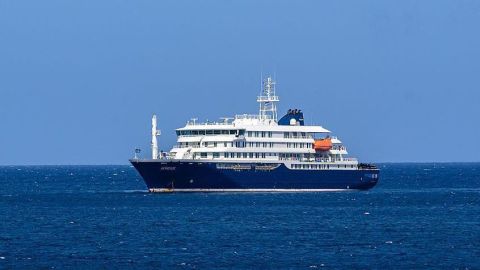
The World Health Organization (WHO) is investigating the possibility of a rare transmission of hantavirus among passengers of the Dutch ship MV Hondius: three people on board have died since the ship began its voyage.
According to the WHO, despite the outbreak on the ship, the risk to the public at large is low and travel restrictions are not recommended.
The ship set sail from Ushuaia, Argentina, on April 1 with 174 people on board. The cruise toured remote regions of the South Atlantic, including Antarctica, South Georgia, Tristan da Cunha, Saint Helena and Ascension Island.
On May 2, WHO was officially notified of cases of severe acute respiratory illness on board the ship.
That same day, tests carried out in South Africa confirmed hantavirus infection in one of the patients admitted to intensive care.
As of this Wednesday, seven cases had been identified: two laboratory confirmed and five suspicious. Among the three deceased, a Dutch woman had a confirmed diagnosis of hantavirus. The other two deaths remain under investigation.
The ship was anchored near Cape Verde until May 6, when it set sail again. According to local authorities, the country did not have sufficient infrastructure to carry out all the necessary health and medical operations.
The Spanish Ministry of Health reported that it would receive the MV Hondius in the Canary Islands next weekend, “in accordance with international law and humanitarian principles.”
The symptomatic passengers were removed from the ship and, according to the Spanish Minister of Health, the rest of the passengers do not have symptoms.
The decision, however, generated a political reaction in the Canary Islands. The president of the regional government, Fernando Clavijo, opposed authorizing the ship to dock in the archipelago.
“If the passengers are safe and sound, it makes no sense that they have to go to the Canary Islands to be repatriated. This could be done from the Cape Verde international airport,” he said.
The onboard outbreak also revived a question that gained traction during the Covid-19 pandemic: Are cruise ships safe environments from a health perspective?

Infectologist Elba Lemos, researcher at the Hantavirus and Rickettsiosis Laboratory of the Oswaldo Cruz Institute (IOC/Fiocruz) and coordinator of the reference service on the matter for the Brazilian Ministry of Health, said that it is still early to conclude if there was transmission within the ship or if the passengers were infected before boarding.
“In order for us to reach a conclusion, we need something basic: to collect all the clinical and epidemiological data,” Lemos told BBC Brazil.
“Where these people were, if they had exposure sites and what they did. We still don’t know that.”
According to the WHO, there are indications that the first infected person could have already boarded while infected.
The South African Ministry of Health reported that the Andean strain of the virus was detected in two people who were evacuated from the ship to that country.
The WHO, for its part, is studying the possibility of transmission “between really close contacts” within the ship.
Lemos said the most important thing right now is to avoid jumping to conclusions or scaremongering.
“It is very important that we have more information to be able to have a noxious,” he said. “What happened was something unusual.”

Closed and busy spaces
In October last year, more than 90 passengers and crew members of a Royal Caribbean cruise ship fell ill during a voyage that departed from San Diego, in the United States.
The Serenade of the Seas cruise ship recorded an outbreak of norovirus, which causes gastrointestinal infections, before its final stop in Miami, according to data from the Centers for Disease Management and Prevention (CDC) of the United States.
In January of this year, the virus also affected passengers and crew of the Holland America Line cruise ship Rotterdam, which set sail from Florida. According to health authorities, more than 80 people showed symptoms during the trip.
Cruise ships have characteristics that favor the spread of infectious diseases: large international circulation of people, shared environments, prolonged coexistence and closed spaces.
“What characterizes a cruise ship? A closed, hermetic environment, with a ventilation system, all confined,” listed the infectious disease specialist. “You just have to imagine a restricted environment inside your house. What’s going to happen? A spread.”
Historically, outbreaks on cruise ships have typically been linked to respiratory or gastrointestinal viruses, such as influenza, measles, Covid-19, and norovirus.
In addition to confinement, typical leisure travel behaviors also influence the spread, according to the infectious disease specialist.
“People are there to have fun. Even that gets in the way, because basic hygiene measures often leave a lot to be desired.”
The pandemic once again put ships in the spotlight. In 2020, the Diamond Princess cruise ship was quarantined off the coast of Japan after recording hundreds of cases of the disease.
More than 700 passengers and crew would have been infected before the evacuation.
In the first months of the pandemic, more than 40 cruise ships recorded coronavirus cases. The impact was so great that companies began to dismantle old ships due to the collapse of the sector.
Lemos noted, however, that the hantavirus is very different from covid-19 in terms of contagion. “There is no [en el caso actual] “the possibility of an epidemic equal to that of covid-19.”
The environment conducive to disease transmission does not necessarily mean that cruise ships are inherently unsafe. Lemos said that the sector operates today under stricter health regulations than before the pandemic.
According to the researcher, there are rigorous standards for air conditioning, food handling, waste elimination, water adjustment, vector monitoring and health evaluation of passengers and crew.
However, he highlighted that the detailed evaluation of these protocols corresponds to regulatory bodies in each country.
“It can no longer be something amateur,” he warned.

Hantavirus: why the case is considered atypical
Hantavirus is a group with more than 20 species of viruses, transmitted mainly by wild rodents, through inhalation of particles present in the urine, feces or saliva of animals.
The infectious disease specialist stressed that the virus is not associated with urban rats.
“It is very important that we say it, because it is not about the rat or the mouse, but about wild rodents.”
Lemos explained that hantaviruses are not a new discovery, they have been circulating in the Americas for decades and are linked to different species of rodents depending on the region.
In Brazil, for example, variants such as Juquitiba and Araraquara were already identified in the 1990s. Since then, the country has registered just over 2,000 cases, says the infectious disease specialist.
He noted that people who become infected tend to be those who live in rural areas.
“These are people who, for example, have lower purchasing power, are not large farmers, do not have silos, have their small corn plantation and store the harvest in a room of their house in an inadequate manner, which can serve as food for rodents,” he explains.
“There, the animal defecates, urinates and the person comes into contact with the virus in that place.”
“In terms of transmission, this is what predominates for all hantaviruses, of all species. But the Andean strain virus has a peculiarity: there is the possibility of transmission from person to person.”
This type of transmission is considered exceptional and has been documented mainly with the Andean strain, found in Argentina and Chile.
Therefore, according to Lemos, the appearance of cases on a cruise ship is something unusual. “It is not an environment where you would expect to find hantavirus inside a ship.”
Hantaviruses can cause two major syndromes: a renal hemorrhagic syndrome, common in strains found in Europe and Asia; and another pulmonary one, more related to the American continent.
“This difference is due to the fact that the native rodents of Europe are very different from those here, just as those from Brazil are also different from those from Argentina or the United States,” he points out.
“Each species of rodent, in simple terms, has a specific virus. The Andean strain virus, which is now of concern, is associated with a species of rodent from Argentina, the Oligoryzomys longicaudatus [ratón de cola larga]”.
Although it is a rare disease, it is worrying due to its high lethality. “Of every 100 people who contract dengue, five can die. In the case of hantavirus, the rate can range between 20% and 50%,” he explained.

Is risk cause for concern?
At the moment, international organizations do not consider the episode as a major threat to public health. The WHO highlights that most common tourist activities present little or no risk of exposure to hantavirus.
The organization recommends monitoring symptoms, washing hands frequently, ventilating adequately and isolating passengers with symptoms.
The infectious disease specialist said that cruise ships require the same precautions recommended for other closed spaces with a large influx of people, such as paying attention to vaccination, frequent hand hygiene and caution against respiratory symptoms.
In a non-public capacity, the doctor indicated that she does not feel comfortable in confined spaces for long periods, although she stressed that the ships operate under strict health surveillance.
“I’ve already been on a cruise, but I don’t feel comfortable,” she said. “As a doctor, even on the plane, if I see someone sneezing or coughing, it bothers me.”
The concern goes beyond the boats.
“We are talking about a cruise ship, which has a whole series of health requirements,” he said. “Now imagine the places we frequent and where you don’t know if the air conditioning system and filters are properly maintained, or what the level of rigor is in that place.”
He also advocated for travelers to receive more guidance on the health risks specific to the destinations they visit.
“It is very important that whoever is going to travel knows what is happening in the place they are going,” he said.
“Are you going to the Amazon? You have to know what diseases are circulating there. Are you going to Argentina? You need to understand what the risks are in that region. Information is part of prevention.”
According to her, tourism professionals should be better prepared to guide passengers about endemic diseases and local risks.
Oceanwide Expeditions, which operates the Dutch ship MV Hondius, said it continues to respond to the medical situation on board.
According to the company, the “health and safety of all passengers and crew” remains the top priority.
He added that the ship operates under medical and health protocols.

click hereto take a look at more stories from BBC Data Mundo.
Subscribe hereto our new publication to receive every Friday a selection of our best content from and the week.
You can also follow us on YouTube, instagram, TikTok, x, Facebookand in our whatsapp channel.
And remember that you can receive notifications in our app. Download the latest version and activate them.
- Andean strain of hantavirus that is transmitted between humans is identified in the deadly outbreak on the cruise ship that set sail from Argentina
- “We are people, not just news”: the clamor of passengers trapped on the cruise ship affected by the hantavirus
- 3 dead in a possible hantavirus outbreak inside a cruise ship that set sail from Argentina


