
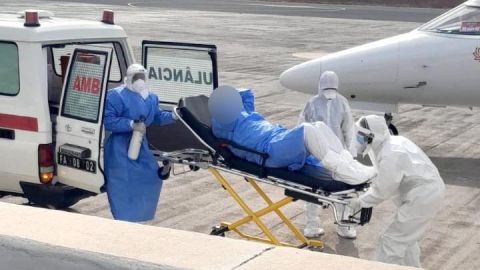
A rare strain of hantavirus, which can be transmitted between people in close and prolonged contact, has been detected in patients affected by a deadly outbreak aboard an Atlantic cruise ship.
The South African Ministry of Health reported that the Andean strain of the virus was detected in two people who were evacuated from the ship to that country.
Three passengers on the MV Hondius have died since the cruise ship set sail from Argentina about a month ago on a voyage across the Atlantic Ocean.
Three more people with symptoms were evacuated on Wednesday morning to receive medical care in the Netherlands, the World Health Organization (WHO) reported.
The evacuated people are a 56-year-old British man, a 41-year-old Dutch citizen and a 65-year-old German woman, according to the Netherlands Ministry of Foreign Affairs.
“At this stage, the risk to public health remains low,” said WHO chief Tedros Adhanom Ghebreyesus.
He added that tracking and monitoring of passengers on board and those who have already disembarked has already begun.
“I cannot allow him to enter the Canary Islands”
The cruise ship’s operating company, Oceanwide Expeditions, previously said that two of the evacuees were crew members, including the ship’s doctor, who is reportedly a British national.
The third case corresponds to a passenger linked to a German citizen who died on board last week.
The WHO also confirmed that a Swiss citizen who returned to his country after traveling on the ship is receiving treatment for hantavirus in a sanatorium in Zurich.
Some 150 people remain on board the MV Hondius under “strict precautionary measures,” according to the operating company.
The ship is currently anchored near Cape Verde, off the western coast of Africa, and is scheduled to head to the Canary Islands, where passengers could eventually disembark.
Madrid accepted the map, but the regional authority of the Canary Islands expressed its rejection and requested an urgent meeting with the president of the Spanish government, Pedro Sánchez.
“I cannot allow him to enter the Canary Islands,” Fernando Clavijo told Onda Cero radio.
“This decision does not follow any technical criteria nor have they provided us with sufficient information to maintain a message of calm.”
On social networks, he asked for security and guarantees for both passengers and residents of the Canary Islands.
The only one that can be transmitted from person to person
So far, eight cases of hantavirus have been identified, three confirmed and five suspected cases, among people who were on board, according to the latest update from the WHO.
The organization has reiterated that the risk of transmission to the fashionable population is low.

The virus is usually transmitted through rodents, through their urine, saliva or feces. However, experts have observed that the Andean strain can spread between humans.
South African health authorities indicated that this strain, common in Latin America, was detected in both confirmed cases after analyzes carried out by the National Institute of Communicable Diseases of South Africa.
A report presented to the South African Parliament, to which the BBC had access, indicates that the Andean strain is “the only known one that can be transmitted from person to person.”
The document emphasizes that transmission remains rare and occurs only in cases of “very close contact.”
It also details efforts to trace contacts of those infected. So far, 42 of 62 identified people have been located.
Contacts include paramedics, ambulance drivers, port personnel, air crew and healthcare workers. The authorities continue tracing efforts.
“Spain has the right and correct obligation to help”

Of the two confirmed cases in South Africa, one corresponds to a Dutch woman who died after her husband had already died at sea. The other is a 69-year-old British man who remains hospitalized in Johannesburg where he was evacuated.
The presence of hantavirus has not been confirmed in the Dutch citizen who died or in another German passenger who also died.
The Spanish Ministry of Health reported that the rest of the passengers will continue to the Canary Islands. They are expected to arrive in three or four days, although the exact port where it will dock has not yet been defined.
The company Oceanwide Expeditions indicated that its map is to reach Gran Canaria or Tenerife.
According to the company, the WHO would have indicated that Cape Verde “cannot carry out this operation.”
“The Canary Islands are the closest place with the necessary capacity. Spain has the right and correct obligation to help these people, among whom there are several Spanish citizens,” the statement added.
Once in the Canary Islands, passengers and crew will be medically evaluated and receive care, after which they will be able to begin their return to their countries.
All interactions will be carried out in special spaces and transport to avoid contact with the local population and protect health personnel, according to Spanish authorities.
However, the president of the Canary Islands rejected the map.

click hereto survey more stories from BBC News World.
Subscribe hereto our new newsletter to receive a selection of our best content of the week every Friday.
You can also follow us on YouTube, instagram, TikTok, x, Facebookand in our whatsapp channel.
And remember that you can receive notifications in our app. Download the latest version and activate them.
- “We are people, not just news”: the clamor of passengers trapped on the cruise ship affected by the hantavirus
- 3 dead in a possible hantavirus outbreak inside a cruise ship that set sail from Argentina


