
The phrase that titles this article continues to echo in my head. It was expressed to me by a former Mexican ambassador who lives in the United States. I do not mention his name because I am not authorized, but it occurred around a conversation about the exploitation of natural resources in Mexicoafter an analysis table in New York.
So? Without further ado? I asked him, surprised by his expression, waiting for a more elaborate diplomatic argument. “Yes, just like that,” he said.
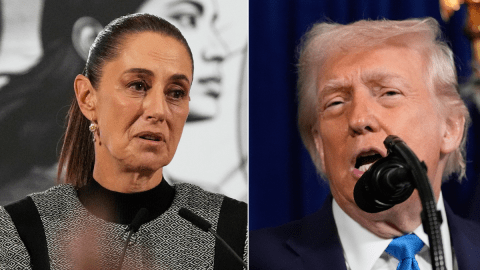
The position of the former Mexican ambassador establishes the challenges that Mexico faces in the diplomatic relationship with the United Stateswhich is particularly different in this second term of President Donald Trump’s government, something that was not seen even during his first term, when his foreign policy maintained “the ways” of conducting itself, under respect – at least frontally – of the Vienna Convention, humanitarian law and the unwritten ‘worn law’ or law of respect for borders.
In the current Trump government the situation has changed, as seen in Venezuela, Iran, Cuba, the Caribbean and the Pacific; the unusual tariff policy – stopped by the US Supreme Court – and the immigration actions that have forced agreements with almost 30 countries to send immigrants who are not from such nations, as documented by the organization Migration Policy Institute.
In domestic politics, The Trump administration has faced challenges – and several defeats – in courteven with the blocking of several of its economic, immigration, labor actions, among others, but at the international level the situation changes: there is no figure that counterbalances the United States, even against its historical economic and military allies, members of NATO, as Trump has made clear by launching threats against Germany, Spain and Italy. The reason for this seemingly free path is that the US does not recognize international courts – against its policies and officials – and has reviled the UN and other international organizations. It is essential to understand this, because in International Relations, it is a maxim that countries relate in the midst of anarchy and international organizations have been essential to generate a kind of balance in the economy, respect for sovereignty and human rights. President Trump has changed that.
Reports from the Center for American Development (CAP) and the Council for International Family (CFR) warn that President Trump’s strategy is imposed in the world under the umbrella of “national security” for the US, even if it affects the image of the country.
“The Trump administration has used the military in an improvised way, issuing threats and carrying out actions that have weakened alliances, emboldened adversaries and undermined the credibility of the United States,” indicates the CAP report of February 19, 2026, a few days before operations against Iran were implemented.
The extreme case occurred in Venezuela, with the extraction of Nicolás Maduro. The operation sparked criticism from congressmen – mainly Democrats – but the Trump administration made it clear that it would do anything to achieve its objectives abroad, even if it violated the Constitution, as the Brennan Center for Justice warned about the actions in Venezuela.
However, on January 3, 2026, the Secretary of State, Marco Rubio, ordered two messages at the press conference after arresting Maduro.
“Don’t play with this president in office, because it’s not going to turn out well,” Rubio said about the current US president.
The second message made it clear that the US would apply extraterritorial actions regardless of the political consequences.
“Remember, in essence, [la operación en Venezuela] “It was about the arrest of two fugitives accused by American justice,” Rubio said. “Now, this has broader political implications, but it is simply not the type of mission that can be notified in advance because it jeopardizes the mission.”
Although it has been criticized, The US maintains the use of courts to persecute foreign officialssomething authorized by the Supreme Court.
On the other hand, the serious security problem that Mexico has should not be denied and although it has advanced with significant actions, for its main trading partner it has been insufficient. The objective of the “Shield of the Americas”, created by the Trump government last March with 20 Latin American countries, has right-wing governments as allies, but the most worrying thing for Mexico is that the axis of the group, the enemy to defeat, are the Mexican cartels – and the officials who help them –, something that the government of President Claudia Sheinbaum cannot ignore.
In this context, the government of Sheinbaum plays critical aspects in his evaluation of the accusations of drug trafficking and corruption against the governor of Sinaloa, Rubén Rocha Moyaand the other nine defendants accused of ties to the Sinaloa Cartel. Mexico could try to follow the extradition agreement with the US, but keeping in mind that the Trump administration establishes its own limits and under the risk that, some early morning, like January 3, 2026 in Caracas, a US commando decides to go to Sinaloa for “fugitives accused by US justice”, paraphrasing Secretary Rubio.
The question is not whether the action defended by Rubio is approved in the international framework – to which the Trump government is not aligned – but rather how Mexico would respond without having to face a military superpower. The dilemma is tactical and diplomatic.
Jesus Garcia He has an MA in Political Science from the Graduate Center (CUNY) with a specialty in International Relations.


