
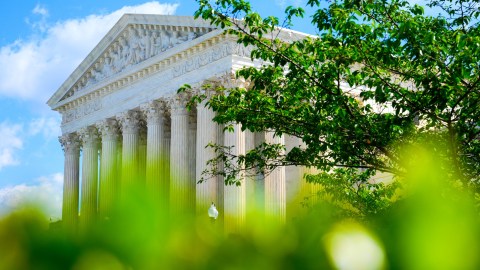
The legality of President Donald Trump’s decision to cancel TPS for 350,000 Haitians and 6,000 Syrians is in the hands of the Supreme Court, but the decision made by the highest court would affect 1.3 million beneficiaries from 17 countries. Trump revoked TPS for nationals of 13 countries. A ruling is anticipated this summer.
If the cancellations proceed, it would be the largest delegalization of people in United States history, according to the American Civil Liberties Union (ACLU).
But Trump’s decision fits with his pattern of not only persecuting the undocumented, but also canceling programs that allow the regularization of immigrants, from DACA, to asylum, refuge, humanitarian parole and TPS, among others.
The goal is to remove their protections and make them vulnerable to deportation.
TPS grants work permits and protection from deportation to people in the United States who come from countries that are at war or have experienced a natural disaster or other internal conditions that make it unsafe for their nationals to return.
La Opinión reported that “the judges’ questions did not make their inclination on an eventual decision very clear, since Judge Brett Kavanaugh – appointed by Donald Trump – suggested that the country (Syria) is in a better situation since Bashar al-Assad was overthrown in 2024. Meanwhile, Judge Sonia Sotomayor – appointed by Barack Obama – questioned the attorney general, John Sauer, how the president’s statement Trump’s claim that immigrants are “poisoning the blood of America” does not demonstrate “discriminatory intent” in his decision to cancel protections.
According to a new report from FWD.us, TPS beneficiaries “live with 390,000 US citizen children and more than 410,000 US citizen adults.”
And the analysis adds that “they contribute about $29 billion annually to the U.S. economy, in addition to paying $7.8 billion in combined federal, state and local taxes.”
Another immigration decision questioned in federal court
And in another case that questions the legality of the president’s actions on immigration matters, a federal judge in Maryland ordered USCIS to reactivate the permanent residency petitions of 83 immigrants who sued USCIS and are nationals of some of the 39 countries to which Trump has imposed total or partial travel restrictions to the United States.
But these are immigrants who are already in the United States and have their applications for permanent residence pending.
Judge George L. Russell indicated that USCIS “has no discretion to decide not to adjudicate cases at all.” It also “determined that the pause, imposed by Donald Trump’s government, is illegal.”
According to Judge Russell, the government has not explained why it decided to pause immigration benefits for people from these countries who have been in the country “for years, even decades, have maintained an honest status and, in many cases, have contributed substantially to medical and scientific research.”
The travel ban is one of multiple actions taken by the government to reduce documented immigration to the United States. A report from the Migration Protection Institute lists others, among them, the suspension of the issuance of migrant visas to nationals of 75 countries; new background check guidelines that have caused a substantial drop in the granting of student visas; a $100,000 application fee for highly skilled workers with an H-1B visa; and the diversion of staff processing immigration applications to check applicants’ backgrounds.
USCIS delays immigration procedures
La Opinión reported that “a recent directive from the Citizenship and Immigration Services (USCIS) has tightened background check controls with the support of the FBI and manmade intelligence systems, which has caused additional delays in a system that was already saturated.”
“According to internal documents cited by CBS News, officials received clear instructions: not to approve any application that has not gone through the new filters. This includes processes for permanent residence, citizenship, asylum and family reunification. The measure came into effect on April 27 and even requires the reexamination of old cases,” the newspaper explained.
Currently the backlog in applications is 11.6 million, according to the article, and with the changes waiting times will increase.
Trump signs bill that reopens DHS, but ICE and CBP do not receive funds
The Lower House loudly approved the bill that the Senate had advanced to fund vital DHS agencies that were not receiving funds due to the impasse between Democrats and Republicans over reforms to the way ICE and CBP agents conduct themselves after they shot and killed two American citizens in Minnesota.
In a win for Democrats, ICE and CBP remain unfunded on this project and pressure for reform continues. However, it is worth noting that both agencies have ample funding through the Massive Honest Staunch-Looking Out Bill.
Likewise, Republicans are promoting an additional $70 billion for both agencies through the conciliation process that allows them to advance measures by a simple majority, avoiding a Democratic blockade and leaving out the reforms to ICE and CBP that the minority demands.
La Opinion reported that “the approval will allow the resumption of operations and financing until September 30 for key DHS agencies, such as the Federal Emergency Management Agency (FEMA), the Coast Guard, the Transportation Security Administration (TSA) and the Secret Service.”
Trump immediately signed the measure ending a 75-day partial DHS shutdown.
“My husband has been transferred 16 times, to 11 (detention) centers, in the last eight months, even after winning our case…I am just trying to keep our family together, and I feel that the system constantly separates us. Being here this weekend showed me that we are not alone and that we can unite, organize and make ourselves heard,” said Angela, a teacher from Pennsylvania, who, as La Opinión reported, participated in the Americans Connected event that brought together people from various states in the country affected by Trump’s immigration policies.
“Members of the movement, directly affected by immigration policies, pledged to share their stories with millions of people, as well as to stop detention and deportation policies that have impacted their families,” the newspaper wrote.
“According to the Migration Policy Institute, it is estimated that 14 million US citizens, green card holders and temporary visa holders live in households with at least one undocumented immigrant,” he added.


