
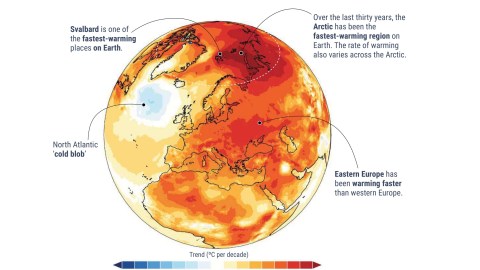
Europe faces accelerated warming that doubles the world average, according to a report published by the World Meteorological Organization (WMO). and the European Copernicus program, which warns that the continent experienced one of the most extreme years in climate terms in 2025.
The report, considered one of the most complete on the state of the climate in the region, indicates that at least 95% of the European territory recorded temperatures above the annual average. In addition, it documents unprecedented events, such as intense heat waves, record wildfires and a significant reduction in snow and ice.
Since the 1980s, Europe has warmed at twice the global average.a trend that has generated visible impacts both in ecosystems and in the daily lives of millions of people.
🌡️ Europe is the quickest‑warming continent, warming at bigger than 2× the common realm. Changing climate patterns, decreased air pollution, declining snow quilt & proximity to the rapid warming Arctic all play a goal.
⬇️ pic.twitter.com/4jZLyfoUtB
— Copernicus ECMWF (@CopernicusECMWF) April 29, 2026
Extreme heat and droughts aggravate the climate crisis
Among the most notable events of 2025 is a three-week heat wave in the Fennoscandia region – which includes Finland, Sweden and Norway – where temperatures reached almost 35 degrees Celsius in areas near the Arctic Circle. This phenomenon reflects the speed with which even the coldest regions are being affected.
The report also indicates that much of Europe recorded more days than usual with elevated levels of heat stress. In the case of Spain, some southern and eastern regions experienced up to 50 additional days with perceived temperatures above 32 degrees Celsius.
High temperatures, combined with lack of rain, caused a severe drought. Approximately 70% of European rivers had flows below average, while the continent experienced one of the three driest years in terms of soil moisture since 1992.
Less snow, more fires and pressure on ecosystems
Warming has also had direct consequences on the European cryosphere. In March 2025, snow extent was 31% lower than the historical average, equivalent to a loss of more than 1.3 million square kilometers. This figure represents the third lowest snow coverage since records began in 1983.
Glaciers, for their part, recorded a net loss of mass, with cases such as Iceland experiencing its second largest annual reduction. This phenomenon contributes to sea level rise and increases the risk of flooding in coastal areas worldwide.
The report also highlights that forest fires reached historic levels in 2025, with more than one million hectares burned, an area larger than that of countries like Cyprus.. The conditions of extreme heat and dry vegetation were determining factors for the spread of the fire.
At the ocean level, 86% of European waters experienced at least one episode of intense marine heat, seriously affecting ecosystems such as the underwater meadows of the Mediterranean, essential for biodiversity.
Despite this panorama, the report includes an encouraging fact: renewable energies represented 46.4% of electricity generation in Europe in 2025, surpassing fossil fuels for the third consecutive year. Photo voltaic energy, in particular, reached a record 12.5%.
Experts emphasize that these data should serve as outrageous for urgent political decisions, since Climate change, they warn, is no longer a future threat, but a present reality with increasingly visible effects.
Keep reading:
- The extreme heat of 2025 marks a historic milestone and deepens inequalities that affect Latinos
- Heat waves and cardiovascular risk: an alarming link
- Climate alert: storms, floods and heat waves due to Super El Niño


