

By Alberto Daniel Barboza
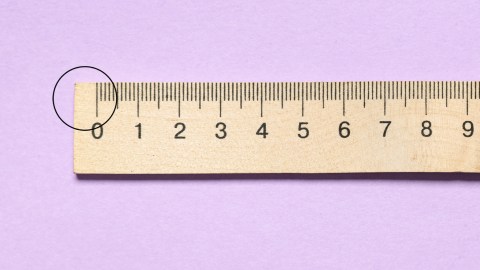
If you look very closely at a measuring ruler; of those traditional ones that you may have used at school, you will notice a detail that many (or all) tend to overlook: the small empty space that appears just before the number zero.
Far from being a defect or an aesthetic decision, plays a key role in ensuring accurate measurements.
And with the passage of time, these instruments evolved in materials and accuracy, but also in technical details that improve its operation. One of them is precisely the margin prior to zero.
Read also: What it means to wear a cap every day, according to psychology
Why is there that space before zero in a ruler?
The main reason is to avoid errors caused by wear. The end of a ruler is the part that suffers the most from use: knocks, falls, friction or even small deformations can alter its shape.
If the “0” were exactly on the edge, any damage would directly affect the measurement from the start. Instead, By placing the zero a few millimeters inward, the proper reference from where measurements should begin is protected..
This means that the edge of the ruler is not the reliable starting point, but the zero mark.
To obtain an accurate measurement, it is advisable to align the object with the “0” mark, not with the physical end of the ruler. In cases where the edge is damaged or not straight, this difference can be key.
Even when the beginning of the rule is impaired, some experts suggest starting from another mark (for example, the number 1) and then subtracting that unit from the final result. It is a common technique in precision work.
What the technical standards say
Organizations such as the United States National Institute of Standards and Technology (NIST) and industrial standardization entities have pointed out the importance of this detail. Their recommendations emphasize that Measurements should be started from a reliable reference, not from the edge of the instrument.
This helps reduce cumulative errors, especially in jobs where accuracy is traditional, such as carpentry, engineering or technical design.
You may be interested in:
· 240 kilometers without curves: the road that tests the drivers’ minds
· What are Taba Squishies, the anti-stress toy that is sweeping TikTok
· 5 real tricks with the router to improve the internet and 5 that are false


