
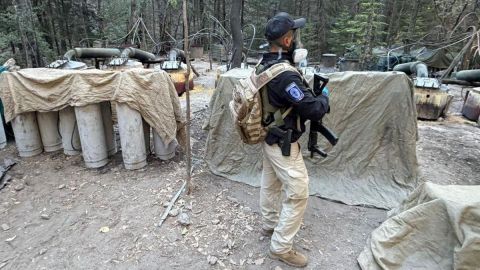
In the early hours of this Sunday, a convoy of five official vehicles was moving through the Tarahumara mountain range, a vast mountainous area in the Mexican state of Chihuahua famous for its rugged geography and the presence of organized crime.
They had just dismantled six sophisticated drug laboratories located through drone overflights in an operation that included a hundred officials, one of the most important successes in years for the Chihuahuan prosecutor’s office and police.
In an area of ravines and forest, the first of the cars in the caravan seems to have had an accident: it skidded, fell down a ravine and exploded.
Four people died: the local director of the State Investigation Agency, Pedro Oseguerahis escort, Manuel Mendezand two agents of the United States Central Intelligence Agency (CIA) – as revealed by the newspapers Washington Post and The New York Cases- whose names they did not disclose.
Neither have the US government and the CIA released the names or confirmed whether the two men worked for the intelligence agency.
Although it is not the first time it has happened, The death of US officials in Mexican territory raises major questions: Has Mexico given up part of its sovereignty by allowing them to operate here? Is the United States dismantling laboratories in Mexico, as it wants donald trump? Is the “collaboration” mentioned by the Mexican authorities deeper than they usually admit?
The Mexican president, Claudia Sheinbaumusually denies that US authorities physically participate in operations in Mexico.
“Until now the information we have is that they were working together,” he said on Tuesday. “The entire investigation must be carried out by the Prosecutor’s Office to see if the Constitution or the National Security Law was violated.”
Sheinbaum insists, almost daily, that Mexico is willing to collaborate with the United States in the fight against drug trafficking, on the condition that Mexican sovereignty—that is, the National Security Law—is respected.
But for decades Mexican leaders have denied what for many experts is evidence: US agents operate in Mexico with or without approval from the authorities.

It has been going on for years, without noise.
David Saucedo, a security consultant, says that the presence of US agents in Mexico has been documented for decades. But he adds that the difference now is that Donald Trump’s government is willing to do it with less method and more show.
“For some time now there have been covert operations by agents of United States security agencies: the FBI, the CIA, the DEA and Homeland Safety, some with knowledge of Mexico and others not.”
“They participate in geolocation, arrest of drug traffickers, They are armed, they carry out criminal investigation tasks and police work that in theory they could not do.”
“They can provide advice or provide data, but in theory they would not have the power to make arrests, seizures or carry weapons; however, this has been happening for decades in Mexico,” says the expert.

In February, the Mexican army killed one of the most wanted drug traffickers in the world—the leader of the Jalisco New Generation Cartelknown as “El Mencho”— in an operation that, according to the authorities of both countries, relied on intelligence information provided by the United States.
That data came from the Joint Interagency Anti-Cartel Task Force, a unit of the US Army’s Northern Command created by Trump to combat cartels, now considered terrorists, that allegedly threaten the United States.
In the war on drugs, Washington usually has vivid information that the Mexican authorities do not have, especially that disclosed by the drug lords imprisoned there, such as, for example, Joaquín “El Chapo” Guzmán either Ismael “El Mayo” Zambada.
Trump has reiterated his interest in the army making incursions into Mexico, but says he respects Sheinbaum’s condition—in a constant and difficult trade, immigration, and, of course, security negotiation—to collaborate without intervening.

The vivid fiber of interventionism
The Chihuahua prosecutor, César Jáuregui, first said that the US officials were not part of the operation, but rather They were giving drone training in the area and they had been picked up by the convoy like someone giving a ride to a colleague.
Later, however, he admitted that they were part of the operationwhich raised doubts from Sheinbaum when he said that “the prosecution changed their statement.”
“There was no joint operation on the ground with US agencies; the work was technical support and training,” he insisted.
The discrepancy between local and federal authorities, especially coming from a state governed by the opposition to Sheinbaum, raises the question of whether there are regional governments that speak and collaborate with Washington without consulting the president.
Sheinbaum, in fact, He said he did not know about the presence of the agents in Chihuahua.
And the US ambassador to Mexico, Ronald Johnson, left the question open: “This tragedy is a solemn reminder of the risks faced by Mexican and US officials dedicated to protecting our communities.”
“It is common for these collaborations to be handled covertly,” says Saucedo, “not only because someone can interrupt them but, above all, because the penetration of cartels into Mexican institutions and the fear of data leaks.”
For Sheinbaum, this is a new episode of an old dilemma, not only for her, but for any Mexican ruler: how to overcome the recurring interventionism of the United States without giving the impression that sovereignty is being sacrificed.
In 1985, the most notorious case occurred in a long succession of events that highlight the dilemma: the murder in Mexico of Kiki Camarenaan agent of the Drug Enforcement Administration (DEA), provoked a US retaliation operation in Mexican territory without government authorization that included the kidnapping – or arrest, depending on how you see it – of one of those responsible to put him on trial in the United States.
But the tension comes from before: since the United States took away a vast portion of its territory in the mid-19th century, Mexico developed an ambivalent foreign policy that boasts of rejecting interventionism while collaborating with other countries to manage Washington’s interests.
Mexican rulers often declare themselves nationalists, but a central part of their job is to at least contemplate the wishes of the government in power north of the border.
Sheinbaum, so far, has managed to give Mexicans the impression that he has strengthened Mexico’s role more than he has given up. But that balance is put at risk every day, especially as long as it is Donald Trump who has to deal with. Tomorrow will probably be something else.

click here to scrutinize more stories from BBC News World.
Subscribe here to our new e-newsletter to receive a selection of our best content of the week every Friday.
You can also follow us on YouTube, instagram, TikTok, x, Facebook and in our whatsapp channel.
And remember that you can receive notifications in our app. Download the latest version and activate them.
- Why the Mexican army is not made for war (and what it means in the fight against drug trafficking)
- “Returnees are an easy target”: Mexicans deported from the US who are reunited with the drug traffickers’ watch over


