
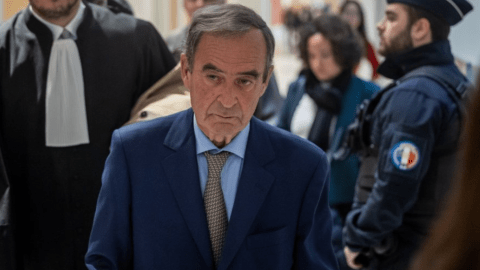
The historic conviction in France of one of its most important companies shakes the world of transnational companies and could change the way they operate in conflict zones.
Last week, cement company Lafarge was found guilty of paying millions of dollars in bribes to jihadist groups, including the self-proclaimed Islamic State (IS), to maintain its business in Syria during the civil war.
Eight former executives of the company were also found guilty of financing international terrorism, including its former CEO Bruno Lafont, who was sentenced to six years in prison with immediate imprisonment.
The company, which is now owned by the Swiss conglomerate Holcim, made payments to three jihadist organizations, including IS, amounting to nearly 5.6 million euros ($6.5 million) between 2013 and 2014 to keep a plant in northern Syria operating, according to the ruling by the Paris Criminal Court.
That money would have allowed IS to “prepare terrorist attacks,” such as the attack on the French weekly Charlie Hebdo in January 2015, according to the court.
The lawyer of the former CEO of Lafarge, Jacqueline Laffont, assured that the decision against her client is “neither fair nor reasonable.”
“This will not be the first nor the last time that a decision of the first instance judges is overturned by the judges of the Court of Appeal,” he stated in an interview with the French public service channel France Files.
“This is a sentence without evidence, without demonstration. The court presumes the guilt of Bruno Lafont and that he was aware of the disputed payments that took place within the Lafarge company, due to the simple fact that he was its president,” he added.
Lafont, who directed the cement company between 2007 and 2015, reiterated his innocence and assured that he had told the truth.
Their representatives have declared that they will appeal the verdict, but the sentence could change the game board for multinationals that operate in conflict zones.
Lafarge told the BBC that it recognizes the court’s ruling and said that the conduct “which took place more than a decade ago constituted a flagrant violation of Lafarge’s code of conduct.”
The company described the decision as an “important milestone” in its efforts to “responsibly address this legacy issue.”
A historic decision
Didier Rebut, professor of law and criminal sciences at the Paris-Panthéon-Assas University, assures that the decision is “historic” for several reasons.
“Firstly, it is historic because of the classification of terrorism applied to acts committed by a company and its leaders within the framework of their economic activity,” he tells BBC Mundo.

“It follows that a company and its managers can be convicted of terrorism due to their economic and financial decisions. This is, apparently, the first time in France and, apparently, in the world, in which a large international company and its leaders are convicted of terrorism, even if, of course, there was no ideological affiliation or collusion with the terrorist groups in question.”
Professor Rebut adds that the decision is also historic due to the severity of the penalties imposed.
As he explains, he has shown that the classification of terrorism, once retained, implies sanctions commensurate with its severity.
“The court thus makes it clear that, in matters of terrorism, there is no reason to mitigate the criminal response simply because the conduct in question consists of an economic or financial decision, rather than a violent act,” explains Rebut.
The professor also concludes that the ruling demonstrates that large companies are not exempt from sanctions when they contribute, “even through economic mechanisms, to the operation of terrorist organizations.”
Payments to ensure passage and raw materials
The Jalabiya cement factory, located in northern Syria, was acquired by Lafarge in 2008 for $680 million and began operating in 2010, just a few months before the outbreak of the civil war in 2011.
According to prosecutors, the company’s employees lived in the nearby town of Manbij and had to cross the Euphrates River to access the plant, located in an area that would soon be engulfed in conflict.

The payments, according to the indictment, would have been made between 2013 and September 2014. They included some 800,000 euros (US$872,000) intended to guarantee the safe passage of the workers, as well as 1.6 million euros (US$2.62 million) for the purchase of raw materials in quarries under the management of the Islamic State.
Civil war broke out in Syria in March 2011, following the violent repression of anti-government protests by then-president Bashar al-Assad.
In 2014, Islamic State jihadists took over large areas of Syria and neighboring Iraq, where they proclaimed a self-proclaimed cross-border “caliphate” and imposed their extremist interpretation of Islamic law.
“They will no longer be able to claim that they simply adapted”
Judge Isabelle Prévost-Desprez affirmed that the payments were “fundamental” for IS to gain control of natural resources in Syria.
“This allowed him to finance terrorist acts both in the region and abroad, especially in Europe,” he added.

In December, the National Anti-Terrorist Prosecutor’s Office (PNAT) described the case as “a slip, a perversion that led Lafarge, a benchmark in the French industry, to end up financing terrorist organizations with a single objective: profit.”
Didier Rebut points out that the greatest consequence of this ruling is that it raises the level of demands for multinationals.
“Companies that operate in conflict zones will no longer be able to claim that they simply adapted to a difficult local context if their payments, intermediaries, suppliers or logistics circuits benefit armed groups or sanctioned entities,” he explains.
This is a verdict that will probably force many companies to strengthen their management, logistics and governance systems.
“In essence, when a company knows that its activity depends on dealing with terrorist organizations, the risk stops being reputational and becomes criminal, both for the company and its managers,” he summarizes.
Rebut says the Lafarge case sets an important precedent: it shows that companies can be prosecuted for financially supporting armed groups in war zones.
But he clarifies that there will not necessarily be many future cases for terrorist financing, since this accusation requires very specific legal conditions.
Instead, it warns that the risk of companies being investigated for complicity in war crimes or crimes against humanity increases if they continue to operate knowing that their activities benefit violent groups.

click hereto look for more stories from BBC Files World.
You can also follow us on YouTube, instagram, TikTok, x, Facebookand in our new whatsapp channelwhere you will find breaking news and our best content.
And remember that you can receive notifications in our app. Download the latest version and activate them.
- “Atrocious and unprecedented conduct”: the French multinational sentenced to pay US$800 million for supporting the Islamic State
- Why Lebanon is key to ending the conflict between the US and Iran
- In video: BBC Mundo visits the “mini-Palestine” of Chile, one of the largest communities of Palestinians outside the Arab world


