
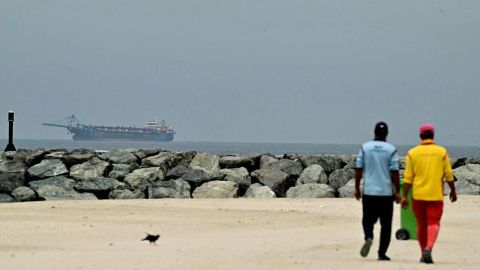
Iran announced this Saturday the closure of the Strait of Hormuz and threatened to attack ships trying to cross it.
The announcement reverses the decision made a day before opening this maritime corridor as part of the ceasefire with the US, Israel and Lebanon, which generated optimism about progress towards resolving the conflict in the Persian Gulf.
The decision to close Hormuz again responded, according to Iran, to the fact that the United States maintains a naval blockade in the area on ships linked to Iran.
Trump affirmed that this blockade – in force since April 13 – “will remain fully in force” until his peace negotiation with Tehran “is 100% completed.”
The decision of the US president to impose restrictions on naval traffic once again placed one of the oldest tools of pressure in contexts of war and military tensions at the center of international attention: the closure of sea routes to weaken the economy, restrict trade and force the other party to change its behavior or surrender.
The naval blockade is not only a military measure, but also has legal, economic, humanitarian and diplomatic implications.
In some historical cases, such as the two world wars, this tool played a significant role in the erosion of the war capacity of the affected countries.
However, in other settings, such as Gaza and Yemen, blockades have fueled humanitarian crises and legal disputes rather than sparking political change.
Historical experience shows that this instrument is often effective in exerting economic pressure, but rarely leads on its own to a lasting political solution.
These are some cases from history.
The British and Allied blockade of Germany in World War I

The naval blockade of Germany during the First World War (1914-1919) was a paradigmatic example of what is known as a “remote blockade.” Instead of directly blockading German ports, Britain controlled trade routes by dominating the North Sea and closely monitoring maritime traffic.
By inspecting ships and putting pressure on neutral countries, the British Proper Navy managed to effectively block Germany’s access to international markets.
London took advantage of its overwhelming naval superiority to progressively expand the list of prohibited goods, which included not only raw materials and military supplies, but also food and fertilizers.
At first, Germany managed to alleviate some of the pressure by resorting to trade with neutral countries, the use of reserves, recycling of materials and local industry. However, as the war dragged on, these strategies became less effective. German imports fell sharply, and shortages of agricultural and industrial inputs caused a decline in domestic production.
The social consequences of the blockade were serious. Starting in 1916, the lack of food became an open crisis, and the famous “turnip winter” came to symbolize the exhaustion of German society.
Historical estimates of the toll from malnutrition and disease vary, but there is broad consensus that the blockade played a key role in the internal weakening of Germany and its allies.
From a political point of view, the blockade was not the only cause of the overthrow of the German Empire or the end of the war, but it is considered one of the decisive factors in the weakening of the State, the collapse of internal justice and the rise of social discontent that ended up leading to the Revolution of 1918.
The Allied blockade of Japan in World War II

During World War II, Japan, as an island nation, relied heavily on the sea, both for the supply of oil, raw materials and food from its occupied territories in Southeast Asia, and for the transport of troops and supplies to combat fronts in the Pacific.
Therefore, the interruption of sea routes directly weakened the country’s military and economic power and, in the final years of the conflict, had devastating effects.
This blockade, especially between 1943 and 1945, was not limited to the action of warships. American submarines systematically attacked the Japanese merchant fleet and later dropped mines during Operation Starvation, crippling the country’s main shipping routes. According to post-war analysis, the destruction of the merchant fleet played a key role in the collapse of the Japanese war economy.
Geographically, Japan was extremely vulnerable and, unlike Germany, did not have effective land routes to circumvent the blockade, making its effects even more lethal.
In terms of effectiveness, the blockade of Japan is considered one of the most decisive in history. Although the country’s surrender responded to a combination of factors—including massive bombing, the Soviet invasion, and eventually atomic bombings—the cutting of sea routes and the sinking of the merchant fleet collapsed the backbone of its war economy.
Cuba’s “naval quarantine” in the 1962 Missile Disaster

The Cuban missile crisis is a different example, as Washington deliberately avoided the term “blockade” and replaced it with “maritime quarantine.”
The administration of John F. Kennedy, aware that the word blockade had connotations in international law of an act of war and could place the United States in a more compromised position, established a naval encirclement to prevent the arrival of Soviet military equipment to the island, relying on the support of the Organization of American States.
The objective of this measure was not to overthrow Fidel Castro’s government or paralyze the Cuban economy, but rather to pursue a more limited and precise goal: to avoid a greater deployment of Soviet missiles and create room for political negotiation with Moscow. This emphasis on a specific objective differentiated it from classic attrition blocks.
The blockade lasted less than a month but marked the moment of greatest nuclear tension of the Cold War.
It had a fundamentally political and deterrent character, rather than an economic one. With the deployment of US naval forces off Cuba, Soviet ships were effectively faced with the choice of stopping or risking a military confrontation; some chose to change course or abandon their destiny.
This naval pressure, combined with the exchange of secret messages and military threats, eventually led to an agreement that involved the withdrawal of Soviet missiles from Cuba and, confidentially, the dismantling of American missiles installed in Turkey.
If the criterion for measuring success is the achievement of the stated objective, the Cuban blockade can be considered a highly effective measure: the United States managed to stop the deployment of Soviet weapons without entering into a full-scale war, while keeping the path of negotiation and diplomatic compromise open.
Sanctions and maritime restrictions on Iraq

Following the Iraqi invasion of Kuwait in 1990, the UN Security Council imposed broad sanctions against Iraq through Resolution 661 and, shortly thereafter, through Resolution 665, and urged Member States to apply these sanctions in the maritime sphere, as well as to monitor and restrict the movement of ships.
These maritime restrictions (1990-2003) became in practice an instrument of economic pressure and a complement to the sanctions regime, with the aim of forcing Iraq to withdraw from Kuwait.
In the case of Iraq, despite its very limited access to the sea, the care for a watch on sea routes played an important role in cutting off oil exports and in the economic isolation of the country after 1990.
However, the ability to bypass some of that pressure across land borders made this tool less decisive on its own and more effective combined with sanctions and military pressure.
Maritime restrictions and controls in the former Yugoslavia

During the Balkan wars in the 1990s, the UN Security Council imposed sanctions against the Federal Republic of Yugoslavia and restrictions on arms transfers in the region, which were implemented in the maritime sphere through joint NATO and Western European Union operations.
This operation in the Adriatic Sea (1992-1996) aimed to monitor, inspect and, when necessary, detain ships to prevent non-compliance with sanctions.
Official statistics show that thousands of ships were inspected and hundreds detained or diverted, reflecting a relatively consistent and multilateral application of these restrictions. The adoption of Security Council resolutions also gave these measures reinforced political legitimacy.
Likewise, the geography of the Adriatic and the limited maritime access facilitated surveillance efforts. However, as with other sanctions regimes, these restrictions alone were not enough to stop the war.
The conflict in Bosnia and subsequent crises were not resolved by naval care for a watch on alone, and a combination of ground, air and diplomatic pressure was necessary to pave the way to a political settlement and the end of hostilities.
The naval restrictions imposed on the former Yugoslavia can be considered a relative success in terms of achieving objectives, although they did not reach the scale and impact of the blockades applied against Germany and Japan in the world wars.
These measures reinforced the effectiveness of the sanctions regime and raised the cost of non-compliance. Experience has shown that, with international consensus, a clear objective and a controllable geography, this tool can be effective, although it is rarely decisive on its own in defining the outcome of a war.
The Israeli blockade of Gaza

The blockade of Gaza in force since 2007 differs from many previous examples in that it is not an exclusively naval measure, but is part of a broader regime that includes the closure of border crossings, the care for a watch on the entry and exit of goods and people, the restriction of fishing, the care for a watch on the supply of fuel and electricity and the limitation of exports.
However, its maritime aspect, which has intensified since 2009, has constituted one of the fundamental pillars of this system, in particular the care for a watch on the coast and the denial to Gaza of free access to the sea.
Israel has justified the blockade for security reasons and to prevent the entry of weapons, but for years international humanitarian organizations have warned that its real effect has been to paralyze the economy and aggravate the situation of the civilian population.
From a legal point of view, the blockade of Gaza is one of the most controversial contemporary cases. In a 2024 advisory opinion, the International Court of Justice again underlined the continuity of the occupation and the integrity of the Palestinian territories. This appropriate framework has intensified the debate over the legitimacy of maintaining these restrictions.
There have been several symbolic attempts to break the naval blockade, including that of the so-called Freedom Flotilla in 2010, but Israel intercepted those ships and prevented them from reaching Gaza.
In practice, the blockade has failed to prevent recurrent clashes between Israel and Palestinian armed groups. In other words, this policy has not solved the security problem and has instead consolidated a devastated economy, damaged infrastructure and widespread dependence on humanitarian aid in Gaza.
If the criterion of success is limited to “imposing and maintaining care for a watch on,” the blockade of Gaza has endured. But it has provided very little in terms of lasting security, prevention of new waves of violence or political stability.
In other words, politics has managed to keep up the pressure but failed to resolve the crisis, a distinction that is perhaps the most important lesson from the Gaza experience for the debate over naval blockades, including in relation to Iran.
The blockade of Yemen led by Saudi Arabia

In the Yemen war, the Saudi-led coalition has tried to restrict the flow of weapons to the Houthis by controlling the sea and airspace. The country’s main ports, particularly Hodeida and Salif, have been placed under strict surveillance, with regular inspections and restrictions.
Although the stated objective of the blockade, in force since 2015, was to prevent the entry of weapons, the fact that Yemen depends on the import of food, fuel and medicine meant that these measures soon began to directly affect the daily lives of the population.
International organizations have repeatedly warned about the worsening of famine, fuel shortages and the interruption of health services suffered by the country.
UN mechanisms were designed to balance security concerns with humanitarian needs and facilitate the passage of goods after inspection, but these processes were often accompanied by long delays.
The underlying problem was that Yemen already had very limited capacity to compensate for shortages, so any delay in the arrival of fuel or wheat could lead to hospital closures, interruptions in water supplies and sharp price increases.
Therefore, the military effectiveness of the blockade was inseparable from its humanitarian consequences.
The Saudi-led coalition managed to make logistics and arms imports more expensive for the Houthis and exert some sustained pressure, but it did not achieve a decisive victory or the collapse of the opposing side.
Instead, the blockade contributed to a massive humanitarian crisis, attracting international attention and subjecting the coalition to increasing diplomatic pressure.

click here to glimpse more stories from BBC News World.
Subscribe here to our new publication to receive every Friday a selection of our best content of the week.
You can also follow us on YouTube,instagram, TikTok, x, Facebookand in our WhatsApp channel.
And remember that you can receive notifications in our app. Download the latest version and activate them.
- 4 possible scenarios that could occur in the war between the US and Iran
- “Irresponsible and dangerous”: China’s criticism of the blockade imposed by the US on Iran’s ports


