
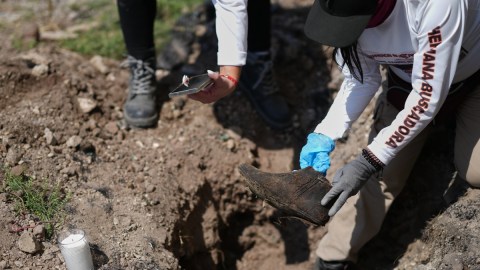
In Mexico, the search for missing people is a frequent task for hundreds of families who, in the absence of an effective response from the authorities, go out into the countryside equipped with picks and shovels to locate their loved ones.
According to an AP report, Search groups carry out these tasks in high-risk conditions and, in many cases, without support from the authorities
On some expeditions, searchers only have basic tools and a “panic button”a device that serves as the only emergency link with the authorities.
One of these people is Raul Servinwho is looking for his son who disappeared eight years ago and every Tuesday he goes out to dig and remove the earth in different parts of northwest Mexico.
The 54-year-old man carries a truck with picks, shovels, water and food. She entrusts herself to God, gathers her companions and sets out to search areas where there are suspicions of hidden bodies, people who disappeared without a trace in the midst of cartel violence.
Your collective, Seeking Warriorsis one of dozens in Mexico with the same mission.
An AP photojournalist accompanied Servín during one of his most recent outings with three companions and witnessed the mix of emotions experienced on the outskirts of Guadalajara, a bastion of the New Generation Jalisco Cartel (CJNG).
Servín and her companions go to various places mentioned in anonymous tips posted on the group’s Facebook, people who have heard screams, gunshots, who have seen something and do not dare to talk to the authorities.
In the previous outing they dug more than a meter deep in four points. Nothing. Sometimes they find blood stains, shell casings. Everything is reviewed. “We cannot remain in doubt,” he says.
The discovery
Suddenly you receive a call. An informant tells them a place where he claims there is a buried body. The data seems reliable and the group changes plans, although that means not visiting the site first.
Some arches mark the entrance to a residential complex indicated by the informant. It is next to a city train, on the outskirts of Guadalajara, a city partially papered by search quest cards. Jalisco is one of the states with the most missing people in Mexico.
The group prepares its equipment, which includes the metal rods they nickname “the seer.” More than a decade ago, this rudimentary tool became essential for all groups. They stick it in the ground and then smell it. If there is an organic smell, there is a clue.
They begin to dig in a small green area of the residential complex. Nothing.
After hours without progress, Servin walks between the wall and the tracks. The ground is soft. “I saw a hole that had stones and it seemed strange to me.”
He kneels and picks up his shovel. First he sees part of a skull. Start removing dirt with the shovel and your hands. “We have a positive!”she shouts to her companions.
The four put on face masks and gloves. A jaw appears.
The man shows his companions his head while holding it with great delicacy. They continue digging parallel to the wall. A bag with bones, a shoe, a pelvis appears.
They place each piece outside the pit. If any bone looked the same, it would be placed somewhere else because it could be from a second person.
panic button
Finding a body can be dangerous and Servin activates his “panic button.” Many search engines have this federal protection mechanism. Since 2010 at least 36 have been murderedaccording to civil organizations. The last one was a woman in mid-March.
Servin speaks with the officials on the other end of the line, confirms his identity with a password, explains what he found, the location and who is accompanying him. He asks to be monitored every hour, which involves a call to see if he is okay. Then call the police.
One of the women prepares a live publication for Facebook. It is the way to keep a record. If they had not made a fool of themselves when they found the ranch where the CJNG operated, probably no one would have believed what they found. It also works in case someone recognizes something.
Servin starts answering questions online. He is not an expert but experience tells him that the body is at most a year and a half old. It may not be his son, but he does not lose hope.
With information from AP
Keep reading:
– Search collective broadcast live the discovery of a clandestine grave in Tamaulipas.
– Ceci Flores, the Mexican mother with more than a decade searching for her 2 missing children.


