
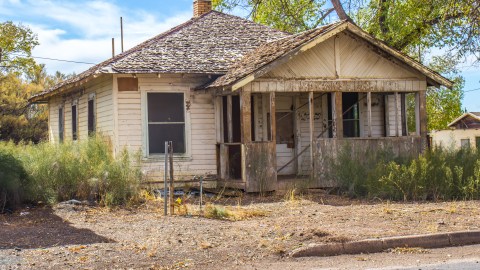
In at least 20 states in the United States there are laws thatunder specific conditions, could allow a person who occupies property without permission, such as a house, to end up claiming legal rights to it. This does not happen immediately or automatically, but it is a legal reality that has a name and that applies to both homes and land, especially when they remain unoccupied or unsupervised for long periods of time.
For a person to claim property without it being theirs would seem incredible to believe, but in simple terms it works like this: If someone occupies a property continuously, openly and without opposition from the owner for several years, the law in certain states may recognize that occupation as a right.. That is, a home or land that is not monitored can become the subject of dispute if someone else acts as the owner for long enough. This is known as adverse possession (detrimental possession).
Adverse possession is a figure in the United States that allows a person who occupies a property without being its owner to obtain legal ownership. if you maintain it under certain conditions for a period of time established by the law of each state.
In states such as Texas, Nevada, Oklahoma, Montana and California, deadlines can be relatively short compared to other regions of the country. In some cases, The process can begin after five years of continuous occupationespecially if the occupant has some type of document that supports their presence or if they pay taxes associated with the property.
In Texas, there are even scenarios where the time can be reduced to three years under specific conditions.
Also There are states where the standard period is seven yearswhich It mainly affects empty homes or rest properties. This is the case of Florida and Arkansaswhere prolonged occupancy without owner intervention can open the door to legal claims if not caught in time.
In other states, the rules depend on the type of evidence the occupant has. In Colorado, Georgia and Illinois, the common term can be up to 18 or 20 yearsbut it can be reduced to seven if there is a “coloration title”, that is, a document that appears to be owned or gives a minimum incorrect right for the claim.
In the case of Louisiana, a person can claim property in about ten years if you demonstrate that you believed in good faith that it was yours. In New York, the term is also ten years, and in certain cases the payment of taxes is not requiredas long as the occupancy is viewed and constant.
In states such as North Carolina, Oregon, Washington, Wyoming, South Dakota, and Arizona, times typically range from ten to twenty years, depending on conditions.. However, in some scenarios these deadlines may be reduced if there is partial documentation or if the owner does not act to recover the adjustment of his property.
The common point in all these cases is the lack of surveillance. Inherited properties, unattended rental homes or investment land in other states are the most vulnerable, as they can remain empty for years without anyone detecting irregular occupation.
Although these laws exist, They do not mean that a homeowner will lose their home easily.. In most cases, owners have the right to intervene, but time and attention to the property are decisive factors to avoid major conflicts.
You may also be interested in:
- The 2026 tax season ends: how to request an extension and how it helps you
- Inflation in the US rises to 3.3% in March due to record rise in energy not seen since 2005
- Price of the dollar in Mexico today, April 15, 2026: is it advisable to send dollars?
- Tinder will have to pay $60.5 million for lawsuit: who qualifies
- How many CDs can you have in a bank without losing FDIC insurance?


