
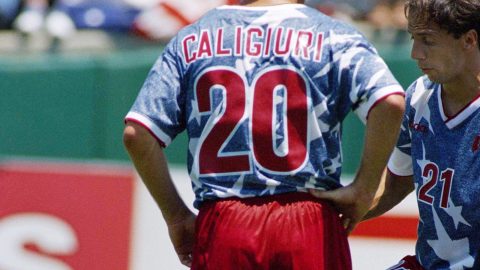
There are those who say that a life is measured in World Cups. Four-year marks on a timeline that goes from childhood, eyes full of wonder, to adolescence, now more awake, and beyond. An album of football memories: the teams you loved, the heroes you adored, the iconic t-shirts they wore.
It is precisely the t-shirts that concern us today. The jerseys that tell a story. Timeless masterpieces. What makes them so durable?
Matthew Wolff is best known for designing Nigeria’s popular 2018 World Cup jerseys, as well as those of that edition’s champion, France. But the American’s portfolio includes Paris Saint-Germain and numerous clubs.
“Most of my favorite football uniforms are from my childhood, in the 90s and early 2000s,” explains Wolff. “That’s the stage in life when players really feel like superheroes and their outfits seem magical.
“Mexico 1998, USA 1994, Germany 1990 and 1994, Japan 1998, even the Cameroon tank top from 2002. For me, these jerseys are special because of how great and magnificent they looked to me as a kid.
“A jersey becomes iconic in part because of what happened while someone was wearing it. The passage of time also changes the way we perceive and appreciate a football uniform,” he says.

Wolff, however, believes that today it is more difficult to achieve truly “iconic” status.
“The landscape has changed and the global market is saturated. There are so many teams and so many new shirts now – both club and national team – that it is really difficult for a single one to stand out.
“Although it is inspiring to see the aesthetics and culture of nations represented through the design of uniforms, this raises questions about consumerism, about how much genuine cultural expression there is in the face of product cycles, and about the pace at which we consume these garments,” he reflects.
With this in mind, let’s look back. And there is always a good dose of nostalgia when we remember the clothing: those diffuse childhood memories that we relive through a golden filter.
It would be tempting to dive headfirst into a smorgasbord of bold prints and baggy T-shirts from the ’90s and early ’00s, or the late ’80s designs that have reemerged as lifestyle staples.
So, to avoid excess, these are the criteria: no more than one shirt per World Cup or per country.
10. Cameroon (2002)

Now, this is a bit controversial, since this jersey was never used in a World Cup. But that is precisely what makes it memorable.
Cameroon adopted a sleeveless jersey for the African Cup of Nations, but FIFA had other plans when the 2002 tournament rolled around.
“Everyone in Africa wanted to wear that shirt,” former midfielder Eric Djemba-Djemba told BBC Sport Africa.
Even Serena Williams joined the trend, wearing a Cameroon-inspired outfit at the French Open that summer, although organizers rejected her request to wear her lucky number, 26, on her back.
Instead, for the World Cup in Japan and South Korea, the Puma brand was asked to add sleeves to the design, as you can see below.
However, it would not be the last time that Cameroonian designers irritated FIFA officials: two years later, football’s governing body also banned the release of a “one-piece”, with the shirt and shorts sewn together to form a single garment.

9. England (alternative kit, 1966)

The Three Lions red shirt is emblematic for what it represents for their country: the only English triumph in a World Cup, a momentous victory on the venerated grass of Wembley, the hat trick of Geoff Hurst and the ball that (maybe) crossed the goal line.
It immediately conjures up images of Bobby Moore hoisting the Jules Rimet Trophy on the shoulders of his teammates.
The 1982 and 1990 shirts were also in contention (as shown below), but if there can only be one England shirt on the list, it has to be this one.

8. France (1982)

“That was my best match. No film or play could ever capture so many contradictions and emotions. It was perfect. It was fabulous,” said France captain Michel Platini, recalling the defeat of Les Bleus in the semi-finals against the Federal Republic of Germany in 1982.
Goalkeeper Harald Schumacher’s shocking tackle on Patrick Battiston, a thrilling 3-3 draw after extra time, the first penalty shootout in World Cup history.
France appeared imperturbable at all times under the stifling heat of Seville, with the star piece of that historic outfit that was its first uniform.
7. Netherlands (1974)

Rebellious, stubborn, with impeccable style. Johan Cruyff was the face of the Netherlands’ “total football” revolution.
Cruyff had already won three European Cups with Ajax and had twice received the Ballon d’Or by the time he arrived at the 1974 World Cup, the scene of his most famous moment.
The Netherlands faced Sweden at the Westfalenstadion in Dortmund, although the playmaker wore a different uniform to his teammates, who wore the Adidas three stripes on their sleeves.
Cruyff, however, had a contract with Puma and had already refused to wear Adidas cleats; After a confrontation between the brands, the players and the leaders of Dutch football, it was also decided that a stripe would be removed from his shirt.
“The KNVB (Royal Netherlands Football Association) had signed a contract with Adidas without telling the players,” Cruyff wrote in his autobiography. “They thought it wasn’t necessary because the shirt was theirs. ‘But the head that sticks out of it is mine,’ I told them.”
6. Croatia (1998)

Davor Suker, France 1998, with a red and white checkered print across his shoulder. Majestic.
That design became Croatia’s national emblem and made them immediately recognizable on the pitch.
Croatia caused a sensation at Euro 96, where they also wore a spectacular kit, but this was an especially emotional sporting moment for the country, which was competing in its first World Cup since declaring its independence seven years earlier.
Suker – along with Robert Jarni, Zvonimir Boban, Robert Prosinecki and company – led the team to the semi-finals, where the Real Madrid striker put his team ahead 1-0 against the hosts, before an inspired France came back in the match.
Croatia, wearing an equally iconic blue jersey as their second kit, then beat the Netherlands in the play-offs to finish third.

5. Nigeria (1998)

The 2018 Nigeria jersey was a phenomenon, a rare example of a kit that became instantly iconic, not because of who wore it on the field, but because of the impact it had on culture and fashion circles.
Three million people pre-ordered the shirt and after its launch, shoppers queued outside Nike’s flagship store in London.
“We were directly inspired by Nigeria’s own t-shirt history,” explains designer Wolff. “The 2002 kit was a reference: that bright shade of green was something I wanted to bring back. And, obviously, we were also inspired by the 1994-95 kit.
“The objective was not to invent something out of nothing, but to take up threads that already existed in the country’s football identity.
The timing was perfect in many ways. Nigeria was experiencing a global cultural moment in fashion, music, poetry, art, film, and many others. The uniform arrived in the middle of that wave, and I think it had an impact because the wave was growing.
“Credit must be given to the entire Nike team that made it possible. A uniform does not become a phenomenon because of a single designer. It becomes a phenomenon because many people are doing meticulous and thoughtful work.”
4. Brazil (1970)

There is arguably no other country in the world of football that is more synonymous with a color than Brazil.
Even in the old, grainy images, their canary yellow jerseys from 1970 look vibrant and eye-catching, worthy of the world-class players who sported them under the Mexican sun.
Pelé, Carlos Alberto, Rivelino, Jairzinho. The archival footage broadcast at each World Cup makes you feel like you’re in the Azteca Stadium watching the Brazilians defeat Italy: their wonderfully simple yellow jerseys are a masterpiece of football folklore.
3. USA (alternative uniform, 1994)

“Outside our borders, there was a lot of skepticism from most of the world’s soccer fans, scratching their heads, wondering, ‘How can a country that’s not a soccer power put this together?’” recalls former U.S. Soccer president Alan Rothenberg after the United States won the 1994 World Cup.
What the players – most with contracts with the American federation rather than representing professional clubs – did not want was to become the laughingstock of the tournament.
But when Adidas presented the uniforms for the World Cup, intrepid central defender Alexi Lalas and his teammates thought they had been played a joke.
The big stars printed on washed denim may have been typically American, but they were bold and flashy from a football point of view, and the team feared being ridiculed.
At least, the proposal of a dyed t-shirt in the style tie dye it did not materialize.
However, it would become an icon and would be adored by both the players who wore it and the fans who idolized them, undoubtedly thanks to the United States’ performance in that tournament, in which they lost to the future champion, Brazil, in the round of 16.
That this jersey is among the top three may be due to the fact that the World Cup returns to the United States this summer, but 1994 was a tournament of memorable jerseys.
2. Argentina (alternative uniform, 1986)

Argentina’s victory over England in the quarterfinals of the 1986 World Cup saw two of the most famous goals in history: Diego Maradona’s “Hand of God” and his fascinating, unstoppable midfield dribble, considered by FIFA as the goal of the century.
But what lies behind the shirts that Argentina wore that day is equally well-known.
FIFA informed Argentina that they would have to wear their second shirt, dark blue, so as not to contrast with England’s white ones. But in an earlier victory against Uruguay, the players found that jersey heavy and stifling in the Mexican heat.
The manufacturer, Le Coq Sportif, had no alternative, so the story goes that coach Carlos Bilardo sent his team to the Tepito neighborhood of Mexico City – famous for imitation merchandise – to find r new ones.
It is said that Maradona made the final decision on the designs they brought, pronouncing the immortal phrase: “How beautiful this shirt is. With this one we beat England!”
Those in charge of the uniforms spent the 24 hours before the game embroidering the numbers and the national crest on those jerseys.
Thirty-six years later, English midfielder Steve Hodge put up for auction the shirt he exchanged with Maradona that day. It sold for 7.1 million pounds ($9 million).

1. Federal Republic of Germany (1990)

At number one is a design classic, a shirt highly coveted by collectors and often considered the pioneer of a new generation of shirts: the emblematic Federal Republic of Germany from the 1990 World Cup.
“You have to look at it in the context of what was there before, when t-shirts were quite simple and minimalist in design,” explained John Blair, author of A Culture of Kitsto the program Wearing Stare from the BBC World Service
“It’s a combination of a truly outstanding element of its time, a winning team and the first truly expressive design to come to light.”
However, the shirt was almost discarded before the World Cup, after having debuted in the Euro 1988, when the hosts lost in the semi-finals.
Designer Ina Franzmann was already working on a new one, until coach Franz Beckenbauer intervened and said he wanted to keep the common design.
Franzmann, who also made tennis designs for Adidas, and was not a soccer fan, was commissioned to bring “a small revolution” to the national team’s jersey.
“It was Horst Dassler himself (son of founder Adolf) who had the idea of using a little color, so it was obvious to use the colors of Germany,” he said.
Dassler died in 1987, so he didn’t get to see West Germany lift the World Cup and draw attention at Italia 90. It was a momentous moment for Franzmann, although true recognition came decades later.
“The shirt became a masterpiece years later,” he added. “I am very proud of the great interest it arouses, everyone wants to know the story behind it.”

click here to take into anecdote more stories from BBC Info Mundo.
Subscribe here to our new newsletter to receive a selection of our best content of the week every Friday.
You can also follow us on YouTube, instagram, TikTok, x, Facebook and in our new whatsapp channel.
And remember that you can receive notifications in our app. Download the latest version and activate them.
- When does the 2026 World Cup begin and other questions about the first World Cup with 48 teams
- What is the prediction of the German economist that the World Cup champion was right in the last three editions?


