
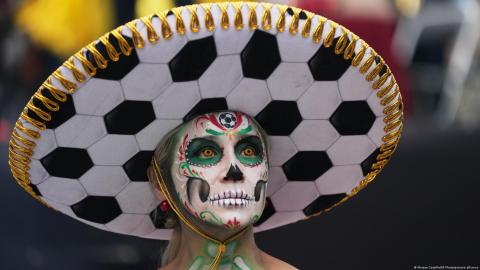
Two days before the opening of the 2026 FIFA World Cup in Mexico City, a mix of emotion and indignation runs through the megacity.
While the government of the president Claudia Sheinbaum promises a celebration “in peace and tranquility”, striking teachers and relatives of missing people have announced protests in front of the Azteca stadium, taking advantage of the global attention that the sporting event will generate.
How safe is Mexico for its citizens and the tourists and soccer fans it will receive?
An express security arrangement
In 2018, the country officially became one of the three World Cup hosts, along with the United States and Canada.
However, just six months ago “the Mexican authorities began to take seriously the preparation for an event of such magnitude,” and just three months ago they announced their security arrangement, the “Notion Kukulkan”observes Paloma Mendoza Cortés, from the Center for Studies on Security, Intelligence and Governance of the Autonomous Technological Institute of Mexico (CESIG-ITAM).
The Mexican Government will focus on civil protection (crowd management), cybersecurity (avoid cyber attacks and guarantee the supply of electricity, water and communications) and the counterterrorism.
Beyond the “Notion Kukulkan”, The leadership of the World Cup security coordination is in the hands of the US Northern Command. (USNORTHCOM), says the consulting firm specialized in national security issues.
More than 200 armed arms of organized crime
At the moment, more than 40 organized crime organizations operate in Mexico. In 40 percent of the states, two or more criminal groups divide the territorial adjustment, explains Mendoza, in an interview with DW.
“It all depends on the geographic region and its strategic importance,” he continues. Thus, for example, on the border with the United States, there are at least 9 criminal organizations.
In 2000, Mexico had seven major cartelssays, in turn, Oscar Balmen, journalist specialized in organized crime and co-author of several books on violence and insecurity.
“At this moment, there are more than 200 armed groups, that is, atomizations of these seven large cartels, whose main ‘black markets’ have little to do with drugs and more to do with other illicit activities such as extortion, kidnapping or human trafficking,” he continued in statements to DW.
World Cup venues “reasonably safe”
He Jalisco New Generation Cartel and the Sinaloa Cartel ―with its splits, like “Los Chapitos”– are the most important. “They practically have a presence throughout the country, in addition to having a presence in all 50 US states and around 60 countries in the world,” Balmen clarifies.
In his opinion, the Mexican Government is ready to “neutralize the threats of organized crime” that could arise during the World Cup, especially because criminals are aware that “high exposure is not convenient for them, which would attract unwanted attention.”
On the other hand, Balmen is convinced that “illegal underground activity will be present all the time”for example, with the drug trade or fraud associated with the sale of fake tickets.
The soccer tournament will be held in Guadalajara, Monterrey and Mexico City. “The Mexican World Cup venues seem reasonably safe to me,” says political analyst and security expert David Saucedo.
Possible threats during the World Cup
In the capital, violent incidents could be recorded within the framework of the announced social protests. In the metropolitan area of Guadalajara, meanwhile, “it is presumed that there could be some type of act of narcoterrorism by the Jalisco New Generation Cartel, in retaliation for the attacks it has suffered at the hands of the Governments of Mexico and the United States,” details Saucedo, in an interview with DW.
Likewise, the analyst comments that “Americans are concerned that there could be attacks by Islamic fundamentalist terrorist cells“, in the wake of the US and Israel war against Iran.
In the rest of the country, “it is very likely that there will be high-impact events,” he warns, “because the bulk of the elements of the National Guard, the Army and the Navy are guarding the World Cup venues.”
“Prison governance”
Beyond the 2026 World Cup, for Paloma Mendoza, from CESIG-ITAM, the important threat to Mexico’s national security is the phenomenon of “prison governance.”
And he explains that, today, criminal networks exercise both territorial adjustment and social and economic adjustment, they use strategic violence and have captured institutions.
The president’s pressure donald trump on its Mexican counterpart to combat drug trafficking cartels would have become a “true sovereignty dilemma” for Sheinbaum, according to the expert.
Recently, for example, The United States requested Mexico to extradite ten peoplefrom municipal officials and the former head of military intelligence to an acting governor.
“Now, there is an interesting discussion in Mexico about narcopolitics, based on pressure from the United States to combat criminal groups and, furthermore, the politicians who support these criminal groups,” adds journalist Balmen.
“We are not a narcodemocracy yet, but we are going there”sentence, for his part, David Saucedo.
According to the analyst, in around a third of Mexican states “there is a total symbiosis between political elites and criminal elites”; another third would be penetrated, but not co-opted, by organized crime; and in the remaining third this type of prison governance schemes have not yet been registered.
(rml)


