
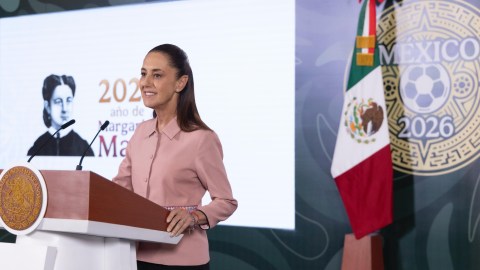
The president of Mexico, Claudia Sheinbaum expressed confidence in the continuity of the Treaty between Mexico, the United States and Canada (T-MEC), after President Donald Trump once again questioned the renewal of the trade agreement by ensuring that his country does not need its North American partners to maintain its economic growth.
During his morning conference this Thursday, The Mexican president affirmed that the treaty has generated shared benefits for the three economies and considered that, despite the differences that may arise during the review process, the agreement will remain in force.
“I believe that the T-MEC is going to be maintained; in any case, what the United States wants are certain conditions for Mexico and certain conditions for Canada,” he said. Sheinbaum when referring to the statements made by Trump a day earlier.
The US president stated that he does not know if he will renew the trade agreement because, in his opinion, the United States is in a stronger economic position and does not depend on products from Mexico or Canada. Among other examples, he mentioned automobiles, energy and wood.
However, the Mexican president defended the economic integration of North America and maintained that the treaty has strengthened regional supply chains, favoring job creation and the competitiveness of the three countries.
SHEINBAUM DEFENDS THE USMCA AFTER DOUBTS RAISED BY TRUMP
The president of Mexico, Claudia Sheinbaum, stated that “it is better to be together than apart” when referring to the economic relationship between Mexico, the United States and Canada, after Donald Trump questioned the? pic.twitter.com/Rn5MPY8XCG
— News On Keep a query to (@OnDemand_News) June 11, 2026
Economic integration as a regional advantage
Sheinbaum argued that shared production between North American economies has proven beneficial for consumers and businesses.. As an example, he pointed out that the increase in tariffs in different sectors has contributed to the increase in vehicle prices in the United States.
As he explained, maintaining the treaty, and even improving it through agreements that benefit the three parties, It would help reduce costs for American consumers and strengthen regional production.
“If one part of a vehicle is manufactured here and another part there, employment increases in both countries,” he stated.
The president also rejected the idea that Mexico’s industrial and job growth represents a threat to the US market.. On the contrary, he maintained that both economies are complementary and that the strengthening of one can boost the development of the other.
Likewise, he highlighted that one of the main arguments of the Mexican negotiating team is that an integrated North America has greater possibilities of competing against other regions of the world, especially against China. “It is better to be together to compete with China than to be apart,” he said.
“I believe that the T-MEC is going to be maintained,” said President Claudia Sheinbaum, after Donald Trump declared that he is not sure if he wants to renew the treaty between Mexico, the United States and Canada. pic.twitter.com/WxdJ7NlY9N
— NMás (@nmas) June 11, 2026
Treaty review continues
Sheinbaum considered that Trump’s comments are part of the negotiation and recalled that the US president himself has previously recognized that the USMCA represents an improvement over the old North American Free Trade Agreement (NAFTA).
The president indicated that currently the technical conversations for the review of the agreement are taking place mainly between officials from Mexico and the United States, while Canada will later join some of the discussions.
Mexico, he added, will seek to reach agreements that protect the national economy, maintain the generation of jobs and guarantee favorable conditions for companies established in the country.
Meanwhile, signs of openness to exploring complementary agreements with Washington also emerged from Canada.. The Canadian minister responsible for trade with the United States, Dominic LeBlanc, pointed out that bilateral understandings could be finalized parallel to the trilateral framework of the USMCA, as long as they contribute to resolving pending issues between the three trading partners.
The T-MEC entered into force in July 2020 and contemplates a joint review six years after its implementation. Both Mexico and Canada have publicly expressed their interest in preserving the agreement, while negotiations continue on possible adjustments promoted by Washington.
Keep reading:
- Trade uncertainty increases in North America, Trump threatens not to renew the T-MEC
- American Society of Mexico proposes bilateral treaty against crime outside the T-MEC
- How the World Cup exposes the tense relationship between the three neighboring countries of North America


