
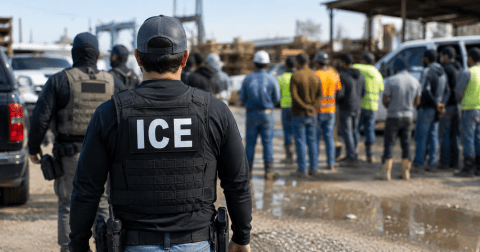
An immigration raid at work can change a family’s life in a matter of minutes. In South Carolina, 48 immigrant workers were arrested during an operation at a metallurgical plant in Abbeville, after an investigation of almost two years for alleged use of false documents and stolen identity. The defendants also include company executives, according to documents cited by AP.
The case once again put a question that worries thousands of workers at the center of the debate: Which industries are most exposed to Immigration and Customs Enforcement (ICE) operations? in workplaces. Labor investigations usually focus on sectors with high demand for labor, subcontracting, hourly jobs and presence of immigrant workers.
The construction, tourism, and restaurant and other food service industries are the most monitored and affected by workplace raids and operations. In fact, a recent investigation by the Brookings Institute determined that the campaign of workplace arrests caused the loss of more than 668,000 jobs nationwide.
Let’s see what are some of the hardest hit sectors.
Agriculture and food processing
Farms, packing plants, poultry plants, meat processors and businesses linked to the food chain have historically been sensitive sectors for labor investigations.
These are labor-intensive industries and are places where authorities often review potential problems with I-9 forms, false documents, identity theft or unauthorized hiring.
Construction
Construction is another sector that is especially monitored. Job sites often have contractors, subcontractors and temporary workers, which can complicate labor verification.
In 2025, ICE arrested 31 immigrants during a raid at two construction sites in Laredo, Texas, a case that sparked community workshops to inform workers about their rights.
Restaurants, hotels and cleaning
Restaurants, hotels, cleaning and maintenance services also frequently appear on the immigration radar.
In 2025, there was even a mooted temporary pause for operations in farms, hotels and restaurants, but then stocks returned to those sectors, according to national media reports.
Manufacturing and factories
The industrial plants and factories may come under investigation when authorities suspect broader trafficking schemes. false documentation or stolen identity.
The recent South Carolina case shows that approach: not only were workers arrested, but charges were also brought against six people, including two plant managers.
You can see: What to do with your children if ICE arrests you: key steps for immigrant families
What ICE is looking for in these operations
ICE explains that its investigations in workplaces seek to reduce illegal employment, hold employers accountable and detect violations related to I-9 forms, false identity, document theft or irregular hiring schemes.
USCIS reminds that Form I-9 is used to verify the identity and employment authorization of any person hired in the United States.
What workers should know
Organizations like ACLU (American Civil Liberties Union) remind that All people in the United States have constitutional rights, regardless of their immigration status. General recommendations include staying calm, not presenting false documents, not signing papers without understanding them, and asking to speak with a lawyer.
For many families, a workplace raid isn’t just news: It can mean that someone went to work in the morning and didn’t come home that night. For this reason, lawyers and community organizations recommend having a basic emergency plan, legal contacts on hand, and important documents organized.
Continue reading:
Where a family member may be detained by ICE: how to locate them step by step
Children afraid to go to school: pediatricians warn about the impact of the raids in the US
Living in fear of ICE: what happens to the body and mind (and how to handle it)


